A new study on the historic impact of the series also shows that watching "Sesame Street" may still be one of the most cost-effective ways to help kids, particularly those who start out economically disadvantaged, succeed later in school.
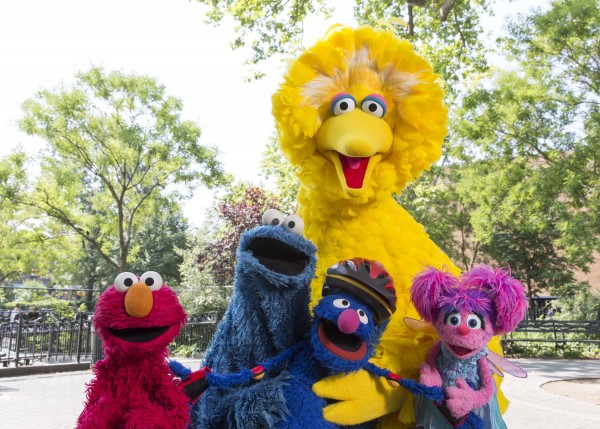
Elmo, Cookie Monster, Grover, Abby Cadabby, and Big Bird visit
Central Park as part of Sesame Street’s 45th season.
Photo by Richard Termine
Watching
Sesame Street may be one of the most cost-effective ways to help kids, particularly those who start out economically disadvantaged, succeed later in school, according to a new study of the show. So notes “
Early Childhood Education by MOOC: Lesson from Sesame Street,” a new study from Wellesley College and the University of Maryland. Researchers looked at preschool-aged children whose families lived in areas with better TV reception—and therefore better access to the storied show when it first aired in 1969—as well as those who lived in locations where TV reception was weaker. Children with superior access were “more likely to advance through school as appropriate for their age,” the study found. In particular, preschool-aged boys who watched the show regularly because of where they lived had a 16 percent less chance of falling behind. In addition, black and non-Hispanic children were 3.7 percent less likely to fall behind than others. “With so much emphasis on early childhood interventions these days, it is quite encouraging to find that something so readily accessible and inexpensive as
Sesame Street has the potential to have such a positive impact on children’s school performance, in particular for children from economically disadvantaged communities,” says Melissa Kearney, an economist with the University of Maryland who co-authored the study with Philip B. Levine, an economist with Wellesley College. "These findings raise the exciting possibility that TV and electronic media more generally can be leveraged to address income and racial gaps in children’s school readiness.” When
Sesame Street first aired, television shows could be watched across UHF (Ultra High Frequency), a weaker signal, and VHF (Very High Frequency), which was higher and was then captured by antennas on people’s homes and sets. Some areas received good reception—and others didn’t. Levine also noted that millions of children watched each episode of
Sesame Street as it aired—which was essentially a free educational resource, aside from the cost of the TV set. The show, still airing on PBS, "may [have been] be the biggest and most affordable early childhood intervention out there," he says.
Get Print. Get Digital. Get Both!
Libraries are always evolving. Stay ahead.
Log In.







Add Comment :-
Be the first reader to comment.
Comment Policy:
Comment should not be empty !!!