


2018 School Spending Survey Report
Program Spotlight: “Reading Friends” Initiative Pairs Retirees with Young Students
At the St. Croix Falls (WI) Elementary School library, retired senior citizens regularly sit down individually with over 130 students to read together, laugh, and learn. Here’s how the program developed.
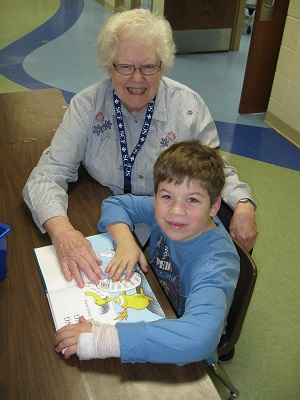
Bev Casperson and first grader Isaac Briggs. All photos courtesy of Rita Platt.
The back of the St. Croix Falls Elementary School library in rural St. Croix Falls, WI, is filled with the buzz of friends, young and old, talking and laughing, but mostly reading. Peggy Anderson and Isaiah, a student, sit close together, smiling at the adventures of Henry and Mudge from the series by Newbery medalist Cynthia Rylant (S. & S., 1996). Mark Boyken and third-grader Sam huddle over a nonfiction book about trucks. Next to them, 92-year-old Al Jette patiently helps a child sound out a word. In another corner, Sarah Adams and Sasha, a student, laugh while reading about the misadventures of Greg Heffley and his "Diary of a Wimpy Kid" crew (Abrams). The sounds of good friendships and the joy of reading fill the room. Most days are like this at this elementary school library. Our Reading Friends program pairs students in need with adults who possess love, patience, and time to share. The volunteers, most of them retired senior citizens, join our school weekly and individually work with more than 130 children to help them learn and enjoy reading.seniors to the rescue

St. Croix Falls Elementary School library media specialist Rita Platt.
It started in 2008, when long-time St. Croix Falls residents Marilyn Brissett-Kruger and her husband, Al Kruger, decided to take action in order to bolster literacy. Marilyn enlisted her close friend, retired teacher Barb Boyken, and together they called their circle of friends, contacted the local elementary school, and started an enduring program called The Reading Friends. At the heart of this venture stand three core beliefs:- Seniors and young people can be good friends to each other.
- Schools and community groups can and should be mutually beneficial.
- Children need Reading Friends to listen to them read and to help them enjoy reading.
How the Friends help
More than 40 percent of our students at St. Croix Elementary receive free or reduced lunch. While they consistently do well on state tests overall, some students need an extra boost.
Marilyn Brissett
The Reading Friends help us meet these needs. Each pre-K through first grade classroom has at least one dedicated volunteer who spends an hour or more weekly with a student, reading aloud or listening to the student read a short story. “Mr. Tom” has been a Reading Friend in teacher Shauna Waltz’s kindergarten room for three years. “They ask every day when he is coming,” says Waltz. Mr. Tom sits at a table outside of the classroom, and each of his kindergarten friends starts his or her session with a hug. Watching them lean in and read together paints a powerful picture, showing that we are never too young or too old to love reading and make friends. In second through fourth grade, students are paired with a Friend for 15−30 minute sessions weekly. Students are selected based on test scores and teacher input. They are often the children who need extra help but do not qualify for Response to Intervention (RTI) services. Reading Friends prevents them from falling through the cracks. We also choose students for non-academic reasons—we know they need a nurturing adult in their lives. Ask third-grader Sam about his time with his Reading Friend, Mark Boyken, and he will tell you that it is one of the best parts of his week. They have been paired for three years. “Reading Friends form bonds that extend beyond just reading,” says fourth-grade teacher Mike Mysicka. “ These volunteers are positive role models. It’s a win-win situation, no matter how you look at it.”THE NUTS and BOLTS
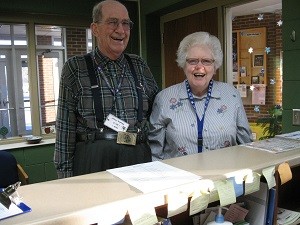
Long-time Reading Friends Marv and Bev Casperson.
Getting the program off the ground was easy. Brissett-Kruger and Barb Boyken quickly recruited enough volunteers. Initially, they found them by emailing friends and calling community organizations such as the Lions Club. These days, most are found through word-of-mouth. Today we have 35 active Reading Friends. Sustaining the program has proven to be challenging, largely due to tightening school schedules in the age of RTI and the Common Core State Standards. Brissett-Kruger and Platt work together to keep it alive, and our volunteers have bent over backwards to adjust their schedules to meet the school’s needs. We start by asking the teachers to share all possible days and times and then work to match them with willing Friends. At the beginning of the school year, we spend hours making pairings and fine-tuning the schedule. After that, the teachers and volunteers coordinate well together, and we can sit back and watch the magic. When we struggle, we take a deep breath, and reflect on our shared belief that together schools and community can make success happen.Reading friends in summer
Two years ago, we realized we wanted to extend our work into the summer. We met with the local nonprofit group Northern Waters Literacy to plan. Many Reading Friend pairs continued their work all summer, meeting at the public library weekly. This venture succeeded beyond our expectations: we halted the typical summer slide in reading among those students who participated. Ninety-one percent of students who had summer Reading Friends didn't drop back in their reading skills, and 70 percent actually increased their reading levels between June and September.TIPS AND Hints for Making A Reading Friends PROGRAM work
- First and most important, find a community member to be your partner. Having a community leader who can recruit, organize, and cheerlead is essential.
- Similarly, a school liaison is needed—a library media specialist is ideal.
- Check with your district on the need for background checks. All of our Reading Friends were required to have commercial background checks.
- Conduct a simple training session for the volunteers where you share the goals of the program. Explain that their role is to listen and to and help their young friends read.
- Work with teachers so they know how to gather just-right books for their students and have them ready to go. We use canvas bags with the Reading Friends logo on them.
- Welcome and support your volunteers. We have lanyards with badges ready to give out to our Friends. Most teachers contact Reading Friends before their first classroom visit, and we always greet them with a friendly smile and a quick chat when they visit each week.
- Celebrate together! We have twice yearly gatherings where teachers and adult Reading Friends share a snack, talk, tell stories, and laugh.
Rita Platt (@ritaplatt) is a Nationally Board Certified teacher. Her experience includes teaching learners of all levels from kindergarten to graduate student level. She currently is the library media specialist for the St. Croix Falls School District in Wisconsin, teaches graduate courses for the Professional Development Institute, consults with local school districts, and writes for We Teach We Learn. Marilyn Brissett Kruger retired from a career in international adult education focusing on addiction counseling. In this second half of her “wild and precious life”, her business card reads: “I’m not meddling. I’m just trying to make your life better.”

Added To Cart
RELATED


RECOMMENDED
CAREERS
The job outlook in 2030: Librarians will be in demand
CAREERS
The job outlook in 2030: Librarians will be in demand
ALREADY A SUBSCRIBER? LOG IN
We are currently offering this content for free. Sign up now to activate your personal profile, where you can save articles for future viewing
ALREADY A SUBSCRIBER? LOG IN
Thank you for visiting.
We’ve noticed you are using a private browser. To continue, please log in or create an account.

Add Comment :-
Comment Policy:
Comment should not be empty !!!
Jean Prestemon
Thanks for printing this thrilling story about the accomplishments of Reading Friends in St. Croix Falls, WI. I knew about the program from my friend Marilyn, and I know this will inspire other seniors in other communities to pass along their love of books to a new generation. I will convey this information on to the organization in our town that does their own form of Reading Friends. Jean PrestemonPosted : Feb 18, 2015 06:24