


2018 School Spending Survey Report
Feeding Minds and Bodies: Libraries, Nonprofits, and Authors Offer Food Education
Libraries, authors, and world-famous chefs, including Chez Panisse's Alice Waters, are stepping in to ensure that children and teens are food literate, from providing food itself to incorporating lessons on nutrition, food sourcing, and gardening into curriculum and literature.
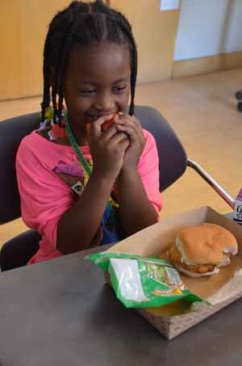
A young girl eats lunch at the Hyde Park branch of the Los Angeles Public Library (LAPL). Photo by LAPL.
These days, many believe that being information literate in the 21st century doesn’t just involve research and vetting sources—it means being food literate. For author Eric-Shabazz Larkin, whose recent children's book A Moose Boosh: A Few Choice Words About Food (Readers to Eaters, 2014) examines issues related to food through poetry, knowledge of food and nutrition is a vital but often overlooked educational component, every bit as essential as knowledge of math or the periodic table of the elements. Many organizations, such as Edible Schoolyard and Slow Foods International, and libraries, such as the Oakland Public Library and the Los Angeles Public Library, are stepping in to develop this much-needed skill, doing everything from providing food itself to incorporating lessons on nutrition into the curriculum. In California, several public libraries have addressed the problem of child hunger in the last few years, through the Lunch at the Library program, which works with the California Summer Meal Coalition (CSMC) to provide free lunches to children. Though the state of California provides free lunch to low-income students, 85 percent of those children don’t receive lunch when school is out during the summer. In 2011, the Alameda Food Bank sought venues for summer meals—including libraries like the Oakland Public Library (OPL). Nina Lindsay, supervising librarian of children services of OPL (and a contributor to SLJ’s “Heavy Medal” blog), says that she was initially daunted by the prospect of serving lunches when the food bank approached her but quickly jumped on board.Lunches at the Library
Though the food bank runs the actual event at OPL, providing the volunteers, the library has more than pitched in, with 11 branches now involved. Staff members help to order food and run special programming right before or after lunches are served, such as storytime and crafts. Kids spend a lot of time in the public library during summer,” said Lindsay. “Serving the lunches is just a natural link for the kids who can get fed right before or after a program.” Lindsay says that the library has been inspired to create several food and gardening-related programs. Three of their branches now have gardens, and many others are aiming to as well. According to Lindsay, programs have included presentations from local beekeepers (complete with free honey samples), talks given by representatives from a local farmers market association, and workshops on simple, nutritious food preparation. The emphasis on food has paid off, Lindsay says. “We notice we get a really good turn out.” The advertisement for one event, where staff made cookies from scratch with children, was limited to an announcement over the PA system, but the program proved massively popular.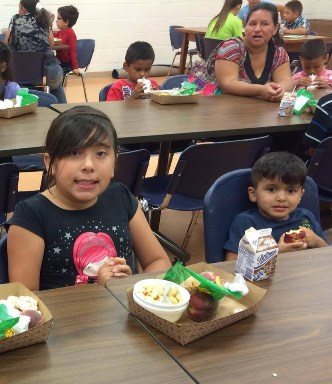
Kids eating lunch at the San Pedro branch of the LAPL. Photo by LAPL.
Overall, Lindsay says, the emphasis on nutrition and food has had a positive response from patrons. “We get a huge thank you from kids and their parents,” she says, attributing its success to the library’s ability to foster a sense of community. “It makes the library feel much more like their home. It adds to that quality of the third space.” The Los Angeles Public Library (LAPL) has also become part of Lunches at the Library program, kicking off their first summer in 2013. Coordinator of Children’s Services at LAPL, Eva Mitnick, told SLJ that she worked with the California Summer Meals Coalition to select eligible sites and to get in touch with the L.A. Regional Food Bank to organize the program. Staff and volunteers were trained on food handling. Kids received much more than a hot meal, however. All the children were signed up for the library’s summer reading program, and several branches offered additional activities, such as helping with a mural or participating with science experiments. The volunteers, many of whom were teens, who read to the children, helped with arts and crafts activities, and signed kids up for the library’s reading club.Nourishing the Community
The program does more than feed children—it’s nourishing the community, says Mitnick. “The community loves the program. Some of our adult volunteers were community members saw what we were doing and wanted to help out.” Her staff, too, feels it’s a strong program that reflects the library’s purpose. “Bring them in, feed their bodies, feed their minds.” For many, awareness about food and nutrition isn’t optional—they see it as a vital but often overlooked part of children’s education. Author and illustrator Eric-Shabazz Larkin, whose recent book A Moose Boosh: A Few Choice Words About Food (Readers to Eaters, 2014) examines issues related to food through poetry, told SLJ that he believes nutrition is a vital part of education. “There’s so many things we’re taught," he says. "It just doesn’t make sense to leave out the one thing you need to survive.”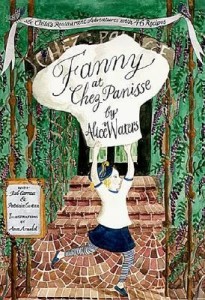
Alice Waters wrote 'Fanny at Chez Panisse' about adventures in her San Francisco restaurant, Chez Panisse, told through the eyes of her seven-year-old daughter, Fanny.
Many organizations are heeding such advice. For two decades, Edible Schoolyard (ESY), a one-acre garden located at Martin Luther King Jr. Middle School in Berkeley, CA, established by activist and restaurateur Alice Waters, author of Fanny at Chez Panisse: A Child's Restaurant Adventure with 46 Recipes (William Morrow Cookbooks, 1997), has followed its mission to “build and share a national edible education curriculum for pre-kindergarten through high school.” Many sister programs all over the country have sprung up, in New York, New Orleans, and San Francisco, among others, and through an online community, 4,000 other programs all over the world are joining in. At ESY, the garden and kitchen are integral to the curriculum, and lessons on math, science, and the humanities are served up alongside cooking and nutrition. According to Kyle Cornforth, executive director of ESY, a science lesson for eighth graders involves testing the pH levels of soil from around the garden, while a sixth grade unit on the Silk Road that takes place in the kitchen involves preparing recipes from places along the route, such as China and India, including vegetable curry and steamed dumplings. These students also identify which cultures the various ingredients with which they’re working are from and engage in mock-trading to fully understand the significance of the Silk Road. Central to ESY, says Cornforth, is the belief that “every kid deserves access to food education and to understand where food comes from.” He emphasized the prevalence of obesity and childhood diseases, many of which are easily preventable through better knowledge of nutrition. Cornforth says, “Education involves a more whole child: How are they feeling? How are they being fed at home? It’s a mix of things.” Similarly, Slow Food International, a global, grassroots organization founded on the belief that “everyone should have access to good, clean, and fair food” is empowering children and teens to become more food literate. Among the organization’s many projects is its National School Garden Program, which promotes the use of gardens in schools across the country through more than 150 local chapters. Andrew Nowak, director of the National School Garden Program, told SLJ that “We believe that school gardens and education around them are allowing students to become more food literate.” He cited several examples: in Charlotte, NC, Slow Food helped launch a program called Friendship Gardens, in which students grow food for Meals on Wheels. In Colorado, Slow Food Denver has an initiative called Youth Farmers Market, where students sell the school garden’s produce in farmers market stands, providing food deserts with fresh, local foods. With programs like these, “They’re building their own knowledge about how to handle food,” says Nowak. “Through this active participation with food...the kids are learning how to make better food choices.” Read our Q & A with Eric-Shabazz Larkin about his book of poetry A Moose Boosh: A Few Choice Words About Food. Books to support food education and food-related themes: Larkin, Eric-Shabazz. A Moose Boosh. 96p. Readers to Eaters. Oct. 2014. pap. $18.95. ISBN 9780983661559. This quirky, eclectic compendium of poetry, complete with artful and innovative graffiti-style illustrations, presents food in a new and delectable light. Larkin deftly weaves in themes about food deserts and the importance of nutrition, but he’s never preachy. A strong and visually enchanting way to cultivate appreciation for food. Marchive, Laurane & Pam McElroy. The Green Teen Cookbook: Recipes for All Seasons—Written By Teens, for Teens. 144p. Zest. Jul. 2014. pap. $14.99. ISBN 9781936976584. Teens interested in whipping up healthy, easy dishes need look no further. This fun and creative cookbook, with recipes by teens, encourages aspiring chefs to use fresh ingredients and makes recipes that are both tasty and accessible. There’s a heavy, though never preachy, emphasis on nutrition that should inspire adolescents to consider the significance of a balanced diet. Jenkins, Emily. A Fine Dessert. illus. by Sophie Blackall. 44p. Random House. Jan. 2015. lib. ed. $20.99. ISBN 9780375968327; Tr $17.99. ISBN 9780375868320; ebk. $10.99. ISBN 9780375987717. This beautifully illustrated picture book is an affectionate look at the way food holds family together. Spanning centuries, the title looks at four families and their experiences with the dessert blackbery fool. Blackall’s sweetly old-fashioned illustrations add charm to this delectable tale. Kurlansky, Mark. Frozen in Time. 176p. Random House. Nov. 2014. lib. ed. $18.99. ISBN 9780375991356; Tr $15.99. ISBN 9780385743884; pap. $7.99. ISBN 9780385372442; ebk. $7.99. ISBN 9780385372435. This adaptation of Kurlanksey’s adult biography of Clarence Birdseye explains how the Birdseye founder pioneered the concept of frozen foods. This thought-provoking look at a lesser-known figure will stir up discussion on food preservation and nutrition. Martin, Jacqueline Briggs. Alice Waters and the Trip to Delicious. illus. by Hayelin Choi. 32p. Readers to Eaters. Aug. 2014. Tr $18.95. ISBN 9780983661566. Founder of Chez Panisse Alice Waters is not only a celebrated foodie and restaurateur—she’s bringing a much-needed lesson on nutrition to children. Though the book’s intended audience may not yet be familiar with her or her work, Martin’s picture book makes Waters’s message kid-friendly and fun, conveying the chef’s sheer delight in food through vibrant illustrations and engaging free verse. Muller, Gerda. How Does My Garden Grow? 28p. Floris Books. Mar. 2014. Tr $17.95. ISBN 9781782500377. With gorgeously old-fashioned, nostalgia-inducing illustrations, this sweetly charming look at a young girl and working a garden with her grandfather is both an enchanting primer on where food comes from and a gentle reminder of the importance of family. Bass, Jennifer Vogel. Edible Colors. 32p. Roaring Brook Press. Nov. 2104. Tr $12.99. ISBN 9781626720022; ebk. $8.81. ISBN 9781466883291. Aimed at the youngest readers--and eaters--this attractive and imaginative concept book groups fruits and veggies by color, highlighting both well known and more obscure examples of red, blue, green, purple, orange, and other shades. A charming and strikingly original way to inject some color onto a child’s palate.

Added To Cart
RELATED


RECOMMENDED
CAREERS
The job outlook in 2030: Librarians will be in demand
CAREERS
The job outlook in 2030: Librarians will be in demand
ALREADY A SUBSCRIBER? LOG IN
We are currently offering this content for free. Sign up now to activate your personal profile, where you can save articles for future viewing
ALREADY A SUBSCRIBER? LOG IN
Thank you for visiting.
We’ve noticed you are using a private browser. To continue, please log in or create an account.

Add Comment :-
Comment Policy:
Comment should not be empty !!!
Lois Brandt
Thank you for this excellent article! Lunches at the library is such a great way to push back against the devastating effect hunger can have on education. Lois Brandt, author of Maddi's FridgePosted : Nov 26, 2014 08:10
Barbara
What a neat idea for those children who are unable to get the required nutrition during summer months both brain and body a give what it needs to learn more effectively. I think I will copy this program and approach our library to see if this is something they can do. I know some of our schools open in the summer or have a lunch program but I feel this way if the library is involved then the mind is fed to9oPosted : Nov 25, 2014 11:05