


2018 School Spending Survey Report
Places in the Heart: Favorite Children’s Books About the Black Experience
To celebrate black history month, we asked some top children’s book creators to choose their favorite titles
Talk about hitting the lottery. That’s how we felt when we asked some of the top kids’ book creators to choose their favorite children’s book about the black experience. The title could be for kids of any age—from a picture book or graphic novel to a chapter book or collection of poems. We told them it could be new or old, fiction or nonfiction. The only requirement? It had to be a book that they truly loved—and, of course, it couldn’t be one of their own.
Sure, we expected to get a list of stellar titles for young people. What we didn’t expect was how these books have made some of our contributors weep out loud, inspired them to reach new creative heights, and, in some cases, even transformed their lives. We hope you’ll join our celebration of black history month by seeking out these remarkable reads. And be sure to visit this article online to share your own heartfelt favorites.
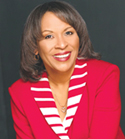 Sharon Draper
When I started teaching, one of the books I personally treasured and passionately shared with my students was I Am the Darker Brother: An Anthology of Modern Poems by African Americans (S & S, 1997), edited by Arnold Adoff. In the early ’70s, poetry by African Americans was rarely included in middle and high school literature anthologies. But this collection sang the songs and wept the tears of the black experience. It opened a whole new world of connections, emotions, and voices for young people—a garden of power and peace.
“Come to me broken dreams and all Bring to me the glory of fruitless seeds, I shall find a place for them in my gardens” —Conrad Kent Rivers (from “The Still Voice of Harlem”)
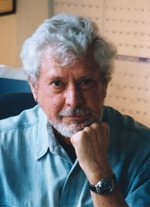
Photo by Evans Chan
Russell Freedman
Virginia Hamilton’s Anthony Burns: The Defeat and Triumph of a Fugitive Slave (Knopf, 1988), one of my favorite books in any category, is an unsparing nonfiction account of the horrors of human bondage and the value of liberty. I love this book because it is so beautifully written; it reads like a novel with all the complexities of plot and characterization, and has the additional power of absolute truth. A classic for all ages to read in tandem is Narrative of the Life of Frederick Douglass, an American Slave: Written by Himself, published more than a century earlier.
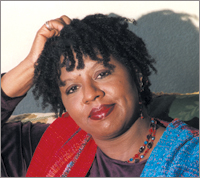 Nikki Grimes
I love it when an author climbs into the skin of a character and gives readers an intimate experience of a world unknown. Julius Lester did that brilliantly in the seminal work, To Be a Slave (Dial, 1968). This title helps black readers to better understand the slavery experience, as well as the strength and resilience of their forebears. And for nonblack readers, this book fosters an understanding of the humanity of those enslaved and of their descendants. Ultimately, Lester moves readers beyond the two-dimensional view of those they consider “other.” Would that every book would do likewise!

Photo by Dave Hall
Phillip Hoose
I love Minds Stayed On Freedom: The Civil Rights Struggle in the Rural South: An Oral History (Westview Press, 1991) by the Youth of the Rural Organizing and Cultural Center. It was published in the early ’90s and may now be unfortunately out of print. It’s an oral history of the civil rights movement in Holmes County, MS, rendered through interviews conducted by local eighth and ninth graders. After receiving training in interview techniques, the teens went out and questioned the elders in their community about what they had been through. The stories are just gripping. Eyes were opened tale by tale. Accounts of the persistent courage required to register to vote transformed grandparents from old, boring people into the heroes they were. I went to Holmes County and met some of the organizers and interviewers. This is one book that really affected the work I do.
 Angela Johnson
Twenty-five years ago, I sat on a friend’s couch reading Virginia Hamilton’s Sweet Whispers, Brother Rush (Philomel, 1982) and was overcome with emotion. I literally wept as I entered Tree’s life, awed by her love for her beautiful and uncomplicated brother. I warily wandered into the haunted past with her and her ghost relative, Brother Rush. Virginia waltzed me into Tree’s family secrets and shames. I was elated and conversely devastated at each revelation. I could not quit reading until all things were revealed. Thus, I sat on my friend’s couch all day, book in hand. Sweet Whispers changed me, literarily and personally.
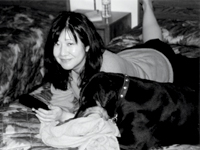
Photo by George Miyamoto
Cynthia Kadohata
Mildred Taylor’s magnificent historical novel The Land (Penguin Putnam/Phyllis Fogelman Bks., 2001) can be read in a number of ways. I read it both as a page-turner and as a lesson in how to write historical novels. It’s about a young man from post-Civil War Georgia who is half black and half white. I read The Land while writing my second children’s novel, Weedflower, and it taught me a lot and in so doing changed my life. The Land is composed in a tidy fashion—a classic novel really—with the story always progressing from scenes to sequences to acts to the whole. I have no idea what Taylor was going through as she wrote it, but for me it also seems to be full of those magical touches you find when you’re in touch with your muse.
 Julius Lester
My two oldest children were born in 1965 and 1967, and during their preschool years books about blacks were not in great supply. Somehow, I came across Harriet and the Promised Land (S & S/Windmill Bks., 1967) by Jacob Lawrence. I still remember the power of his illustrations, which conveyed the agony of struggle, the victory of having endured with one’s soul intact. I think I will get a copy for my grandchildren.
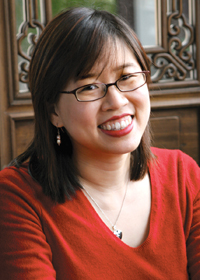 Grace Lin
One of the first books that I absolutely loved when I was a child was Striped Ice Cream (HarperCollins, 1968) by Joan M. Lexau. I think it’s out of print now, but I keep hoping someone will bring it back. The characters were so real that I immediately felt like Becky and her family were my friends. Superficially, we had nothing in common—I was Asian, living in the suburbs, while Becky was black and lived in the city—but the love Becky and her family shared was truly universal. I bought myself a used copy of the book a while ago and reread it every summer (while eating ice cream)!
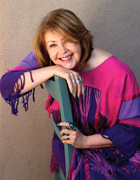
Photo by Cheron Bayna
Pat Mora
Choosing one book from this cornucopia of book-joy possibilities? Difficult as choosing one candy from a grand assortment. I had the pleasure of knowing Virginia Hamilton, and it was a real pleasure. Rereading her lush volume, The People Could Fly (Knopf, 1985), I could see her smile and hear her voice. I savored the lilting cadences and marveled at Leo and Diane Dillon’s artwork. Immersed in this folktale, we witness and experience slavery’s harshness, feel the whip; and yet feel the counter-rhythm, the uplifting swoosh of a people’s magic, faith, hope. I’d forgotten Virginia waves good-bye as her body ascends on the last page. Lucky for us, her spirit and voice live on.
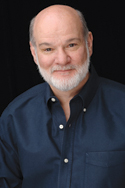
Photo by Arthur Cohen
Jim Murphy
Wynton Marsalis’s Jazz A B Z (Candlewick, 2005) was already sitting on my desk because earlier in the day a postcard had arrived announcing the annual “Giants of Jazz” concert at a local middle school, an awe-inspiring gathering of well over 25 internationally renowned jazz musicians. To get into the concert’s spirit, I reread the book (illustrated by Paul Rogers), an exuberant, ethereal, entertainingly energetic celebration of some of jazz’s greatest artists, done in alphabet book form with free-flowing poetry entries and vibrant, inspired graphics. Very cool.
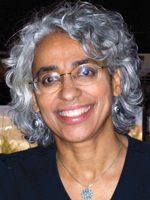
Photo by Drew Nelson
Vaunda Nelson
Aunt Flossie’s Hats (and Crab Cakes Later) (Clarion, 1991) combines two of my favorite things—hats and family lore. Author Elizabeth Fitzgerald Howard and illustrator James Ransome conjure the tender relationship between two young girls and their favorite great-great aunt, who provides tea and cookies, stories about her life back in the day, and “crab cakes later.” I love how this book gently reveals the importance of passing on history through storytelling and demonstrates how keepsakes can trigger key memories. Long after Aunt Flossie is gone, her hats and the stories they spark will sustain her legacy.
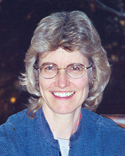 Elizabeth Partridge
In 1995, my editor sent me a new novel, Like Sisters on the Homefront (Dutton) by Rita Williams-Garcia. I was hooked from line one: “The first time Gayle slammed the bathroom door, her mother let it go.” I fell into the story, and didn’t come out for days after finishing the book. I loved watching Gayle go from tough girl to connected to her greater family, and to herself. I admired the way Williams-Garcia dealt honestly with strained family relationships, teen sex, abortion, and pregnancy. Brave, brave author. It mystified me that people weren’t shouting from the rooftops about what a terrific book Like Sisters was. But time and honor have caught up with Williams-Garcia. Jumped (2009) and One Crazy Summer (2010, both HarperCollins/Amistad) were finalists for the National Book Award, and One Crazy Summer has gone on to win the Coretta Scott King Award, a Newbery Honor, and the Scott O’Dell Prize for Historical Fiction. Make sure you don’t miss this earlier novel. It’s a gem.
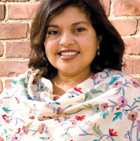 Mitali Perkins
Olugbemisola Rhuday-Perkovich’s 8th Grade Superzero (Scholastic/Arthur A. Levine Bks., 2010) is one of my favorite recent reads. I love it because it delves into faith, social justice, and friendship—themes not commonly found in YA books. Reggie’s voice is funny, fresh, and honest, his family is intact and loving, and he dreams about empowering the poor. He is a black boy like many I know, sadly underrepresented in the media and the world of children’s books. The author is a debut novelist, and I look forward to many more great reads from her pen.
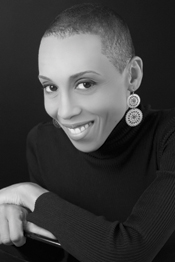 Andrea Pinkney
One of my favorite books is Patricia C. McKissack’s Newbery Honor winner, The Dark-Thirty: Southern Tales of the Supernatural (Knopf, 1992). I’ll never forget the autumn night my husband, Brian, and I decided to read one of the stories aloud by candlelight—just to get the full spooky effect. We chose a story called “The Chicken-Coop Monster.” As we were nearing the scariest part—when the chicken coop’s door creaks open—our apartment buzzer let out a loud brrrzzzzzz! We weren’t expecting any visitors, so the jarring brrrzzzzzz immediately yanked us from the trance brought on by the story’s compelling narrative. Brian and I screamed louder than two kids in a haunted house! And, oh, did we jump! The buzzer kept going brrrrzzzzzz...!
Finally, Brian managed to put down the book. He tentatively answered the door, only to discover that waiting on the other side was a pizza deliveryman who had the wrong address. Even though we were safe and cozy in our New York City home, McKissack’s storytelling power had taken us on a bone-chilling trip through the South. Now, each Halloween we take The Dark-Thirty off our bookshelf and relive its scariness.
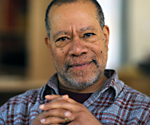 Jerry Pinkney
It is one thing to read and study a time, place, and circumstance with the takeaway being that one has increased his knowledge and understanding. It is something altogether different when one is made to feel as if he were there. The slave narratives in Julius Lester’s To Be a Slave are compelling enough to stand alone. However, it is Lester’s insightful historical commentary that bridges time and space. Published some 43 years ago, accompanied by Tom Feelings’s powerful illustrations, this book is a moving testimonial that gives heart and voice to people who had no voice.
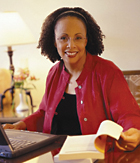 Jewell Parker Rhodes
“Hold fast to dreams/For if dreams die/Life is a broken-winged bird/That cannot fly.” Langston Hughes’s The Dream Keeper and Other Poems (Knopf, 2007), his only book of poems for children, inspired me to celebrate myself, my family, and my culture, and to dream a life not yet visible during America’s civil rights struggles. The poetry remains timeless—rhythmically heralding the joys of nature and friendship, syncopating the sometimes-weary blues of life, and booming like a trumpet with images of dance and just plain fun. Brian Pinkney’s scratchboard illustrations (a technique using a knife to scratch black ink from whiteboard) serve as a fitting complement to Hughes’s stark and grand images. Both men “sing America” beautifully. Every child should sing these poems, too!
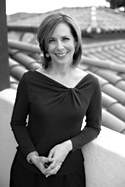
Photo by Sean B. Masterson
Pam Muñoz Ryan
One of my favorite poetry books is Eloise Greenfield’s Under the Sunday Tree (Harper & Row, 1988), with paintings by Mr. Amos Ferguson. The poems transcend the setting of the Bahamas and reflect the universal themes of community, family, and love. The book ends with a toast “To Friendship,” which I have given many times to people sitting at my own table. (The last line is an exuberant, “Let’s eat.”) My favorite poem in the book is “To Catch a Fish.” Once, at a conference, I had the opportunity to recite it to Ms. Greenfield. What a joy to meet her!
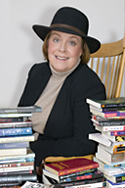
Photo by Todd France
Anita Silvey
On its most basic level, Rita Williams-Garcia’s One Crazy Summer works as a character-driven novel. In the late 1960s, three sisters live for a month with their mother in Oakland, CA. Narrated by 11-year-old Delphine, the book explores how the girls adjust to a summer camp sponsored by the Black Panthers. Filled with humor—with lines like we “didn’t come for the revolution. We came for breakfast”—the book not only brings the times and political issues to life, it explores the universal journey of a child seeking her mother’s love and approval.
 Carole Boston Weatherford
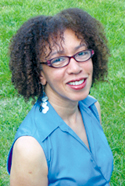
Just as kinfolk flock to homecomings, I return again and again to Jacqueline Woodson’s Coming on Home Soon (Putnam, 2004), a tender story of a girl whose mother goes north to work on trains during World War II. With her grandmother, the girl awaits the letter signaling her mother’s return. A warm and fuzzy subplot involving a stray kitten shows that the house of the heart is never full. Together, Woodson’s lyrical text and E. B. Lewis’s luminous watercolors usher in hope. I always linger on one spread: “Time passes.” This Caldecott Honor book just gets better with the passage of time.
 Rita Williams-Garcia
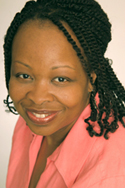
Back in the late ’60s, my school librarian put Reba Paef Mirsky’s Thirty-One Brothers and Sisters (Willcox & Follett, 1952) in my hands. With the exception of Phillis Wheatley’s, Sojourner Truth’s, and Harriet Tubman’s biographies and a novel titled Mary Ellis, Student Nurse, there were no characters in my school’s library books who looked like me. But in Mirsky’s Nomusa, daughter of a Zulu chief, I found my mirror image. She was drawn with brown inks, she had short, thick hair, and was the only girl allowed to go on a hunt with her father and the men of the community. And she was smart.

Added To Cart
RELATED


RECOMMENDED
CAREERS
The job outlook in 2030: Librarians will be in demand
CAREERS
The job outlook in 2030: Librarians will be in demand
ALREADY A SUBSCRIBER? LOG IN
We are currently offering this content for free. Sign up now to activate your personal profile, where you can save articles for future viewing
ALREADY A SUBSCRIBER? LOG IN
Thank you for visiting.
We’ve noticed you are using a private browser. To continue, please log in or create an account.

Add Comment :-
Be the first reader to comment.
Comment Policy:
Comment should not be empty !!!