


2018 School Spending Survey Report
Pen Ultimate: National Novel Writing Month
For kids who take part in National Novel Writing Month—the acid test for would-be authors—it's no guts, no glory
Kathleen Kohl was penning 2,000-word short stories at 12 years old and by 13 set her sights on writing a novel. In a move gutsy enough for any would-be writer, much less a teenaged one, Kohl last year signed on for National Novel Writing Month, an online contest, of sorts, that challenges all comers each November to complete a 50,000-word piece of fiction over 30 days.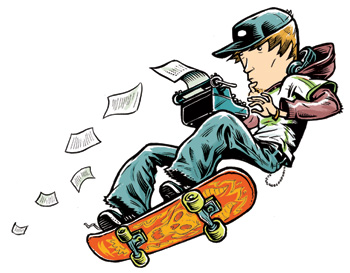
Illustration by Lars Leetaru.
The task’s severe deadline—finishing a novel in one month—actually appealed to Kohl. “It helps you stop putting it off,” says the Portland, OR, high school freshman. And while it’s a bit early to set any career plans, Kohl says that publishing a book, or two, is “definitely something I’m considering.” She’s far from alone. Since launching in 1999, National Novel Writing Month, or NaNoWriMo, has grown from a band of 21 overcaffeinated friends, as founder Chris Baty calls them, to the more than 119,000 hopeful writers who joined in 2008. While most participants simply want to finish, 36 novels begun through NaNoWriMo have been published, according to its Web site, including the former New York Times No. 1 bestseller Water for Elephants (Algonquin, 2007) by Sara Gruen. “I think it’s a direct vehicle to getting published,” says Charlie Newman, 15, a junior at University Laboratory High School in Urbana, IL, and NaNoWriMo participant. “My grandmother said that no one had ever been published from the contest. I went online and showed her she was wrong.” The fantasy of publication notwithstanding, completing the program is a lot like running a marathon for writers, with an average daily goal of 1,700 words, a challenge for a professional scribe, much less the full-time employed, parents, and, yes, teenagers, who sign on to NaNoWriMo. “It got to where I could knock out 1,667 words in 45 minutes,” says Newman. “They’d be just stream of consciousness. But then, with homework, sometimes I didn’t even have 45 minutes.” To encourage students, Baty launched a kid-friendly version of the contest in 2004. The Young Writers Program, in which teens and even younger students can set word-count goals lower than 50,000, had about 22,000 entrants join in 2008. Teachers told Baty that they couldn’t get their participating students to put down their pens. “Kids were suddenly staying up late working on books, feeling novel writing was as fun as any video game,” he says proudly. “Kids who had hated writing would not stop.” Baty, now executive director of the Oakland nonprofit Office of Letters and Light, which oversees NaNoWriMo, credits the youth program’s growth to its director, Tavia Stewart-Streit. Hired in 2006, Stewart-Streit’s main objective is to encourage class participation in NaNoWriMo Young Writers Program. She’s even been known to wander into a Bay Area classroom or two to encourage young writers in person. Group participation is key, particularly in the K–12 environment. While the rare 13-year-old, like Koho, may choose to tackle a 50,000-word writing challenge solo, the writing process can be daunting otherwise. Participants—at any word count—routinely give up. That’s why Stewart-Streit and Baty encourage teachers to create a group environment around the project, just like Baty and his friends did back in ’99. Students stay focused on helping one another persevere, and the contest becomes a social experience. “We had a little community,” says Newman. “When one person finished, it made us all want to finish, too.” Stewart-Streit also offers lesson plans, posters, and stickers on the contest’s site and this year posted curriculum suggestions—all free and designed for teachers to help keep kids engaged. There are even laptops that schools can borrow for the length of the project. “The more people who do it, the more fun for the kids,” says Stewart-Streit. Of course, NaNoWriMo has always offered support in the form of its online community. Once registered, entrants can log on and find others to commiserate with and cajole at any hour of the day—and in any part of the world. But many teens may need a little more handholding. Amber Royer, a former librarian who has sponsored NaNoWriMo programs for teenagers at the Arlington Public Library in Lewisville, TX, believes reasonable goals are vital to maintaining their interest. Royer has helped teachers in her local school districts tailor the program for different grades and suggests revising word goals should kids start to hit a wall midway through the month. “Sometimes they bite off more than they can chew,” she says. “And it can be frustrating. But there’s always next year and always something to celebrate. Maybe they found a character they can use next time.” To Royer, that’s the benefit of writing in a group, as peers can help one another glean the silver lining in what the author may view as a big failure. “You can go to a site and do it alone,” she says. “But it’s more helpful as a community.” Working in tandem helped Maia Gersten, a sophomore who teamed up with Newman at University High School. Both would write for 15-minute chunks during lunch. While Gersten actually hit the 50,000-word goal, she didn’t finish her story. But that hiccup hasn’t changed her plan to reenter the contest this year, nor her goal to eventually get her novel in front of a publisher. For Gersten, like others, the community aspect of the contest worked. And as NaNoWriMo participants ink more deals, it could signal a new phase in authorship, scrapping the stereotype of the solitary, tortured writer, huddled in a cold garret, scrambling to eke out a decent sentence or two each day. Sure, writing retreats and groups have been popular for years, offering feedback and encouragement to individuals struggling to shape a plot or a character’s arc. But the focus there is on the craft. Few writers’ groups advocate a Speed Racer–like mission to simply jam out the words, and those that do rarely have their sights set on getting published. Yet maybe that’s the success of NaNoWriMo, especially for younger writers. By not worrying about crafting what Hemingway called “one true sentence,” penning a novel becomes just another school project. You build a burping volcano, finish the posters for next week’s dance, and keep typing until the word counter pings 50,000. As for Kohl? She didn’t finish her novel. As she puts it, “Homework was more important to me.” However, she plans to re-up for NaNoWriMo come November and, this time, finish. Baty’s not surprised. “You have these high school students who say, 'Yep, I’m going to write a novel,’ and then they do it,” he says. “Part of it is the social aspect, and so they’re not so precious about it. I’m dumbfounded.”
Added To Cart
RELATED


RECOMMENDED
CAREERS
The job outlook in 2030: Librarians will be in demand
CAREERS
The job outlook in 2030: Librarians will be in demand
ALREADY A SUBSCRIBER? LOG IN
We are currently offering this content for free. Sign up now to activate your personal profile, where you can save articles for future viewing
ALREADY A SUBSCRIBER? LOG IN
Thank you for visiting.
We’ve noticed you are using a private browser. To continue, please log in or create an account.

Add Comment :-
Be the first reader to comment.
Comment Policy:
Comment should not be empty !!!