


2018 School Spending Survey Report
It's All About Text Appeal
Want readers’ advisory to make a difference? Teach your kids how to speak intelligently about books.
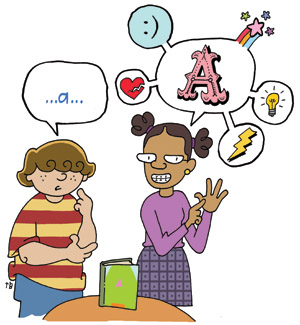
Pulling teeth. That’s how I’d describe my attempts to get my middle school students to talk about the kinds of books they liked to read. It was agonizing. And time consuming. But more importantly, since my students couldn’t pinpoint what attracted them to their favorite titles, I was limited in what I could recommend—and that meant they were missing out on some amazing books.
“Interesting….” That was the most common response I got from the majority of our 1,436 middle grade students at I.S. 281 in Brooklyn, NY, when I asked what they liked about a specific book. But “interesting” isn’t a helpful way to describe a book. After all, what I find interesting, someone else might find downright boring.
What responses had I been hoping for? Well, let’s pretend I’m a patron asking you to recommend a book. When you ask me to name a recent book that I’ve really liked, the first one that springs to mind is Mary Roach’s Stiff: The Curious Lives of Human Cadavers (Norton, 2003). Would you deduce that I’m looking for more books on cadavers? Probably not. As a librarian, you’d understand that a book’s topic is just one of many factors readers may find appealing. In fact, in the case of Stiff, you could probably safely assume that the appeal wasn’t about the subject at all, but rather about the way the book was written.
As we continue to talk, you’d coax more information out of me about some of the other titles I’ve enjoyed, such as The Art of Eating (Peter Smith, 1990) by M. F. K. Fisher, Low Life (Farrar, 1991) by Luc Sante, and An Anthropologist on Mars (Knopf, 1995) by Oliver Sachs. With even more encouragement, you might get me to describe specifically what all of these books have in common: the authors’ astonishing facility with language, strong wit, and keen eye for the absurd. Fortunately for you, I know what I like to read and how to express my likes and dislikes. Armed with this knowledge, you’d recognize pretty quickly that I might also enjoy reading Joseph Mitchell, David Sedaris, and Florence King.
Unfortunately, readers’ advisory with middle schoolers doesn’t come this easily. I realized I had to expand my students’ reading horizons by teaching them to speak intelligently and thoughtfully about their book preferences. But what was the best way to do that?
To help solve the problem, I turned to Mary K. Chelton, my mentor at the Queens College Graduate School of Library and Information Studies in New York, for guidance. She suggested that I take a close look at Joyce Saricks’s Readers’ Advisory Service in the Public Library (ALA, 2005). This book gave me the clarity I’d been craving—a complete explanation of the elusive concept I’d been trying to convey to my students.
Although the book targets reference librarians who often make recommendations to patrons on genres they don’t typically read, Saricks’s advice also applies to school librarians. She shows how to frame a discussion to get patrons to articulate the appeal of a book, author, or genre. Saricks points out that successful readers’ advisory identifies the story line, characterization, and pacing with just a handful of pointed questions that go something like this: Are the characters and plot quickly revealed or slowly unveiled? Is there more dialogue or more description? Is the story’s focus on a single character or on several whose lives are intertwined? And, is the focus of the story more interior and psychological or exterior and action oriented?
More specifically, Saricks suggests replacing the use of subject headings with something she calls “appeal terms,” essentially adjectives that effectively convey a reader’s reaction to certain elements of a book. The reason? They allow us to move away from plot summaries and help us to connect seemingly disparate titles by determining their common appeal.
Gary Paulsen’s Hatchet (S & S, 1987), the story of a 13-year-old who survives a plane crash and uses a hatchet to endure 54 days alone in the wilderness, is a fine example. If a student used strictly subject headings to describe this classic, I’d only glean information about survival and divorce. Using appeal terms, however, opens up a lot more possibilities because the student reveals that the story features a well-developed character, a suspenseful tone, and a plot that’s action driven—all of which better define the kind of experience the reader is looking for in a book.
So a child who enjoys Hatchet because it’s exciting and suspenseful and the main character’s thought process is played out on the page might also like Shane Peacock’s Eye of the Crow (Tundra, 2007), a historical fiction mystery, because it’s also exciting and suspenseful and lets the reader into the mind of the protagonist, in this case, the young Sherlock Holmes.
To encourage our students to move away from summarizing plots, I and Kyra Blair, the literacy coach, asked them to start filling out a form called a Book Hook. The first section of the form asks for a brief description—or “hook”—of a book they’ve enjoyed. Take seventh-grader Gabriella’s Book Hook for Jacqueline Woodson’s If You Come Softly (Putnam, 1998). “Elisha and Jeremiah are two very different people, on the outside. Ellie is Jewish, while Miah is black. But what does the color of your skin have to do with love?” Now that’s gripping stuff.
Another section asks students to consider three appeal terms that best describe the book. Gabriella learned to use the phrases “engrossing pace,” “gentle story line,” “bittersweet tone,” and “detailed characters.” Thanks to the work of all our language arts teachers, our students can now identify the pace, characterization, story line, and tone of a book. How’d we do it? We taught them to use an abbreviated list of Saricks’s adjectives, or appeal terms, that fall into each of the four categories. For example, for pacing, kids now often use words like “breakneck,” “engrossing,” “fast,” “relaxed,” and “unhurried.” For characterization, their go-to words include “familiar,” “multiple points of view,” “quirky,” “realistic,” and “well developed.” For story line, they take advantage of descriptions like “action oriented,” “character centered,” “violent,” “gentle,” “open-ended,” “thought provoking,” and “tragic.” And for tone, they might say “dark,” “edgy,” “hard edged,” “humorous,” “magical,” “romantic,” and “suspenseful.”
I’ve found that using picture books to teach the value of appeal terms is a great way to model how to describe the primary elements of a story. With Melanie Watt’s Scaredy Squirrel (Kids Can, 2006), for instance, kids easily learn the concept of a character-driven plot because the entire story centers on the main character, Scaredy Squirrel, and his thoughts and feelings. The book also has a quirky hero, is fast paced, and has a humorous tone.
Now students in search of reading suggestions know to check either the Book Hook binder in their language arts classroom or my frequently updated Book Hook binder in the library. To date, I have 97 Book Hooks, complete with appeal terms for each. Just by viewing the three appeal terms that best describe a book, students get a quick snapshot of the title and can determine if it’s something they might want to read.
In fact, my students can also access Book Hooks online through Moodle (moodle.org), a free open-source software program, and search the write-ups by appeal terms. Some students have started contributing their hooks to another database in Moodle called Student Book Hooks. This database enables any teacher with a classroom set up in Moodle to access the library Moodle and my Book Hooks, as well as other students’ Book Hooks online. This way, our students can read each other’s Book Hooks—across grades and classes.
Was it worth it to spend two years teaching kids how to use appeal terms? Absolutely. There’s nothing quite as satisfying as the relief I feel when I’m presented with a list of appeal terms to help me better recommend a book.
In the end, however, it’s my students who are getting the most out of it. Consider Anthony, an eighth grader who had just finished reading Nick Hornby’s Slam (Putnam, 2007). When I asked him to describe the book, he reverted to his old ways by retelling the story. I stopped him and reminded him about the list of appeal terms to choose from—and almost immediately he told me that the tone of the book was humorous, the pace was unhurried, and the characters were realistic. Now that’s a ringing endorsement that appeal terms work—and I was able to recommend that Anthony try reading Gordon Korman’s Schooled (Hyperion, 2007) and Jordan Sonnenblick’s Zen and the Art of Faking It (Scholastic, 2007). (By the way, he loved both of them!)
As appeal terms enter our students’ daily vocabularies, they also learn to think and talk about reading in new ways. They’re suddenly able to verbalize that they want character, rather than action-driven books, and they want a tone that’s romantic rather than dark and edgy. Now equipped with the proper vocabulary to get their message across, their reading universe has suddenly opened up to a wide range of possibilities.
Here’s a story I love to tell. Jessica, a seventh grader, read only horror books like those in R. L. Stine’s “Fear Street” series—that is, until she learned that she actually liked books with a dark tone and suspenseful story line. Jessica now reads—and enjoys—books like Kevin Brooks’s Martyn Pig (Scholastic, 2002), a realistic novel, and F. E. Higgins’s The Black Book of Secrets (Feiwel & Friends, 2007), a fantasy.
Needless to say, my work is a lot more enjoyable these days because so many more students find books they like to read and tell each other about them in a more systematic way. How do I know? Circulation numbers give some clues: In 2008, the year we started teaching appeal terms, students checked out a little more than 20,000 books. This year the numbers have exploded to 28,000 books, with just under 2,000 holds in place. And while circulation statistics can be deceiving, the everyday conversations I have with my students about what they’re reading confirm that they’re finding, sharing, and enjoying books.
When kids find books they love to read, they become stronger readers—and that in turn increases the chance that they’ll become lifelong readers who will read for pleasure. Sometimes I still have to pinch myself when a student comes into the library saying, “Miss Nesi, I’m looking for something fast-paced, with a dark tone and well-developed characters.”
But I have to tell you, it’s like music to my ears.

Added To Cart
RELATED


RECOMMENDED
CAREERS
The job outlook in 2030: Librarians will be in demand
CAREERS
The job outlook in 2030: Librarians will be in demand
ALREADY A SUBSCRIBER? LOG IN
We are currently offering this content for free. Sign up now to activate your personal profile, where you can save articles for future viewing
ALREADY A SUBSCRIBER? LOG IN
Thank you for visiting.
We’ve noticed you are using a private browser. To continue, please log in or create an account.
Add Comment :-
Be the first reader to comment.
Comment Policy:
Comment should not be empty !!!