


2018 School Spending Survey Report
Holiday Memories 2009

Author Laurie Halse Anderson lives in upstate New York.
Laurie Halse Anderson likes to tackle tough subjects like date rape, death, and slavery. Her most recent novel, Wintergirls (Viking, 2009), which deals with anorexia, received five starred reviews and debuted on the New York Times Bestseller List. But the award-winning children's and YA author tackles a lighter subject with her latest picture book, The Hair of Zoe Fleefenbacher Goes to School (S & S, 2009), about a little girl's wild red hair, which seems to have a mind of its own.Christmas and Orange-Cinnamon Rolls
A blizzard brought Christmas home to my family. When I was little, Christmas meant a late-night trip over the river and through the (Adirondack) woods, to grandmother's house. My grandparents lived in a tiny village near Lake George, NY, the same village where my favorite aunt and cousin lived. My grandfather had the proper Santa belly and was a jolly old elf himself, but he lacked the beard, for which I eventually forgave him, but not without a great deal of dramatic sighing. My aunt (the relative with the most books) would make us hot chocolate, and my cousin and I would fight to stay awake until the real Santa arrived. We lost every time. No matter. Christmas morning was a frenzy of presents and shrieking and kisses and hugs. Heavenly—from the child's perspective. Hellish, when seen through the eyes of my parents. My mother worked retail. Christmas was a frantic nightmare of long hours and demanding customers for her. She would come home after the store closed and have to load the car for the long journey north. My father, a campus minister, also reached Christmas Eve in a state of exhaustion. Every year they would have to make up a new story about why there were large garbage bags filled with things we were not allowed to see in the back of our station wagon and no, thank you, they really did not want to hear my rendition of "Joy To The World" again.
Laurie Halse Anderson (right), with her favorite cousin, Barrie Lyn, on the left, and her dad, Frank Halse, in the back.
The Gods of Lake Effect Snows conspired to whirl down a blizzard just in time for my 10th Christmas Eve. The roads north were closed. My parents spent a long time on the phone explaining the situation. I was outraged and horrified. How could we have Christmas without the rest of the family? Nothing would be right! Christmas was ruined! I threw a world-class pout and retired to my bed with only Laura Ingalls Wilder for company. HER family wasn't afraid of a little blizzard. HER Pa could drive that wagon through anything! The next morning I crept down the stairs on the verge of tears. I thought my mother hated Christmas—she sure did complain a lot about it. My father was a big fan of Jesus and could give a telling of the whole baby-in-the-manger scene that would have you at the edge of your seat. But Dad didn't understand the Santa side of things. And then I smelled it. Hot chocolate and orange-cinnamon rolls. My heart stopped. Did my mom really make something special? She came out of the kitchen... smiling. Wearing her pretty robe. And perfume. My father called from the living room. I ran and there was the most beautifully decorated tree I'd ever seen, complete with silver threads that hung from every branch. The presents were piled high and deep. The stockings were hung by the fire with care and a large nail, because they weighed a ton each. After that came the frenzy of presents, shrieking, kisses, and hugs. It was the best Christmas ever, because my parents were relaxed, happy, in love with each other, and in love with the day. And the snow piled up outside, foot after foot, giving our little family time to remember what we really cared about the most. We traveled up to my grandparents a day or so later, after the snow stopped and plows cleared the roads. It was lovely being with the extended clan; we drank hot chocolate, swapped toys and books, and ate ourselves silly. That became the new tradition; Christmas with just us first, and with the clan a few days later. And that, my friends, is why you will always be served orange-cinnamon rolls if a blizzard should bring you to my door on Christmas Day.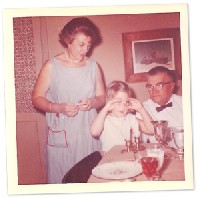
Deborah Heiligman lighting candles with her parents.
Deborah Heiligman has had a whirlwind year with her Charles and Emma: The Darwins' Leap of Faith (Holt, 2008) receiving starred reviews in School Library Journal, Publishers Weekly, Booklist, the Horn Book, and the Bulletin for Children's Books. The book was also a finalist for the 2009 National Book Award in the Young People's Literature category. She writes a blog of her own and contributes to the blog Interesting Nonfiction for Kids (I.N.K.)The Holidays, Family, and Food
My holiday memories are mostly about family and food, the two intertwined almost seamlessly. And growing up I had a holiday every week because we celebrated Shabbat. We didn't observe it in a strict or Orthodox way. But we had a nice dinner in the dining room, often with my grandparents, whom I adored. My mother set the table with a white tablecloth and good china, which I came to think of as the Shabbat dishes. My father picked up a fresh challah at the Egypt Star Bakery in Allentown, PA, where we lived. As the chicken finished baking in the oven, my mother and I lit the candles, and said the blessing over them. Then my father said Kiddush, the prayer over the wine, and the prayer over the challah. Daddy tore off pieces of challah and gave one to everyone at the table, saying "Good Shabbos" and giving me and my mother a kiss on the forehead as he did. Challah was—and still is—one of my favorite foods, and I can still feel my father's kiss when I take that first bite. After dinner on Friday nights we usually went to services at our synagogue. I loved services, especially the singing. And as I got older I sat with my friends, and we giggled, and usually left during the sermon. But after services was the best part: there was an Oneg Shabbat, which meant more food! I can still taste my favorite little chocolate cupcakes with buttercream frosting. Oh how I loved Shabbat. I liked the other fall Jewish holidays, too, again, mostly for the food: apples and honey, more challah… and in spring there was Passover, with its long food- and family-filled seder.
Deborah Heiligman at the 2009 National Book Awards.
But when the winter holidays came around, I must admit I felt disappointed and left out. Even cheated. I mean, Hanukkah just couldn't hold a candle (pun intended) to Christmas. Sure I got presents every night, but they were little presents, and sometimes even things I needed, like socks or underwear. My parents did give me one big present every year—I remember one year it was a special doll I had asked for, and another year it was the Erector Set I had craved. My mother usually made potato latkes once during the week, and there was a Hanukkah party at Sunday school. But it just wasn't Christmas! I didn't get Santa Claus. I didn't get a tree. I didn't get that special moment on Christmas mornings that I read about in books: when you rush downstairs to see what Santa had brought you! (Also, Jewish children learn early on that there is no real Santa Claus, because how else can you explain that he doesn't come to your house? Because you're bad?) My parents understood my feelings; I know that now looking back, though back then I was just mad because they wouldn't let me get a Christmas tree. ("What if the rabbi drives by?") But they knew. Because here are two of my strongest memories: One year Christmas eve fell on a Friday night. So after my parents and I left temple, instead of going straight home, we drove around the streets of Allentown looking at all the Christmas lights. As we admired the lights, we belted out Christmas carols at the top of our lungs. I remember thinking my dad did a particularly moving rendition of "Silent Night." This from a man who was born in the "Old Country" and grew up kosher and Orthodox. And then one year, when I was old enough, my mother shared with me a ritual she had. On Christmas Eve she stayed up and watched Midnight Mass on TV, sitting in the kitchen eating from the many boxes of Christmas cookies friends, neighbors, and my father's patients had given us. Mom and I did this together from then on, every year. As an adult I still had some feelings of sadness around Christmas, but I figured out how to combat the melancholy. With—what else?—food and family. Every year I make latkes, and if I do say so myself, they are the best latkes in the world (the recipe is in my Celebrate Hanukkah [National Geographic, 2008] book). I invite family and friends to come over and we eat latke after latke until we can eat no more. Now that my sons are grown, we don't give presents. Instead we each suggest a charity and then we decide on one or two to give to together. We call it our Tzedekah Hanukkah. Lately we have been giving to food banks and other organizations that feed the hungry. I have to go now. I have a lot of grating to do—it's latke-making time. Here's to warm, food- and family-filled holidays for everyone!
Photo: David Johnson
Barbara McClintock recently illustrated the picture book The Mitten (Scholastic, 2009) by Jim Aylesworth, about the animals who decide to warm up inside a lost mitten. Her book The Heartaches of a French Cat (Godine, 1989) was named a New York Times Best Illustrated Book.My Christmas Memories
When I think about Christmas, I think about airports. My parents divorced when I was nine; my mom, my older sister Kathleen, and I moved from our home in New Jersey to North Dakota to be near mom's family, and my dad moved to Houston, TX, to work for a big portrait photography firm that specialized in society weddings and events. From then on, every year on Christmas day, Kathleen and I traveled from one parent to the other, a trek of over 1,500 miles. Sad as it was to be away from the family Christmases in my first home, Christmas day became an amazing adventure. Very early Christmas morning, mom took my sister and me to our tiny airport in Jamestown. It was always cold and dark, but thrilling to walk out onto the frozen tarmac, and step into the small plane with its interior lights blazing, the first of several planes we would fly on our way to Houston. One thing about airports on Christmas day—they are practically abandoned, which heightened the sense of adventure. There we were, alone, like two orphans from a Roald Dahl story, wandering through the cavernous, empty, echoing Minneapolis airport. It always seemed a miraculous surprise to find the large mosaic image of the world on the floor in the check-in area, like coming upon a key point on a secret map. There must have been adults helping us along the way to find our gate for the next leg of our journey, but I've conveniently obliterated them from my memory. It was just the two of us, walking past closed airport shops displaying mugs with pictures of trout, giant stuffed toy moose, and posters proclaiming 'Welcome to Minnesota, Land of Ten Thousand Lakes!' Giant flags of countries around the world hung high above our heads, still and silent, their colorful forms a direct contradiction to the grey, dull vaulted ceiling of the airport atrium. We owned the airport on Christmas day; the potential to walk onto a plane and wind up in France, or Kenya, or Hong Kong was ours for the taking. But we always managed to find our way to the gate for our flight to Houston, with the idea of going farther next Christmas day, if we so chose. At the Houston end of our trip, after walking down the exit ramp from the plane, out into the waiting area at the gate, there was dad, so excited to see us that he could barely stop hugging us. Our moms' enthusiasm when we returned to Jamestown was every bit as welcoming, our heroes' journey rewarded by much hugging and kissing. But the real gift of Christmas for me was the tight bond created between Kathleen and me as we made our shared way south, on the ground through various airports, and in the air 30,000 feet above the Midwest, and then back north again.
Lauren Myracle (circled) with Santa
Lauren Myracle's Let It Snow (Penguin, 2008), a Christmas story jointly written by Maureen Johnson and John Green, recently landed on the New York Times Bestseller List. Myracle is also the author of several best-selling books including TTYL (Abrams, 2004), Thirteen (Dutton, 2008), and her controversial latest, Luv Ya Bunches (Abrams, 2009).The Ultimate Sacrifice
"You are poor, you are cold, you are hungry," I told them in a low voice. I pushed the thought through with the force of my mind. "Sell it." It was Christmas Eve. I was eleven. My first ever Christmas play—written and directed by me—would begin the moment I opened the sliding wooden doors that separated the living room of our stately Atlanta house from the long hallway that served as our stage. I made eye contact with my little sister, Susan (cast as Child One of a starving farm family), and then, in turn, with each of my cousins: Holly (Child Two), Melanie (the children's father, desperate to make ends meet), and Nan Jeanette (the downtrodden, suffering mother). I nodded at Mary Ellen, my other sister and my stage manager, and she hustled them out of sight. I opened the creaking doors. "Ladies and gentlemen," I said, addressing my parents, aunts, uncles, and grandparents, all of whom held flutes of champagne or snifters of my dad's Remy Martin. Behind them glittered our 12-foot-tall Christmas tree. "Yesssss?" said my dad. "Tim, hush," said my mom. "Lauren, go on." I arched my brows. "For your viewing pleasure, we present"—I paused dramatically—'The Ultimate Sacrifice.'" The audience clapped. "Go," I whispered to Child One, Child Two, and Mother. "Start! Now!" In the middle of the hall, Susan, Holly, and Nan Jeanette plodded in a circle, like mules tethered to a pole. "Work all day," they droned, pretending to pull weeds. "Get no pay. Why are we treated this way?" Around they went, until, after several repetitions, Child One and Child Two broke apart and engaged in a pitiful dialogue. Miseries were recounted—no shoes, no toys, no boiled custard—and my father laughed, making five-year-old Susan forget her next line. Through a clenched jaw, I whispered, "But at least." Susan jumped and said, "But at least we have Jésus." She pronounced it hay-sooze, as instructed. "Whatsoever would we do if not for Jésus?" "Let's go see him," Holly said. "We can give him some aprons." "Acorns," I hissed. "Acorns!" Holly said. "Yes," Susan said. "We'll give him some acorns, and they will bring him Christmas cheer." Thus ended act one, and when the grown-ups realized it, they applauded.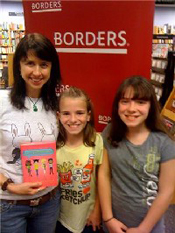
Lauren Myracle (left) with her fans during a recent book signing for 'Luv Ya Bunches'
I closed the living-room doors for the scene change, and Mary Ellen and I dashed to the TV room to retrieve the cage we'd constructed from a cardboard box and aluminum foil. Also in the TV room waited a papier maché stump, an axe, and my cousin, Melanie, aka father. "Is it time?" Melanie asked. "No," I told her. "Not until after the poignant visit." Mary Ellen and I positioned the cage in the center of the hall. "Where's Jésus?" I said frantically. "Here!" Nan Jeanette cried, thrusting a stuffed lion at me. The lion was the mascot for Fidelity Bank, one of the companies my dad represented. As a Christmas promotion, the bank had been giving the stuffed lions to anyone who opened a new account. My dad brought home three. Susan's stuffed lion was pathetic; she'd given it a bath, and it emerged skinny, lumpish, and bedraggled. Mary Ellen had lost hers. We'd searched the house for it, but it was gone, secreted away, perhaps, by our cat. My lion, therefore, was a shoe-in for the role of Jésus the pet turkey. I put Jésus in the cage and trotted to the staircase, gesturing for Nan Jeanette to slide apart the living-room doors. Act two was supposed to open with a flashlight-illuminated vision of Jésus alone—the visual impact, I'd explained, would be infinitely more powerful if poor caged Jésus was alone—but Susan forgot and headed prematurely for the stage. "Susan! No!" Mary Ellen said sharply. When that didn't work, she went after her, body-slamming her to the floor as Nan Jeanette opened the doors. The grown-ups guffawed. Susan cried. Dad served more brandy, and the play went on. It was a simple thing to convey Child One and Child Two's love for Jésus the turkey, because Susan and Holly were little and cute as they pushed acorns through the aluminum foil bars of the cage. Plus, Susan was tear-stained, and still sniffling, which worked to great advantage when Melanie strode from the TV room in a flannel shirt and a 10-gallon hat. She bounced the handle of the axe against her palm. "Father, no!" the girls cried. "You can't kill Jésus! He's our friend, our only friend!" "Move aside," Melanie said. "You will see Jésus again…tonight at dinner." Mary Ellen closed the doors, signifying the end of act two. Now I ran to the TV room and returned with the papier maché stump. Nan Jeanette plucked Jésus from the cage and tossed the cage out of sight. She lay Jésus on the stump, his mane a golden star. "This is your moment," I told Melanie. "Enjoy it." From the audience's perspective, the view must have been spectacular when Mary Ellen opened the doors: Jésus, helpless on the stump, and behind him, Melanie, her feet planted wide and the axe held high. "One, two, three," I whispered, and I killed the hall lights at the exact moment father's axe came crashing down. The final act was, well, a miracle. We dragged a low table into the hall, and Susan and Holly sat morosely behind it, holding Mother Nan's hands. Jésus lay before them on a sterling silver platter. There were candles. Their flames cast flickering shadows on father's face as he pretended to divvy Jésus up. "Now, I don't know about this," my grandmother said from the living room, but all artists have their critics. We plowed on. "What?!" Father roared when Susan and Holly pressed their lips together and shook their heads. "I put food on your plates, and you refuse to eat it?" Melanie snatched Jésus from the platter. "Then you shall go hungry. Nay! We all shall go hungry!" She flung my stuffed lion over her head, sending it sailing out of sight. "Oh, girls, you have angered your father," mother Nan said. "As for Jésus"—her voice caught—"Jésus made the ultimate sacrifice, giving his life so that you may live." She turned to Melanie. "Get the turkey, father." Then she spoke to Holly. "And you, child. There is salt in yon cupboard. Fetch it. It will make the meat more palatable." Melanie went off stage to get the bird while Holly trudged to the chest of drawers at the end of the hall. My mom stored rolls of wrapping paper there, along with her second-best set of placemats, multiple packages of D cell batteries, and, for most of the year, a folk art crèche she bought in Mexico. Susan, Mary Ellen, and I loved that crèche, because baby Jesus had slim silver pins sticking out all over his head, like a halo. We called him Pinhead Jesus, and years later, I would find him in Susan's house, displayed on a side table in Susan's entry hall. I would turn to my mother on that day and say, "How could you?" But on Christmas Eve, when I was 11, the crèche was arranged on top of the mahogany chest of drawers, Pinhead Jesus resting quietly in his crib. "The salt, dear one," Nan Jeanette prompted, and Holly opened the bottom drawer. She gasped. She held aloft what was within, and we all gasped. It was Mary Ellen's stuffed lion, the one Dad brought home for her from Fidelity Bank, the one that had been lost. The cat hadn't taken it after all. "It is Jésus!" I cried, seizing the moment. "He has risen!" Father Melanie, returning with the original stuffed lion, improvised perfectly. "Amen," she said, plunking the Christmas turkey-slash-lion-slash-symbolic-Baby-Jesus onto the table. Raising her voice to be heard over the totally inappropriate laughter of our audience, she issued the play's last line, just as it had been written. "Let us dig in," she proclaimed, suggesting—if only on that one special night—that we could have our Jesus and eat Him, too.
Jon Scieszka is about to end his two-year term as National Ambassador for Young People's Literature.
With his two-year term as National Ambassador for Young People's Literature coming to an end, Jon Scieszka, the second oldest of six sons, chronicles his experiences growing up in Knucklehead: Tall Tales and Almost True Stories of Growing Up Scieszka (Penguin, 2008). He's also the founder of Guys Read, a Web-based literacy program for boys.The Nativity Scene Shoot-out
In the Scieszka house, Christmas was that special time of year when Joseph and Mary and their little baby Jesus and the Three Wise Men… would fight the Nativity Scene Battle against the Green Army Men. Every year my mom set up the battleground, laying blankets of white cotton snow on the little brown headquarters and surrounding table. She positioned the three artillery guys with crowns (armed with Frank and Sense and their secret weapon, Myrrh). She established the attack animals—camels, donkey, ox—in a defensive perimeter, then scattered a few sniper sheep. General Joseph and Admiral Mary huddled inside the HQ staring at the empty crib. The angel was positioned on the peak of the HQ roof to provide air support. Then the Battle was on. My brother Jim and I first softened up the target with our mortar guys, bazooka squad, and machine-gunners. BLAM—the sheep went down. Cracked his plaster neck a little. BOOM—the ox flipped over. Lost a horn. The Wise Men fought back with their heavy stuff. BAAAM—a red ornament wiped out four riflemen. Then ZZZZAAAP—the Angel strafed a platoon of snipers with laser tinsel. But then our minesweepers cleared a sneak attack path through the garland for the final assault. Mary and Joseph were surrounded. Nothing could save them! Nothing except the Secret Weapon Baby Jesus. And He would swoop down wearing just his diapers, screw in the red Christmas tree bulb in the back of the HQ, and fry the entire Green Army with His All-Powerful Light. Then all was calm. All was bright. At least until our next Nativity Scene Battle.
YA novelist Francisco X. Stork, Photo: Anna Stork
Francisco X. Stork rose out of a poor Chicano childhood to attend Harvard University and Columbia Law School. Although he works in Boston as an attorney for a state agency that develops affordable housing, he's also well known as the author of four YA novels. His latest is Marcello in the Real World (Scholastic, 2009), which has received critical acclaim, including NPR's 2009 Best Young Adult Fiction. His next book, The Last Summer of the Death Warriors (Scholastic) is due out in March 2010.Homeland Memories
I am six years old and my mother and I are living in my grandfather's house in Tampico, Mexico. We're there because my mother is a single mother and, well, that's the only place we can be. The living room has one sofa so thin it hurts to sit on and the other three chairs do double duty in the dining room. One of the four empty corners is designated as the spot where, at my insistent request, I will be allowed to assemble the Christmas tableau. My mother brings down a soggy-looking box from the attic. First comes a grayish moss whose function I don't understand, except perhaps to cover up the worn-out floor. Then I take out the stable where the main character of the story is born. It's a horribly open, drafty, wobbly thing with holes on both sides and a missing wall in front. The mother and the baby come next. I like the fact that mother and baby are one, inseparable, the mother absorbed in wonder at the tiny being she is holding. Que bebé tan hermoso. That's what she is saying to herself. I place the bearded father some distance away. The Magi stand mute in front of this scene, wondering if they brought the right gifts: gold, maybe, but frankincense and Myrrh? Out comes the angel decked out in white gossamer, blowing his golden horn. I realize that the shepherds and the four sheep milling sheepishly around them should have arrived before the Magi, but it is too late to go back and undo what has been done. Other logical transgressions follow. The cow and the donkey, the rightful inhabitants of the stable, make their first appearance. I place the cow close to mother and baby so as to warm them with her breath, which I assume is sweet. The donkey keeps the father company. My favorite part comes next. I scatter ducks and dogs, elephants and lions, wolves, rabbits, giraffes, hippopotamuses and polar bears. I hang the monkey by his curled tail on a corner of the barn. The star that guided the Magi and the shepherds is nowhere to be found, lost or damaged most likely by a previous, careless assembler. I sacrilegiously replace it with a pink and silver whirligig. I find a crack on the stable's roof and stick it there. Now I take a deep breath. I have saved for last the most delicate of tasks. I reach into the bottom of the box and lift with my two hands the pond or the lake or the silent ocean, I don't know which. Whatever it is, it is the clearest, purest water I have ever seen or ever will see. I'm told that before she died, my grandmother held that oval, frozen tear in front of her as she combed her lustrous black hair. I move it here and there on the floor until I find the perfect place, the only place. I cover its cedar handle with moss, and when I peer into the depths, I see myself in its infinity.
Added To Cart
RELATED


RECOMMENDED
CAREERS
The job outlook in 2030: Librarians will be in demand
CAREERS
The job outlook in 2030: Librarians will be in demand
ALREADY A SUBSCRIBER? LOG IN
We are currently offering this content for free. Sign up now to activate your personal profile, where you can save articles for future viewing
ALREADY A SUBSCRIBER? LOG IN
Thank you for visiting.
We’ve noticed you are using a private browser. To continue, please log in or create an account.

Add Comment :-
Be the first reader to comment.
Comment Policy:
Comment should not be empty !!!