


2018 School Spending Survey Report
From Writer's Block to The Eternal Smile
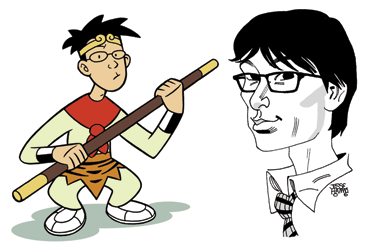
Gene Luen Yang (left) and Derek Kirk Kim (right) Images © 2009 by Yang (left) and Kim (right)
Soon after meeting in the mid-90s in San Francisco at an Alternative Press Expo (APE), Gene Luen Yang and Derek Kirk Kim began working together on “Duncan’s Kingdom," published as a two-issue miniseries by Image Comics. “Duncan” appears to be a comic in the classic superhero vein: an unlikely hero avenges a king’s death, winning the hand of the princess to assume the throne himself. But a recurring dark dream within the story hints at the climactic twist to come, and by the end of the story Duncan is forced to confront some personal issues. "Duncan” now forms the cornerstone of The Eternal Smile (Roaring Brook, May 2009), a trio of thematically related pieces, about three distinct protagonists each destined for a certain path, but each of whom ultimately finds his or her own source of contentment. In “Gran’pa Greenbax and the Eternal Smile,” Greenbax values money above all—or does he? Janet Oh’s life in “Urgent Request,” which plays out primarily against a duotone palette, seems drab enough for her to succumb to an email scam—but she’s smarter than she appears to be. Here Yang and Kim describe the nature of their collaboration, the genesis of The Eternal Smile, their passion for comics, and their excitement about the possibilities of graphic novels everywhere—including in the classroom.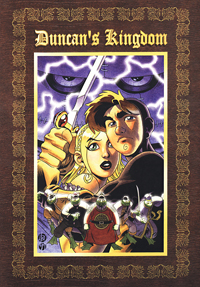
The Eternal Smile (Yang) © 2009 by Kim
How did your first project, “Duncan’s Kingdom,” come about?
Derek Kirk Kim: I was experiencing writer’s block, so I asked Gene if he’d write something for me to illustrate. First Gene did a story about a cook and a dragon…do you want to tell her, Gene? Gene Luen Yang: It was about a dragon terrorizing a medieval town, and the last person left was the baker; he was the one who defeated the dragon. No one liked the story. DKK: Gene has an obsession with bakers. GLY: I like baked goods, I guess.How do you work together?
GLY: Generally I give the story to Derek as thumbnails, and Derek creates the art. DKK: I wanted to print Gene’s thumbnails in the back of the book, but he didn’t want to include them.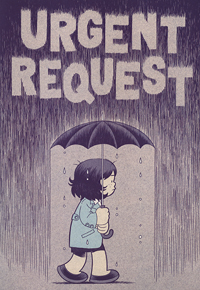
The Eternal Smile (Yang) © 2009 by Kim
GLY: It would be ugly. Derek took a more active role in the storytelling in the last piece in the book, “Urgent Request.” He wanted to try drawing a story outside the traditional six-panel grid.Can you explain what you mean by a traditional six-panel grid?
GLY: I think most comics follow a standard grid, three rows of two panels each [per page]. Jeff Smith’s “Bone” (Scholastic) series uses a six-panel grid. Watchmen [by writer Alan Moore, artist Dave Gibbons, and colorist John Higgins (DC Comics, 1995)] is presented on a nine-panel grid. GLY: Some cartoonists don’t work on a grid, but a good number use one. DKK: The storytelling style in “Urgent Request” is a culmination of all the work I’ve done–taking the comics medium and adapting it for my own purposes. Much of the storytelling in the reader’s mind occurs in the gutters [between the pages of a book], or in the case of comics, between the panels. [Without grid restraints] you can play with the timing and the beats in the story. I drew all the panels separately; once I was finished, I put them together and tried to use the gutter to the best advantage. If you work on a grid, it’s very hard to pull out one panel. GLY: Derek also came up with the idea of throwing the word balloons off the picture plane. Most artists will include the balloons as part of the picture. DKK: I’ve been doing comics as far back as I can remember. Drawing them the way you’re supposed to draw them didn’t match what was instinctive to me. [I moved] the balloons off the panel because I wasn’t able to compose the panel for the image.…Most artists do the balloons first, then draw around what’s left. GLY: I prefer less picture. I like having the balloon in there. DKK: That’s a real art, too, making the panel look good with the balloons inside, like Chris Ware did with Jimmy Corrigan (Pantheon, 2000). His compositions are like jigsaw puzzles; everything’s perfectly placed. When people do that well, it’s amazing.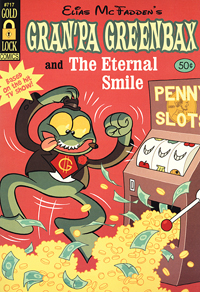
The Eternal Smile (Yang) © 2009 by Kim
Each of the three stories in The Eternal Smile has its own distinct style of illustration and its own pacing. Do you have an idea for the plot and then decide what artistic approach would best suit it?
DKK: I’d read Gene’s story and think about which style worked best. When you read Gene’s writing…it seems to be a genre you’re familiar with, then there’s a twist. I chose an artistic style that would trick people into thinking it would be a certain kind of familiar comic, like Carl Barks’s work for “Gran’pa Greenbax and the Eternal Smile.” [Carl Barks created the Scrooge McDuck character, and the Duck Tales for Disney.] Indie comics and artists such as Chester Brown, Chris Ware, and Laura Park [with their] slice-of-life art style were the inspiration for the final story in the book, “Urgent Request.” I tried to keep my own voice, but infuse the art with those influences. GLY: With “Greenbax,” I wanted something that was close to Carl Barks. It’s not a pure ape of Carl Barks, it’s its own unique thing, [there’s] a lot of Disney art influence. The color was all Derek. I’m terrible with color. Even with my own comics I get someone else to color. DKK: Coloring is the one thing I can take credit for. Coloring is the invisible art in comics. If it’s done well, you don’t notice it until afterwards. I played with a lot of different color schemes to try to and get those right. I especially like the [rose-colored] scenes in Elias McFadden’s office in “Greenbax.”All three stories deliver a surprise at the end. Do you know before you begin what that twist will be? Or does it reveal itself as you plot out the story?
GLY: For the first story, “Duncan’s Kingdom,” I think I must have built the whole thing around the twist. After the comic-novel boom came around, we thought about how we could parlay “Duncan’s Kingdom” into something that could be sold in a bookstore. The twist was the heart of that story, so I figured I could come up with a couple of stories that were connected in that way….I’m trying not to do a twist with my next book. DKK: You do it well, so you shouldn’t abandon it. It comes naturally to you. GLY: People have tics that are natural to them!Is there any limit to where graphic novels can go? I’m thinking of Gene’s comic “Factoring with Gene & Mosley the Alien” that teaches math, for instance, and his The Rosary Comic Book (Pauline Books and Media, 2003).
GLY: I think we’re just starting to explore where comics can go, even as a narrative form, and beyond storytelling, using it for education and journalism and that sort of thing. DKK: I don’t think there’s ever been a limit. The only limit was that comics weren’t a viable career choice.What would you say to teachers who are hesitant to delve into the comics genre?
GLY: Read Maus [Art Spiegelman’s Pulitzer Prize Special Award-winning memoir about the Holocaust (Pantheon, 1986)]. DKK: Read American Born Chinese [Gene Luen Yang’s memoir and a National Book Award Finalist (Roaring Brook, 2006)]. GLY: Teachingcomics.org is a great resource— it’s all comics-based curricula.I recently saw the YouTube video created by one of Derek's "assistants." Would you mind if I shared it with our readers?
GLY: Assistant? What assistant?Jennifer M. Brown is the children's editor for Shelf Awareness, a daily enewsletter for the publishing trade. She recently launched the Web site Twenty by Jenny, which recommends titles to help parents build their child's library one book at a time. TeachingBooks.net resources on this interview »»»

Added To Cart
RELATED


RECOMMENDED
CAREERS
The job outlook in 2030: Librarians will be in demand
CAREERS
The job outlook in 2030: Librarians will be in demand
ALREADY A SUBSCRIBER? LOG IN
We are currently offering this content for free. Sign up now to activate your personal profile, where you can save articles for future viewing
ALREADY A SUBSCRIBER? LOG IN
Thank you for visiting.
We’ve noticed you are using a private browser. To continue, please log in or create an account.

Add Comment :-
Be the first reader to comment.
Comment Policy:
Comment should not be empty !!!