


2018 School Spending Survey Report
Dancing with the Stars: What’s Brian Floca doing illustrating a brand-new book about ballet? | Under Cover
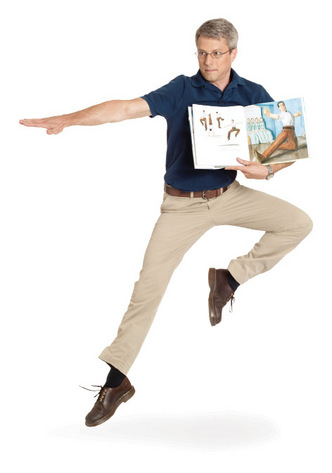
Photograph by Matt Peyton/ Getty Images for SLJ.
Ballet for Martha, by Jan Greenberg and Sandra Jordan, tells the story of how Martha Graham teamed up with composer Aaron Copland and sculptor Isamu Noguchi to create Appalachian Spring, a modern dance masterpiece. No offense, but it doesn’t seem like you’d be an obvious choice to work on this book.
I was obviously not obvious. [Laughs]
You excel at illustrating detailed, technical topics, like the Apollo 11 mission in Moonshot. But this new book is all about figure drawing and portraiture. How’d you get the gig
I absolutely loved doing Moonshot, but I’ve also always loved figure drawing. I had done some sketches at Fashion Week in New York several years ago, and they were up on my website. I used to teach a continuing-ed class at the School of Visual Arts, and Johanna Wright, who’s a great author and illustrator and who is now publishing with Neal [Porter of Roaring Brook], took the class and very kindly linked to me on her website. One day Neal was looking at her site and just followed it over to mine and saw these drawings, which he would not have been expecting from me, and that made him think, “Maybe this is a fit for Martha.”
You’re not a big dance guy. So how did you get your head around Graham’s work?
This was amazing. Right after I joined the book team, the Martha Graham Dance Company was performing Appalachian Spring. So Neal took Sandra, Jan, and me to see it. We ended up in the front row, which is not necessarily the best place for watching the dance, but it was revelatory in terms of understanding the physicality of the dance, how much work was going on, and being close enough to hear the dancers breathe and hear their footsteps and see the sweat. Then just out of the blue, I sent Janet Eilber, who’s the artistic director of the Martha Graham Dance Company, an email, asking if I could see them rehearse.
It must have been a huge help to attend the rehearsals.
Yeah. I probably saw the company rehearse, I don’t know, half a dozen to 10 times. They let me sketch, which was very hard to do because they move so much, and take pictures of them. I also watched a couple of good documentaries about Graham on DVD. But it was really the time I spent with the company that was the main way into the dance for me.
Did you do much photographic research?
I did. But I didn’t want to end up doing drawings of photographs that people had seen. So I relied a lot on the pictures that I took. I would look at the rehearsal images and then I would go back to images of the original performance and dress the current dancers the way they were dressed on the premiere night in 1944.
It’s rare for authors and illustrators to work together on picture books. Was there a lot of collaboration on this project?
There was, actually. Jan lives in St. Louis, so she couldn’t join us every time. But we got together three or four times at Neal’s apartment [in New York] and talked about things. That kind of thing is very tricky if the different members of the bookmaking team don’t respect other people’s judgment or territory. I felt like Jan and Sandra were going to have things to say about the drawings, but at the end of the process, they were going to be my drawings and my decisions. I’m sure I said things about the text they wisely ignored. It was a very cheerful process, I have to say.

Added To Cart
RELATED


RECOMMENDED
CAREERS
The job outlook in 2030: Librarians will be in demand
CAREERS
The job outlook in 2030: Librarians will be in demand
ALREADY A SUBSCRIBER? LOG IN
We are currently offering this content for free. Sign up now to activate your personal profile, where you can save articles for future viewing
ALREADY A SUBSCRIBER? LOG IN
Thank you for visiting.
We’ve noticed you are using a private browser. To continue, please log in or create an account.

Add Comment :-
Be the first reader to comment.
Comment Policy:
Comment should not be empty !!!