


2018 School Spending Survey Report
Stop Calling Them "Young Adult" Books, Teens Say
Eight high school students sounded off about the "YA" label, print books versus ebooks, and why they read what they read during a panel discussion at the 2015 Nielsen Children’s Book Summit in Manhattan.
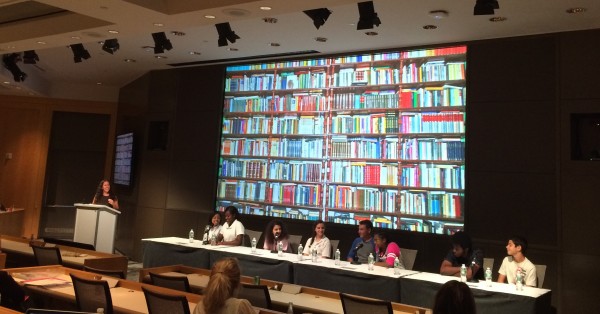
Stephanie Retblatt (left) moderates the all-teen panel “Suburban Teens on Reading, the Young Adult Label and More” at the Nielsen Children’s Book Summit in Manhattan. Photograph by Lauren Barack
Think twice about pushing a “young adult” book on teens—particularly if the title includes hashtags, text-speak, and other digital text language. So said a panel of eight New York–area students, ages 14 and up, who held forth with their thoughts on books, digital readers, and how they select their titles during a “Suburban Teens on Reading, the Young Adult Label and More,” a presentation at the Nielsen Children’s Book Summit in Manhattan on September 16. “It feels like you’re trying too hard,” says Xian, 17, a 12th grader from Jersey City, NJ, when asked if he liked reading books that use texting language to try and connect more to teens. That writing style, meant to mimic the tween and teen way of writing that some adults believe students prefer, was just one of the topics that Xian and his fellow panelists chatted about during the panel. Moderator Stephanie Retblatt, chief brainiac and head of research, at the consulting firm Smarty Pants, peppered students with questions to help attendees understand how—and why—this generation consumes books. Many of her questions probed the teen participants about their preferences for printed books versus ereaders, or vice versa. While some students noted that ebooks are cheaper and more convenient to buy and read, others strove to describe the feeling of reading from a physical page—an experience they clearly enjoy. “It feels like I’m reading a book,” said Jamie, 15, an 11th grader from Valley Stream, NY. “And an ebook feels like I’m on my phone.” Xian agreed. “[A physical book] feels like you’re allocating your time to something positive, or beneficial,” he said. How they select titles to read was also a conversation topic. Teens say they’re often influenced by books that have inspired movies and TV shows. Online reviews, on sites from Amazon to their local library’s web page, also help them make up their minds. Peers' reading choices can also be a big influence. “I usually read books my friends really like,” said Ivanka, 15, a 10th grader from Manhattan. “I don’t want to be disappointed.” When a story resonates with them, students tend to seek additional information about authors they like online, such as John Green and his wildly popular YouTube videos. Ivanka noted that teachers use Green’s videos in her class, “…because he talks really fast and gets a lot of information in a short video.” Alyssa, 14, a ninth grader from Belleville, NJ, added that she’ll sometimes look up writers online to get more background on their lives. As for that “young adult” tag, only one student raised a hand when asked if that was an accurate way to describe the books he read. Austin, 15, a 10th grader from Pearl River, NY,, noted that his favorite book was Gary Paulsen’s Hatchet (Bradbury Press, 1987), a book he knows is identified as “YA” fiction. Austin thinks of it as an adventure story instead. “[‘YA’] means books with characters trying to connect to you,” said Simiya, 14, a ninth grader from the Bronx. Retblatt then asked if the teens thought a “YA” description drew them toward books. The answer? A clear no.
Added To Cart
RELATED

RECOMMENDED
CAREERS
The job outlook in 2030: Librarians will be in demand
CAREERS
The job outlook in 2030: Librarians will be in demand
ALREADY A SUBSCRIBER? LOG IN
We are currently offering this content for free. Sign up now to activate your personal profile, where you can save articles for future viewing
ALREADY A SUBSCRIBER? LOG IN
Thank you for visiting.
We’ve noticed you are using a private browser. To continue, please log in or create an account.
Add Comment :-
Comment Policy:
Comment should not be empty !!!
Sabrina N
In my middle school library, I use YA label for mature content or sensitive subjects, and that is all. It's not whether the subject matter is about older teens. I just don't have a better label for these. Fiction can give you a nasty surprise sometimes if you don't have that notice of PG-13 or R, like the movies. Some 6th graders requested the notices last year, so I'm slowly combing through the collection.Posted : Oct 08, 2015 07:55
Debbie
It's a panel of only 8 teens.Posted : Sep 26, 2015 11:05
Jen Bojkov
I enjoy hearing the feedback from this panel of teens. I think it is useful to have insight from the very people we are trying to reach. We've never had any comments or complaints from teens about the YA term- but I do think it sometimes throws parents. I think they think that the books are somehow more "adult" and there fore the content is questionable. Thanks for the article!Posted : Sep 25, 2015 07:56
Nicole
I always thought the term YA just meant the characters were that age group. I don't think all those authors are "trying to connect." Look at Enders Game- an adult novel that has been repackaged and now targeting a younger audience mostly because the main character is a kid.Posted : Sep 25, 2015 11:15
Charissa
I wouldn't have thought "Hatchet" would be considered "YA" as in my local library it is in the juvenile fiction area. I wonder what an alternative category might be for YA. I always think of YA as books that are closer to adult books content wise. I am sure there is another category, just not sure what it is. I almost think that the younger kids might not like "juvenile" fiction more than a teen might not like "young adult" as a category.Posted : Sep 25, 2015 12:41