


2018 School Spending Survey Report
Book Publishing—from Executives to Reviewers—Is White and Female, Survey Finds
Nearly 80 percent of publishing and review journal staff is white, according to the 2015 “Diversity Baseline Survey.” The under-representation of African Americans in the book industry mirrors a trend among children's book authors, says survey creator Jason Low.
Nearly 80 percent of publishing and review journal staff is white, according to the 2015 “Diversity Baseline Survey,” which found that the book industry is also primarily female (78.2 percent).
Released today, the survey results, while not unexpected, add another dimension to the ongoing discussion about diversity in children’s books. Spearheaded by Jason Low, publisher of Lee & Low Books, the survey was sent to 11,713 publishing employees by 34 participating publishers, which included Penguin Random House, Hachette Book Group, and other major houses, according to today’s blog post on the Lee & Low site. The one-page questionnaire asked employees to anonymously provide their racial identity, gender, sexual orientation, and disability status. Eight publications, from Kirkus Reviews and Publishers Weekly to The Horn Book and School Library Journal, administered the survey to 1,524 review journal employees. Total survey results reflect a 25.8 percent response rate, Low reported in the post. Just under 80 percent of publishing staff and review journal staff self-identify as white, according to the survey, followed by Asians/Native Hawaiians/Pacific Islanders at 7.2 percent and Hispanics/Latinos/Mexicans (5.5 percent). Black/African Americans comprise 3.5 percent of publishing employees, and biracial/multiracial people, 2.7 percent, Native Americans, 0.5 percent, and Middle Easterners, 0.8 percent. "While all racial/ethnic minorities are underrepresented when compared to the general US population, the numbers show that some groups, such as Black/African Americans, are more severely underrepresented," writes Low. "This mirrors trends among children’s book authors. In 2014, just 2 percent of the books tracked by the Cooperative Children’s Book Center were by black authors. Latinos were similarly underrepresented in both places." The survey infographic is reproduced below with permission of Lee & Low. For a complete list of participating publishers and review journals, see "Behind the Scenes of Publishing’s First Diversity Baseline Survey."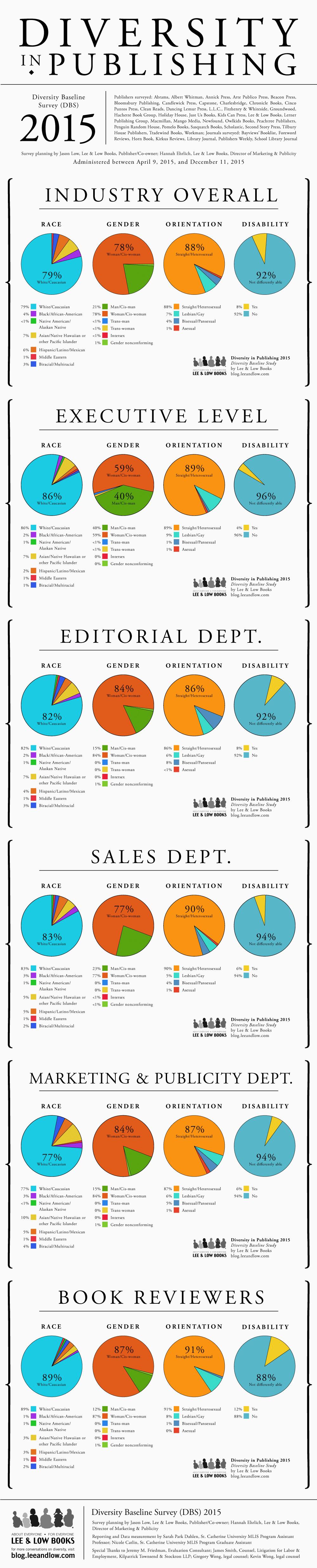

Added To Cart
RELATED


RECOMMENDED
CAREERS
The job outlook in 2030: Librarians will be in demand
CAREERS
The job outlook in 2030: Librarians will be in demand
ALREADY A SUBSCRIBER? LOG IN
We are currently offering this content for free. Sign up now to activate your personal profile, where you can save articles for future viewing
ALREADY A SUBSCRIBER? LOG IN
Thank you for visiting.
We’ve noticed you are using a private browser. To continue, please log in or create an account.
Add Comment :-
Comment Policy:
Comment should not be empty !!!
ChristieK
From the stats perspective, the number that jumps out to me is the low response rate, 25.8. This means the real data may be far more drastic than is represented here. What would the numbers look like with a 100% response rate and those non-reporting were of this majority? Even more dismal. But we all have a responsibility: Children need to have access to the broadest range of books and the way to make that happen within the publishing AND school/library setting.Posted : Jan 28, 2016 07:54
Wanda
I think it's easier to say 'why question it, let's just make good books' when your work statistically is the book that will land on bookshelves. It's harder to say that when you have grown up with little to no books that reflect you or your culture. It's important that children and all readers have access to diverse books that encompass who we are as a nation and as an ever changing society. 2% is not diversity and is simply not acceptable in 2016.Posted : Jan 28, 2016 06:14
Kathy
Why do we always have to worry about race, gender, orientation when lets just do a good job and enjoy it.!Posted : Jan 28, 2016 01:14