


2018 School Spending Survey Report
Pick of the Day: Eye to Eye
Large, colorful pictures of more than 20 animal eyes are accompanied by a small illustration of the entire creature and a brief paragraph of intriguing information.
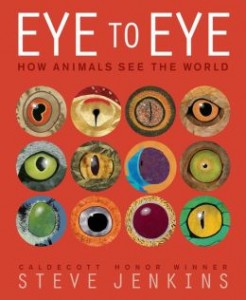
 Jenkins, Steve. Eye to Eye: How Animals See the World. illus. by Steve Jenkins. 32p. bibliog. diag. glossary. Houghton Harcourt. Apr. 2014. Tr $17.99. ISBN 9780547959078. Gr 3-6–The ability to perceive light and dark first developed in simple animals approximately 600 million years ago. Since that time, multiple variations of eyes have evolved from four main types: eyespot, pinhole, compound, and camera. Toward the end of the book, Jenkins devotes a page to describing the “evolution of the eye,” enabling readers to easily follow the changes. Jenkins’s outstanding torn- and cut-paper illustrations offer a fascinating look at these important organs, which range in size from the tiniest holes (starfish) to basketballs (colossal squid). Eyes not only allow animals to find food and avoid predators but can also assist in swallowing food and aid in attracting a mate. Large, colorful pictures of more than 20 animal eyes are accompanied by a small illustration of the entire creature and a brief paragraph of intriguing information (for example, as a halibut ages, one eye moves until both end up on the same side of its head, the panther chameleon can operate both eyes separately, and the hippopotamus has a clear membrane that enables it to see while underwater). Animal facts, a bibliography, and a glossary round out this slim volume that will captivate readers of all ages.–Maryann H. Owen, Children’s Literature Specialist, Mt. Pleasant, WI
Added To Cart
RELATED


RECOMMENDED
CAREERS
The job outlook in 2030: Librarians will be in demand
CAREERS
The job outlook in 2030: Librarians will be in demand
ALREADY A SUBSCRIBER? LOG IN
We are currently offering this content for free. Sign up now to activate your personal profile, where you can save articles for future viewing
ALREADY A SUBSCRIBER? LOG IN
Thank you for visiting.
We’ve noticed you are using a private browser. To continue, please log in or create an account.

Add Comment :-
Be the first reader to comment.
Comment Policy:
Comment should not be empty !!!