



2018 School Spending Survey Report
The Story of Owen
The Story of Owen: Dragon Slayer of Trondheim by E. K. Johnston Published by Carolrhoda Lab, March 2014 Reviewed from final copy You know we’re not going to get out of here without a Trogdor reference, right? I mean, that’s not in any way the point or even relevant, but it’s still burninating me up [...]
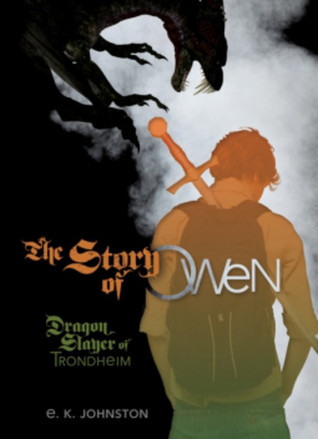
The Story of Owen: Dragon Slayer of Trondheim by E. K. Johnston
Published by Carolrhoda Lab, March 2014
Reviewed from final copy
You know we’re not going to get out of here without a Trogdor reference, right? I mean, that’s not in any way the point or even relevant, but it’s still burninating me up inside. Much like the countryside and all those peasants. Which doesn’t get us to the three stars, the three best of year lists (so far), or the placement on the Morris shortlist. The Story of Owen may not have thatched-roof cottages, but it is mostly full of fantastic fantasticness.
Top of the list for fantastic fantasticness is Siobhan’s voice: it’s wry and funny quirky without being annoyingly so. She is putting on a performance that rarely feels like a performance — which makes sense. Since this is a story that is all about storytelling and presentation, it makes sense that we would see her use her well-developed storytelling machinations, rather than just tell us she’s developing them.
Having such a strong narrative voice masks a few things, like a slow plot, a complicated world explained by infodumps, and the sometimes tricksy history that Johnston has created. The plot takes a while to get started (there’s a real dearth of dragon action for the first ⅓ of the book), but with Siobhan’s entertaining narration, we are treated to tons of asides, true to life moments (her awkwardness with Sadie is endlessly endearing), and the minutiae that make up high school (national anthems, tyrannical teachers, assigned seating). It also allows all kinds of foreshadowing for later events to come in to play without seeming forced.
Other great stuff: This is a genuinely funny story that also made me cry. The relationships that get set up are moving and emotionally powerful and so authentic. There’s cool action. There’s some subtle, solid diversity in the family structures. And the characterization, overall, is really strong: Owen and Siobhan, Lottie and Hannah, Aodhun — all interesting, engaging figures.
There are a couple of things that I’m still mulling over — in a good way, I think, in a way that is a testament to how complicated this story is, and how smart. I’m really intrigued by the public’s many perceptions of the dragon slayers. They inhabit such a gray space: they’re seen as superhero figures often; hard, brave, battle worn soldiers often; cold-hearted mercenaries often. Siobhan ties this to the story of Vlad the Impaler and that world’s version of Dracula, and seems to think that it’s Bram Stoker’s fault that people don’t trust dragon slayers entirely. Look, I’m going for this metaphor, hard; look at the way we support our troops but also feel ambiguous about being at war. But I wonder at the way Siobhan puts all of that on Dracula. In this world, people feel conflicted about dragon slayers because they do conflicting (and sometimes troubling) things; this is supported by the text. This is what Lottie and Aodhan, and others, want to change. Why point solely at Dracula, then? And then why be a Vlad the Impaler defender? (She equates the Eloise and Abelard story with the Dracula story, and then says that both stories are examples of dragon slayers who didn’t “do anything wrong.”) Is it just because Siobhan is young and needs a wider perspective?
This isn’t a perfect book, however. Siobhan’s acceptance of her situation at the end is a little too fast (though it did make me cry at the time, so points for emotional storytelling). And as far as the way dragon slayers do their fighting, I keep going back and forth. I get that precision is needed, but….swords and leather armor? Really?
There are also some threads that get lost in the narrative. Emily and Sadie are a little interchangeable (foils to Siobhan), and are both picked up and dropped at the whim of the plot. In the Eloise and Abelard chapter, there’s a quick mention that implies that Owen and Sadie are greatly affected by the changes Siobhan, Aodhan, Lottie, and Owen himself, are working for: “the same cannot be said of Owen and Sadie.” It’s just left there — in fact, it ends the chapter — and it feels like maybe there was more (or a different) Sadie subplot before. I’m sure there’s more to come, too, but just left hanging there like that, it feels like a dropped stitch. Generally, the whole concept of a bard feels undeveloped. It’s made clear that dragon slayers and bards don’t often work together any longer (thanks, Beatles!), but no one seems to even blink when Siobhan is introduced as Owen’s bard.
Speaking of having a bard — it’s a good thing that when the Thorskard family moves to Trondheim, a very small town, there’s a friendly young talented proto-bard who happens to get detention with Owen so that they can become friends. It’s pretty convenient that all works out — Lottie really seems to encourage their friendship, so were they always looking for a bard? Or were the Thorskards just delighted that one magically appeared? Since the Owen-Siobhan friendship does develop quite authentically, this series of coincidences are easy (for me) to forgive — but of course I don’t know how RealCommittee will feel.
Well, I don’t know how RealCommittee will feel at all, of course. If I were at the table, I’d be excited to talk about all the stuff I loved (and I did: I loved so much of this book). But I’d also be ready to hear any criticisms fellow committee members have to share (because when I so love a book, I want to defend and defend and defend without dealing with the bits that don’t quite work). What about you? Meet me in the comments; let’s talk.



RECOMMENDED
CAREERS
The job outlook in 2030: Librarians will be in demand
CAREERS
The job outlook in 2030: Librarians will be in demand
ALREADY A SUBSCRIBER? LOG IN
We are currently offering this content for free. Sign up now to activate your personal profile, where you can save articles for future viewing
ALREADY A SUBSCRIBER? LOG IN
Thank you for visiting.
We’ve noticed you are using a private browser. To continue, please log in or create an account.
Add Comment :-
Be the first reader to comment.
Comment Policy:
Comment should not be empty !!!