


2018 School Spending Survey Report
Tracking Tapirs with Sy Montgomery | Interview
Why are scientists interested in this elusive creature that looks like a cross between a hippo and an elephant? Sy Montgomery explains.
 When readers of nonfiction see the names Sy Montgomery and Nic Bishop on the cover of a book, they know they're in for an adventure. Together this author and photographer dream team has written about and photographed expeditions on the trail of snow leopards in Mongolia, tarantulas in French Guiana, and the kakapo in New Zealand. On a recent trip, the two traveled with Pati Medici to the Pantanal Wetlands in Brazil, described as "the Everglades on steroids," and home to tick swarms, pumas, wild pigs, giant amadillos, and the elusive tapir. Why are scientists interested in the tapir? The tapir is South America's largest land mammal, and it's what's known as a "keystone" species: an animal whose lifestyle profoundly affects the health of its ecosystem, which makes it important to all the other animals and plants who share its habitat. Tapirs love fruit and they transport the seeds in the fruits they’ve eaten far from the trees on which they grew. Pati calls the tapir “the gardener in the forest” because it “plants” (complete with fertilizer) the seeds that grow into trees upon whose fruit many other animals depend. So tapirs are integral to the rainforest ecosystem. Yet very little is known about them—including how best to protect them. The tapir looks almost prehistoric. Tell us about them. A tropical animal with a long, flexible snout (which it can use a snorkel when it swims) and a stout body, four hoofed toes on front feet and three on each in back, the tapir looks like a cross between a hippo, an elephant, and something prehistoric. But tapirs aren't related to elephants and hippos. Because of their flexible snouts, some people think they're anteaters, but they're not; their closest relatives are rhinos and horses. But the tapir is prehistoric; it has remained unchanged since the Pliocene, more than four million years ago, when mastodons and giant ground sloths roamed North America, and the first humans had not yet evolved in Africa. Tapirs lived all over Europe, Asia, and the Americas then. Now they’re found only in South America and Southeast Asia. Your trip brought you to the Pantanal wetlands in Brazil, a place that has been described as “South America’s Serengeti” and “the Everglades on steroids.” What challenges did that environment present? One challenge was all that water. This is the world's largest wetland, and so many areas are difficult to reach because in the wet season, they are flooded. It also presents a danger to a tapir if you dart one outside a trap. Tapirs often flee to water, and this can be very dangerous for the tapir if it rushes into water for safety and then collapses from the tranquilizer. Another was the heat—especially when we had a tapir in a trap. Normally they would be in the shade of the forest or the cool of the water by mid-day; we were eager to get them out of the traps as soon as possible anyway, but after early morning, we were especially worried that hot temperatures would add to the stress. And for us, the ticks were a nuisance—they were thick as flocking on our pants, and their bites were itchy! What sort of team must be assembled for this sort of mission? Our team was headed by Brazilian scientist Patricia Medici and included her Brazilian field assistant, a Brazilian-American darting specialist, a French zoo veterinarian, a Brazilian specialist in animal diseases and parasites—plus photographer Nic Bishop from New Zealand and me from New Hampshire in the States. What modern technology did the team use to track the animals? We followed the tapirs with radio telemetry and tracked them with collars transmitting GPS information to orbiting satellites. We searched on foot, by car, and with motion-sensing remote cameras. And we (and off site, some of Pati's other colleagues) used microscopes, PCR, powerful computers and other lab equipment to look at their blood, classify their ticks, and analyze their genetics. Once a tapir is captured, what happens next? We would dart the animal to tranquilize it, so it wouldn't be frightened while we examined it and affixed a radio collar to its neck. It was thrilling to be so close to a tapir, we could touch it. But we had to work fast. You don't want to use too much tranquilizing drug—but you don't want your 400-pound tapir to wake up in the middle of an exam, either! You noted in the book that one of the scientists’ goals was to find out how much roaming space tapirs need to survive. What did they discover? What other information do they hope to learn as they continue to study these animals? Pati hasn't crunched her data yet, as she is hoping to get more tapirs and more years of information before she analyzes it all for a large sample size. But it's known that often animals of the same species have different space requirements in different habitats. Tigers, for instance, in the cold Russian far east may need 10 times the space that tigers in the tropics might use. As Pati points out, tapirs live in lots of very different kinds of places—from high mountains to the Amazon. Tapirs live in five different types of habitat just in Brazil alone. So it's necessary to study them in each of these habitats to see what their needs are. Was this a successful trip? Pati said she thought this was the most successful of her research expeditions yet! Before Pati and her team left the field, they had captured and collared three new tapirs and microchipped another; recaptured three old friends; collected tapir poop, skin, hair, and blood; and located other tapirs with sightings, camera traps, and telemetry. It was just fantastic to be part of it! How did it compare to some of your other trips to learn about animals: snow leopards in Mongolia, the tree kangaroo in New Guinea, the kakapo in New Zealand? Each trip has different challenges and delights. The snow leopard work in the Altai Mountains of the Gobi demanded hours of difficult, high-altitude hiking on rocky scree—and as result we got incredible views of this stark and gorgeous landscape. To even get to the area where we'd look for tree kangaroos in the cloud forest of Papua New Guinea, we had to hike to 10,000 feet on slippery mud for three days, bringing with us everything we'd need, including tents and scientific equipment, for two weeks. We didn't camp in Brazil for the tapir book—we stayed in a comfortable fazenda on a cattle ranch, with beds and showers. But it was a very dramatic book. At first it seemed our dart guns and anesthetic wouldn't work. We were capturing tapirs but couldn't collar them. What was going wrong? That was part of the scientific challenge of field work, and figuring out the problems was something Pati's team did beautifully.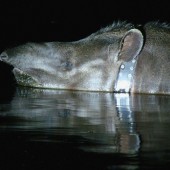
Sy Montgomery, the tapir. From 'The Tapir Scientist' (Montgomery) Houghton Mifflin.
Any comment about the two recently named tapirs traipsing about the Pantanel: Nic Bishop and Sy Montgomery? Both tapirs have been spotted repeatedly since they were collared, and Sy Montgomery has been seen with her new baby. I understand you just returned from scuba diving in the Pacific with octopuses. Is another book in the works? Indeed! The next book to appear will be Chasing Cheetahs, which Nic and I researched in Namibia together last summer at the Cheetah Conservation Fund's African headquarters. In the South Pacific I was researching a book on octopus, working with underwater photographer Keith Ellenbogen to record how a team of researchers from Canada, Alaska, and Brazil are figuring out how octopuses' personalities affect their food choices. No kidding—one of the things the team did was give each octopus we found a personality test! I learned to scuba dive for that book, even though we ended up finding most of our octopuses in very shallow water in which we could snorkel—but I plan to use my scuba skills to work with Keith on a book on great white sharks after that. The Tapir Scientist by Sy Montgomery, Illustrated by Nic Bishop (Houghton Mifflin Harcourt, 2013; Gr 4-8.) Sy Montgomery reveals her passion for animals in this mini-documentary, courtesy of TeachingBooks.net
Added To Cart
RELATED


RECOMMENDED
CAREERS
The job outlook in 2030: Librarians will be in demand
CAREERS
The job outlook in 2030: Librarians will be in demand
ALREADY A SUBSCRIBER? LOG IN
We are currently offering this content for free. Sign up now to activate your personal profile, where you can save articles for future viewing
ALREADY A SUBSCRIBER? LOG IN
Thank you for visiting.
We’ve noticed you are using a private browser. To continue, please log in or create an account.

Add Comment :-
Be the first reader to comment.
Comment Policy:
Comment should not be empty !!!