


2018 School Spending Survey Report
Torben Kuhlmann's 'Lindbergh' Soars as an iBook
Torben Kuhlmann’s picture book, Lindbergh, the Tale of a Flying Mouse was published last year to glowing reviews. The recent release of the iBook version, with visual and audio enhancements, offers more to praise.
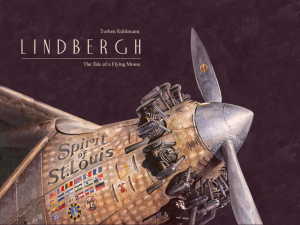 Torben Kuhlmann’s picture book Lindbergh, The Tale of a Flying Mouse (NorthSouth, 2014; Gr 2-5) was published last year to glowing reviews. Through gorgeous, detail-rich sepia art and a minimal text, the author tells the story of a diminutive animal, who, after discovering what’s decimating the population of his homeland, builds a flying contraption and makes his way to the United States. Kuhlmann’s expressive text and dark images featuring dizzying perspectives heighten the story’s tension, but readers soon learn that neither mechanical setbacks nor predators can stop this courageous creature. Recently, the story was released as an animated iBook (Verlag Friedrich Oetinger GmbH; $3.99). We spoke with Kuhlmann about the iBook's creation and how the enhanced version differs from the print edition. DG: I understand the print version of Lindbergh has been translated into a number of languages and you’ve been traveling around the world speaking to schoolchildren about it. What do they share with you about their experience with the story? TK: It was really great to visit so many different countries with my book. I’ve been to the United States, Russia, South Korea, and Japan, reading the story and conducting workshops. Children everywhere have reacted similarly to the adventurous flying mouse. They drew inspiration from this story. I’ve met many kids who became little inventors themselves, imagining fantastic contraptions for flying animals, or became interested in the history of aviation, or felt emboldened by the message that even the smallest among us could achieve the great things. With its sepia pages, sketches of contraptions, and a fascination with mechanics, this mouse could also have been named Leonardo after da Vinci. It’s clear you have a great interest in mechanics and reading—books, newspapers, and words are also everywhere in the illustrations. Leonardo da Vinci’s inventions were an undeniable influence throughout the book. You can even find a portrait of him hidden in one illustration and there are several references to his famous sketches—from his drawings of a mechanical wing to his ideas of a primitive helicopter. But the whole book was designed with nods to many famous inventors and pioneers of aviation in mind. Their achievements are very inspirational—as is their courage and daring. Another theme is knowledge—represented by the many books that the mouse reads during its adventure. I also used books, newspapers, and other elements to create an authentic depiction of a world one century ago.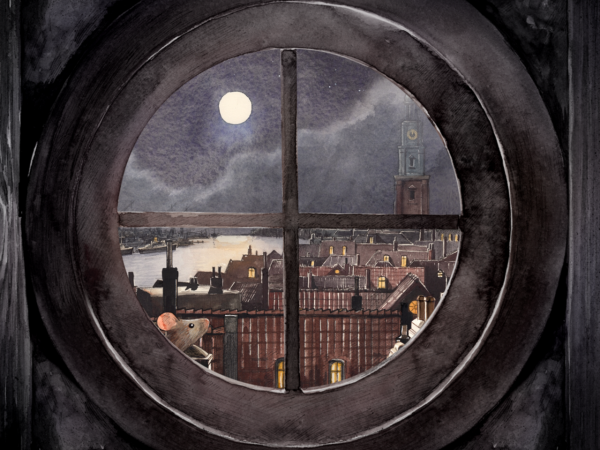
Interior screen from Lindbergh, the Tale of a Flying Mouse (Verlag Friedrich Oetinger GmbH) ©Kuhlmann
How did the idea of creating an iBook come about? Was it your first venture in animation? The idea to develop an iBook came shortly after the printed version was finished. My Switzerland publisher NordSüd has a close relationship with German publishing group Oetinger, a pioneer in interactive books for children here in Germany. So, soon after the printed version of Lindbergh was on the market, we began brainstorming. And there was the lucky fact that I had made a trailer for Lindbergh. The animated sequences I created for the trailer became the basis of our work—similar animations and a similar tone are found in the iBook. I really enjoy doing little animations and films using my own illustrations, so adapting Lindbergh into an animation-heavy interactive adventure wasn’t a big leap. Were there challenges to creating an animated version? What sort of team did you assemble? There were some challenges. It’s a massive project—a 96-page children’s book adapted into an animation-heavy iBook. One concern was the size of the final file. But there was a very inspired and diligent small team of animators and graphic artists working on the project. They adapted the feel of the original story and consulted me whenever there were questions. The iBook’s sound effects and animation both add to the story’s tension. Were there enhancements you wished to add but could not? I'm very happy with the final product. Of course, you can always imagine more. Adding all the little parts such as sounds, animations, and interactive elements, you almost have to restrain yourself—and not only because of the amount of data. I could have imagined more camera movements, and music, but that would have turned the book into slideshow/movie mixture with less interactivity.
Interior screen from Lindbergh, the Tale of a Flying Mouse (Verlag Friedrich Oetinger GmbH) ©Kuhlmann
How do you balance enhancements and story progression? When and how do enhancements work best? What goes into your decision about where and how to enhance a page, and the overall story arc? Enhancements and animations should be in service of the narrative. They should not be a gimmick glued on top of the story. Many illustrations in the book where conceived like scenes from a film—blocking, camera perspective, lighting—so there was almost always a sense of motion present in the illustrations. By adapting the book into an interactive format, we unleashed this sense of motion. On the other hand, I tried to put many details and references into the illustrations, that can be discovered by conscientious readers and now this act of discovery is even more prominent. You click here and discover that, or you push there and something appears…. Adding a few sounds to an illustration is also almost always a big attribute to the atmosphere and likewise to the narrative: eerie owl calls, howling winds, or rain. Has the reaction to the iBook differed from that of the print book? There is a slightly different reaction to the iBook, but it boils down to the same observation. When I do readings of the book, children are drawn into the story page by page. At the beginning, they pay attention to other parts, details and surroundings, but they become more and more engaged with the small protagonist as the story progresses. It’s the same with the interactive version. First, they push and click everything, but as soon as the story begins to unfold, they follow the little mouse and use the interactive elements more selectively. Do you see the iBook as an adjunct to your print book, or as a separate entity? Do you have a preference to which version children experience first? I think the printed version and the iBook can exist quite harmoniously next to each other. That was indeed one of my goals for the adaption. It’s not just a digital version of the printed book. Actually, there are some different illustrations in the iBook. Each version has its distinct character. For me, I love to have a printed, old-fashioned book on my shelf. And Lindbergh was conceived as a traditional book first, so I would always go with the print version. But I am really happy to have this wonderful, innovative, and enhancing digital version as well! Your next picture book, Moletown (NorthSouth, Oct., 2015), a wordless book with an ecological message, will be published in the fall. Any discussion yet about creating an iBook or app for that title? Oh yes, I’m sure that this subterranean tale will see an iBook or app version. Again, there is a lot that can be enhanced, expanded, or animated!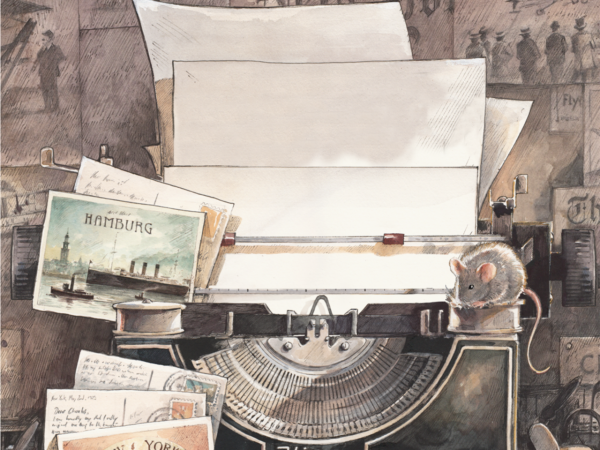
Interior screen from Lindbergh, the Tale of a Flying Mouse (Verlag Friedrich Oetinger GmbH) ©Kuhlmann

Added To Cart
RELATED


RECOMMENDED
CAREERS
The job outlook in 2030: Librarians will be in demand
CAREERS
The job outlook in 2030: Librarians will be in demand
ALREADY A SUBSCRIBER? LOG IN
We are currently offering this content for free. Sign up now to activate your personal profile, where you can save articles for future viewing
ALREADY A SUBSCRIBER? LOG IN
Thank you for visiting.
We’ve noticed you are using a private browser. To continue, please log in or create an account.

Add Comment :-
Be the first reader to comment.
Comment Policy:
Comment should not be empty !!!