


2018 School Spending Survey Report
The Year of Mathical Thinking: A new award celebrates excellent math titles
This past spring an award worthy of your attention was announced: Mathical Books for Kids from Tots to Teens. The prize, which honors exceptional books, evolved from an alliance between Mathematical Sciences Research Institute (MSRI), and the Children’s Book Council (CBC).
Which subject area receives the least amount of attention in your library? The section that isn’t considered as appealing or as much fun as the others—but just may be as attractive and exciting? I bet I know: math books. If math titles are your ugly duckling, I have a solution—a way to free those titles that are as fresh and as interesting and as alive as the latest sports result—to flock with the other swans. This past spring an award worthy of your attention was announced: Mathical Books for Kids from Tots to Teens.
A bit of background: the prize evolved from an alliance between Mathematical Sciences Research Institute (MSRI), a nonprofit that focuses on mathematical research and works to deepen appreciation of mathematics across all age levels, and the Children’s Book Council (CBC). The CBC works with other organizations, such as the National Council of Social Studies and the National Science Teachers Association, to produce annual lists of “notable” trade books in those fields. But Mathical is different. As David Eisenbud, director of MSRI, explained, the organization wanted to select and honor exceptional individual books, which makes the award sound to me more like American Library Association’s (ALA) celebrated youth award winners rather than a long list of titles.
The name Mathical was chosen to imbue math with a sense of the magical, or mythical—an aura of wonder and inspiration—and Eisenbud hopes that the prize will help K-12 readers appreciate the “charm and reach” of mathematics. Thus, MSRI is open to all books in which math plays a role. Nonfiction, of course, but also adventure stories, picture books that take an imaginative and original approach to the topic, applications of math to real-life situations and concerns, and more.
To facilitate this wide-ranging mandate, the organizers have crafted an impressive, and unusual, set of judges. There are math professors—including Jordan Ellenberg, of the University of Wisconsin and author of the wonderful How Not to Be Wrong (Penguin, 2014), who was struck by the “variety and multiplicity” of approaches in the books—but also librarian and SLJ blogger Betsy Bird; and author and former children’s book ambassador Jon Scieszka, who, along with some middle and high school math teachers, rounded out the panel. Each book had many readers, and indeed, some judges actively sought comments from young readers. The judges then met—physically and digitally—to share perspectives. Out of this discussion came the first list of winners and honor titles—and one very special addition.
The Mathical folks are aware that in honoring math books they have a lot of catch-up to do and have added a “Hall of Fame” category. This category recognizes a great book published long before the prize existed. The first inductees in the the Hall of Fame were, of course:
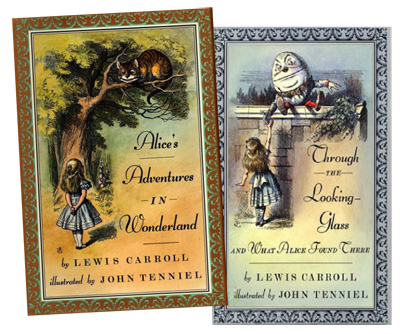
Alice’s Adventures in Wonderland and Through the Looking-Glass, and What Alice Found There by Lewis Carroll.
The next round of books, the 2015 candidates as well as the second Hall of Fame selection, will be announced at a propitious time in the coming year. For authors or publishers interested in submitting books for consideration, a set of guidelines is available from mathicalbooks.org/guidelines-2/.
So, take flight with your math books. It’s time.
 The Mathical prize winners, published in 2014
Pre-K
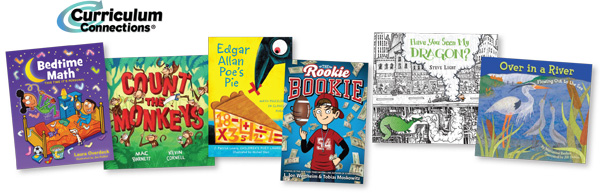
Have You Seen My Dragon? by Steve Light. illus. by author. Candlewick.Grades K-2
One Big Pair of Underwear by Laura Gehl. illus. by Tom Lichtenheld. S.&S./Beach Lane.Grades 3-5 and Grades 6-8:
Really Big Numbers by Richard Evan Schwartz. American Mathmatical Society.Grades 9-12
Nearly Gone by Elle Cosimano. Kathy Dawson Bks./Penguin Group.
The Mathical Honor books (published 2009–2014)
Pre-K
Count the Monkeys by Mac Barnett. illus. by Kevin Cornell. Disney-Hyperion. 2013. Over in a River: Flowing Out to the Sea by Marianne Berkes. illus. by Jill Dubin. Dawn Publications. 2013.
Grades K-2
Zero the Hero by Joan Holub. illus. by Tom Lichtenheld. Holt. 2012.
Grades 3-5
Bedtime Math: This Time It’s Personal by Laura Overdeck. illus. by Jim Paillot. Feiwel & Friends. 2014. Blockhead: The Life of Fibonacci by Joseph D’Agnese. illus. by John O’Brien. Holt. 2010. Edgar Allan Poe’s Pie: Math Puzzlers in Classic Poems by J. Patrick Lewis. illus. by Michael Slack. HMH. 2012. Numbed! by David Lubar. Lerner/Millbrook Pr. 2014. The Rookie Bookie by L. Jon Wertheim and Tobias Moskowitz. Little, Brown. 2014.Grades 6-8
Mathemagic! Number Tricks by Lynda Colgan. illus. by Jane Kurisu. Kids Can Pr. 2011. The Ice Castle: An Adventure in Music by Pendred Noyce. illus. by Joan Charles. Mighty Media. 2012.Grades 9-12
The Unknowns by Benedict Carey. Abrams/Amulet. 2009. What Is Relativity?: An Intuitive Introduction to Einstein’s Ideas, and Why They Matter by Jeffrey Bennett. Columbia University Pr. 2014.
Added To Cart
RELATED


RECOMMENDED
CAREERS
The job outlook in 2030: Librarians will be in demand
CAREERS
The job outlook in 2030: Librarians will be in demand
ALREADY A SUBSCRIBER? LOG IN
We are currently offering this content for free. Sign up now to activate your personal profile, where you can save articles for future viewing
ALREADY A SUBSCRIBER? LOG IN
Thank you for visiting.
We’ve noticed you are using a private browser. To continue, please log in or create an account.

Add Comment :-
Be the first reader to comment.
Comment Policy:
Comment should not be empty !!!