


2018 School Spending Survey Report
Spotlight On Ecosystems | Terrestrial Biomes & Their Denizens
When we think of the major terrestrial biomes—desert, grassland, forest, tundra—we envision dramatically different climates, flora, and fauna. If only it were so simple!
 In the seemingly lifeless sand waves and deep crevices of a blistering desert, frogs burrow into the clay, moles bulldoze through the sand, and a host of other creatures hunt, eat, and thrive. Author and illustrator Narelle Oliver’s authentic, orange-and-brown earth-tone illustrations in Sand Swimmers: The Secret Life of Australia’s Desert Wilderness (Candlewick, 2015; Gr 2-5) depict life above and below ground, where creatures such as lizards and marsupials work in the cool of the night. Equating the landscape imagery to a rippled expanse like the ocean, Oliver relates the feelings she had upon visiting this barren, but breathtaking, area. In a parallel narrative, she offers historical perspective in the form of clever sketches and maps, describing early European explorers forging through a terrain that was hazardous enough to break a horse’s leg and so hot that hair ceased to grow. This title is a standout for offering two perspectives on each page, revealing the paradox of nature and highlighting humankind’s misconceptions about the environment.
  Upper elementary and middle readers will find the beautiful photography and maps and fact boxes in Molly Alojan’s The Mojave Desert (Crabtree, 2012; Gr 3-7) appealing for inquiry projects. Though relatively small, this desert located in the Southwestern United States is typical of many deserts in its climate, geographic features, and the amazing adaptations of its plants and animals (most notably here, the yucca, Joshua Tree, gecko, burrowing owl, chuckwalla lizard, desert bighorn). Equal attention is given to the human factor, starting with a history of indigenous peoples such as Paiute, Cahuilla, and namesake Mojave who succeeded growing corn, beans, and pumpkins using desert springs for water. A discussion of the degradation of this desert, that includes Las Vegas in its borders, touches on urbanization, water depletion, and off-road vehicles. Readers are exposed to the dilemma of balancing the Mohave as a tourist destination, recreational area, and mining resource, with a conservation ethic. Other volumes in the “Deserts Around the World” series by Alojan include: Gobi, Kalahari, and Sahara. Great Victoria and Atacama were authored by Lynn Peppa.
  Desert animals and their habitat are introduced to a much younger audience in Darcy Pattison’s Desert Baths (Sylvan Dell, 2012; PreS-Gr 2). Pattison’s premise is that desert animals stay clean, quite nicely, with little water—including the gecko whose long tongue moistens its own eyeballs, the snake that sheds its dusty skin, and the javelina (a wild pig) that bathes in mud at night. Desert Bath’s illustrator, Kathleen Rietz, uses bold earth tones for realistic paintings of a dozen animals (roadrunner, bobcat, mule deer, desert tortoise, and more) in their desert landscapes at various times of day and night, and frames them in a decorative nature pattern. The book, which would work as a read aloud choice, contains several appended pages of matching games, fun facts, bath themed true-false questions, and an activity that asks students to guess time of day from clues in the illustrations. Another Pattison and Rietz collaboration yielded the similarly themed Prairie Storms (Sylvan Dell, 2011; K-4), arranged by the changing seasons, and with slightly more narrative for older readers.
 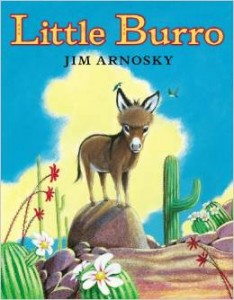 Awarded by the American Association for the Advancement of Science (AAAS) for his lifetime contribution to science, Jim Arnosky is a noted nature book author and illustrator (Every Autumn Comes the Bear, Sketching Outdoors in Spring). In the charming story Little Burro (Putnam, 2013; PreS-Gr 1), a wild burro baby makes her first trip across the hot desert canyon to swim in a lake. She follows her mother tentatively on the steep trails and rocky terrain, not knowing where she is going, but is enthralled by her first water experience and happily returns home to eat twigs and water-filled cactus plants. In an author’s note, Arnosky comments he was inspired by a group of wild burros he observed at an Arizona lake. The authentic depiction makes for a good introduction to desert habitat, as well as a satisfying read aloud of a creature not afraid to try new things. Aronsky’s illustrations, in blues, pinks, and muted canyon colors, have a timeless quality. The little burro is drawn realistically—but adorably—and children will be instantly drawn in to the account of her special day.
 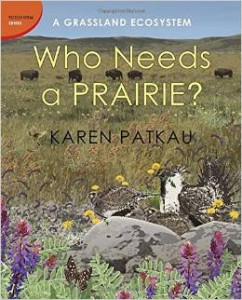 Much of the world’s food is grown on grassland, and the importance of protecting this ecosystem is highlighted in Karen Patkau’s Who Needs a Prairie? (Tundra, 2014; Gr 1-3). The book jacket is a call-to-action and inside, the message is relayed in flowing, lyrical text and artistically painted landscapes. Author/illustrator Patkau renders the temperate prairie seasons accurately, as well as emotionally, such as deer foraging in a blizzard, creatures fleeing a grass fire, and a meadowlark singing after a rain. A few diagrams explain concepts such as a food chain, or how sod’s unique denseness protects against frost or fire. A world map of prairies shows readers where other grasslands exist, but the book's focus is clearly the Great Plains. A glossary, and more detailed information about prairie plants and animals, is appended. Other ecosystems in the series include: Who Needs a Desert?, Who Needs an Iceberg?, Who Needs a Jungle?, Who Needs a Reef?, and Who Needs a Swamp?—all great to read-aloud choices for content vocabulary and text-to-picture connections.
 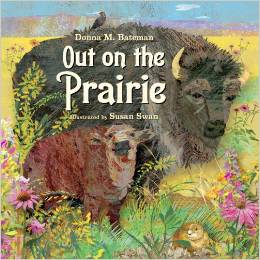 “Out on the prairie where the snakeroot greets the sun/Lived a shaggy mother bison and her little calf One/ ‘Wallow!’ said the mother. ‘I wallow,’ said the One/So they wallowed in the dust where the snakeroot greets the sun.” The rhymes introduce youngest readers to plants and animals of the Badlands National Park. Donna M. Bateman’s Out on the Prairie (Charlesbridge, 2012; PreS-Gr 1) also features frogs jumping through clover, grouse chasing beetles, grasshoppers hopping through the grama grass, as their numbers increase one-by-one to ten. Susan Swan’s cut paper and mixed media illustrations are lively, capturing the natural textures of a dusty bison, wispy grasses, coarse-coated coyotes, and the like. The movement of animals matches the action of the text, and the double-paged scenes are filled with sensory details. Extras include a more detailed description of the South Dakota badlands and species of plants and animals referred to in the rhymes.
 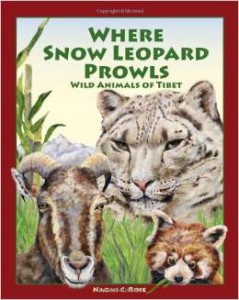 In the highest expanse of elevated land, the Tibetan Plateau, plants and animals have adapted physically to very cold and harsh conditions. Focusing mainly on large animals, Naomi C. Rose’s Where Snow Leopard Prowls: Wild Animals of Tibet (Dancing Dakini, 2013; Gr 2-5) features research-friendly information on Red Pandas, Chirus, Wild Yaks, and more. Most striking are the illustrations of boldly colored animals against an uncluttered tan background, for close-up examination. “Did You Know?” sidebars relate facts related to the frigid environment, such as the thick hairy paws of the Snow Leopard keep it from sinking in snow. Intended for elementary researchers, the narrative is chunked in three or four paragraphs and appended activity suggestions include creating yak masks, in the Tibetan tradition, to promote harmony with nature. While lacking detailed how-to instructions, many of the ideas promote human respect for nature, and suggested books and web sites underscore conservation.
 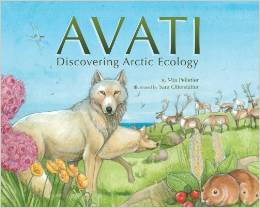 Avati, the Inukitut word for environment, covers an expansive area in the far North where the Inuit have lived for thousands of years. In Avati: Discovering Arctic Ecology (Inhabit Media, 2012; Gr 2-4), Mia Pelletier dispels the notion of a cold and barren landscape and invites readers to explore the Arctic’s seasons and its numerous thriving habitats such as floe edges, ocean cliffs, and tundra. Her conversational narrative includes detailed scene descriptions and sensory information, such as the “Prreep! Prreep!” of the sandpiper and “BzzzzZZZZZZ” of mosquitos. The book’s landscape format accommodates the double-page illustrations by Sara Otterstätter, where all possible inhabitants (flora and fauna) share one scene, including some above- and below-ground depictions. A glossary underscores important vocabulary. The value in this title lies in its point-of-view, a reminder that this biome is, and was, vital and life sustaining for the Inuit, who have maintained a strong relationship to their environment. The book would be a good read-aloud introduction to tundra or Inuit habitat.
 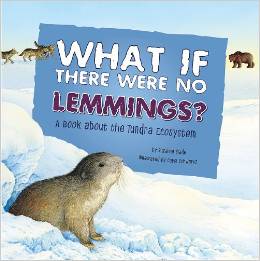 Environmentally conscious students can learn what would happen to the balance of wildlife in the tundra if just one animal became extinct in What if There Were No Lemmings?: A Book about the Tundra Ecosystem (Picture Window, 2011; Gr 2-4). Author Suzanne Slade describes lemmings as a “keystone species” that are a main source of food for owls, ermines, and other creatures that eat meat. Carol Schwartz’s double-paged illustrations show the affected species in solid black, alongside colorful images of those that might survive for a time. As pages turn, the tundra landscape depicts black shapes for the wolves, foxes, hares, and voles. The suggestion of the species impacted is powerful and can jumpstart discussions about the interdependence of animals and plants.Additional visuals to support the concept include a food web diagram, a world map of the lemming population, and reassurance that their numbers are thriving. Tundra animals potentially at risk appear in the back with a glossary, book, and web site resources. Students can also address the question of keystone species through other titles in the series including: What If There Were No Bees? A Book About the Grassland Ecosystem; What If There Were No Gray Wolves? A Book About the Temperate Forest Ecosystem; What If There Were No Sea Otters? A Book About the Ocean Ecosystem.
 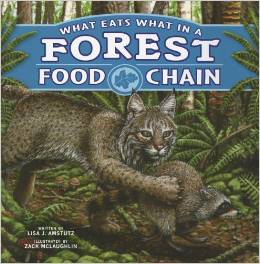 While the concept of a food chain is the main focus of Slade’s Lemmings, it relates many aspects of the ecosystem’s relationship between habitat and its denizens. In Lisa J. Amstutz’s What Eats What In a Forest Food Chain (Picture Window, 2013; K-Gr 2), the sun shines on the oak tree, the trees drop acorns, a weevil eats the seeds, a mouse eats the weevil, and so on. In the book’s clearly written text each animal is identified as a producer, consumer, scavenger, and omnivore. Rich greens and browns of the forest characterize Zack McLaughlin’s illustrations, and his detailed acrylic paintings provide crucial context for the habitat for such animals as snake, bird, coyote, vulture, and their prey. Decomposers such as worms and bacteria are shown breaking down the dead animals (not too gruesome) as the soil becomes enriched and the cycle continues. A glossary, index, web sites, and further reading aid inquiry. Other titles in the “What Eats What” series include: Suzanne Slade and Zach McLaughlin's What Eats What In an Ocean Food Chain? and What Eats What In a Desert Food Chain? and Suzanne Slade and Anne Wertheimand's What Eats What In a Rain Forest Food Chain?
 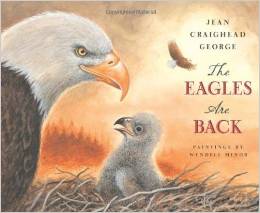 Noted nature writer Jean Craighead George (Julie of the Wolves; My Side of the Mountain) tells a story about a boy who helps a forest ranger monitor two eagle eggs in the 1950s in an effort to encourage nesting and reverse the near extinction of these birds due to hunting and DDT. The Eagles are Back (Dial, 2013; Gr 1-4) ends with the boy, now grown, returning with his son to watch the eagles soar. Bringing to light humankind’s obligation and concerted efforts to protect habitats is a theme throughout George’s body of work. Wendell Minor’s illustrations display an authenticity achieved from his visits to Yellowstone Park and the earthy, voluminous plein-air watercolor paintings and make this a standout. The author and illustrator work can also be experienced in their The Wolves are Back (Dutton, 2008; Gr 1-5), and The Buffalo are Back (Dutton, 2010; Gr 1-5). The titles encourage observation and participation, elements touted in new science standards to help engage students’ environmental problem solving sensibilities.
 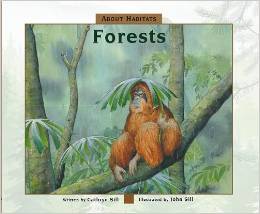 Another team that has collaborated on a number of books offers a concept book about forests for beginning readers. Catherine Sill’s simple text on a plain white page allows readers to soak in John Sill’s realistic watercolor paintings opposite, in About Habitats: Forests (Peachtree, 2013; PreS-Gr 2). The color plates are a stunning variety of colors and scenes of a boreal, tropical, conifer, or deciduous forest (and more) and one or more of its animal or bird denizens. Spare one-sentence descriptions accompany the illustrations, but further facts appear in an afterward, nicely formatted alongside a thumbnail of the illustration. This extra information adds relevant details about temperature ranges, the role of plants, and concerns about endangered species. Additional teacher resources include a glossary, bibliography, and web sites. Ideal use might include a picture walk through the forest, as a concept introduction, allowing students to make inferences from the illustrations. Also in the “About Habitats” series: About Habitats: Deserts; About Habitats: Grasslands; About Habitats: Mountains; About Habitats: Wetlands; and About Habitats: Oceans. “Over in the forest/Where the clean waters run/Lived a busy mother beaver/And her little kit one.” Young children love rhymes and Marianne Berkes’s Over in the Forest: Come and Take a Peek (Dawn, 2012; PreS–Gr 2) is interactive way to learn about forest animals, their tracks, and their babies, while they count them up. The engaging verse describes the lives of 10 creatures and the proper terminology for offspring such as possum joeys, turkey poults, or turtle hatchlings, and can be sung to the tune of, “Over in the Meadow,” (musical notes found in the back of the book). Other appended information points out that, despite mostly factual, the numbers of babies typically born don’t necessarily match the text depictions. Appealing cut paper illustrations by Jill Dubin, in browns and greens, also contain fun-to-find hidden animals on each page, as well as drawings of true-to-size animal tracks. Lists of hands-on and indoor learning activities, web sites, and related books will be especially valuable to teachers.
 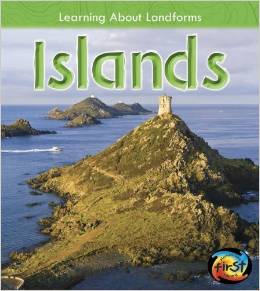 Beginning readers can be independent researchers using Ellen Labrecque’s Islands (Heinemann, 2014; Gr 1-3). Arial color photos differentiate tidal islands from barrier, coral, and others, and labeled world maps show where they are typically found. Sections devoted to sample plants, animals, and people (such as Polynesians) that inhabit particular islands, flesh out the big picture about indigenous peoples, their culture, and how exploration played a role in settlement. Large read-alone font and terms in bold, such as “mainland” and “sandbar,” are defined in a glossary, though many context clues are provided for young readers. The fresh and vivid photography makes this a first grab for students’ interest, but more importantly, what scientists are currently studying about islands, such as rising sea level and tsunamis, covered briefly in concluding pages, serves as a key reminder about the vulnerability of this terrestrial biome. Also in the “Learning About Landforms” series by Leabreque: Caves and Valleys, and by Chrris Oxlade, Volcanoes and Mountains .
 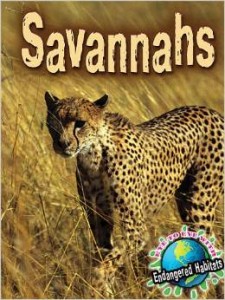 A minimal text in large font is coupled with gorgeous full-page photographs of the grassland ecosystem known as the savannah. Precious McKenzie’s Savannahs (Rourke, 2011; Gr 2-5), is a slim volume noting the basic characteristics of African, Australian, and South American savannahs, and a few of their plants and animals. Close-up photos of kangaroos allow visual learners to zone in on details, such as a thumb-sucking joey in one’s pouch and a meerkat’s razor-sharp claws. Two pages are devoted to environmental concerns, such as overgrazing, expanding human population, and poaching. Suggested solutions are the establishment of national parks, and promoting ecotourism. A glossary, web sites, and index will help elementary or lower-ability middle grade learners. Despite the copyright date, the information is timely. The “Eye to Eye With Endangered Habitats” series also includes Rainforests; Glaciers; Oceans; and Coral Reefs.
 Eds. note: Classrooms and libraries with iPads should consider two related apps appropriate for elementary students, Plants (Tinybop; K-Gr 5) and The Prairie that Nature Built (Dawn; PreS-Gr 3). The first explores three biomes: deciduous forest, temperate grassland, and arid desert. The second is based on Marybeth Lorbiecki’s the book of the same title (2014). Both explore their respective biomes through texts that examine the interconnections of plants, animals, and landscape; detailed illustrations; and multiple interactive opportunities. For more about these two apps, follow the links provided.

Added To Cart
RELATED


RECOMMENDED
CAREERS
The job outlook in 2030: Librarians will be in demand
CAREERS
The job outlook in 2030: Librarians will be in demand
ALREADY A SUBSCRIBER? LOG IN
We are currently offering this content for free. Sign up now to activate your personal profile, where you can save articles for future viewing
ALREADY A SUBSCRIBER? LOG IN
Thank you for visiting.
We’ve noticed you are using a private browser. To continue, please log in or create an account.

Add Comment :-
Be the first reader to comment.
Comment Policy:
Comment should not be empty !!!