


2018 School Spending Survey Report
Read Like a Professor, Write Like a Superhero
Making the reading-writing connection for students in the Common Core era requires models of good literature, a keen understanding of the text craft and structure, and solid skills in writing conventions. This season's crop of writing guides provides students with all of the above.
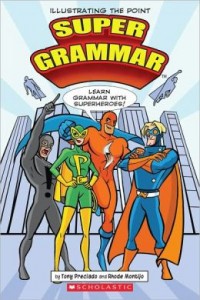 Tony Preciado and Rhode Montijo clearly empathize with kids who would never pick up a grammar guide. Their Super Grammar (Scholastic, 2012; Gr. 2-8) delivers a group of dynamic comic-book heroes, asking readers to learn the character's "names, powers, teams, and how they work together!” The book's graphic-novel format employs bright primary colors for each section. The “Amazing Eight,” highlighted in red, teach the parts of speech. The green (and evil) “Sabotage Squad” trick writers into using sentence fragments, run-on sentences, and double negatives. In the later case, a boy and villain are depicted in a stand-off. “You’re not no superhero!” he declares, a comment corrected with new phrasing and an illustration that conveys the intended meaning. Notable for its broad appeal, this title allows young readers to create their own superhero worlds, and won’t turn off older students who benefit from visuals as they learn grammar concepts. CCSS L.3.1 Demonstrate command of the conventions of standard English grammar and usage when writing or speaking. 3.1a. Explain the function of nouns, pronouns, verbs, adjectives, and adverbs in general and their functions in particular sentences. CCSS L.3.2 Demonstrate command of the conventions of standard English capitalization, punctuation, and spelling when writing. 3.2c.Use commas and quotation marks in dialogue. 3.2d.Form and use possessives.
 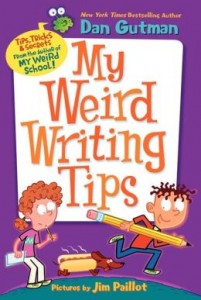 Employing the cartoon characters A. J., and Andrea from his "My Weird School" series, Dan Gutman offers humorous advice in his conversational My Weird Writing Tips (HarperCollins/Harper, 2013; Gr. 2-5). In crafting a story, the author recommends, “Start with a bang!” and create tension by having something bad happen to your main character. Gutman's sample outlandish scenarios will amuse readers—and tempt them to take the bait. Once they have, Part 2 will help them finesse their narrative writing with information on the parts of speech, spelling and punctuation tips, and suggestions on how to communicate ideas and tell a good story. “Cut! Cut! Cut!” suggests the author when revising, and reward yourself with an M&M candy each time you eliminate a word that doesn’t affect the meaning of your work. He cautions students not to “look like a dumbhead” by using texting language in school assignments. Students who aren't receptive to more formal grammar instruction will find Weird a relatable guide that reinforces those easily forgotten, but important conventions. CCSS W.3.3 Write narratives to develop real or imagined experiences or events using effective technique, descriptive details, and clear event sequences. CCSS L.5.2 Demonstrate command of the conventions of standard English capitalization, punctuation, and spelling when writing.
 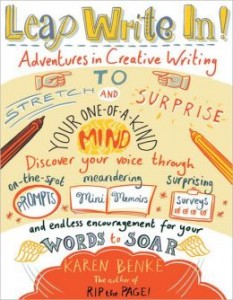 Tapping into the young writers’ senses, Karen Benke offers relaxation exercises to open the mind, and writing prompts such as eavesdropping on a stranger’s conversation to capture how people do communicate, or don’t communicate. The author also invites doodling and pre-writing in blank spaces provided throughout the pages of Leap Write In! Adventures in Creative Writing to Stretch and Surprise Your One-of-a-Kind Mind (Roost, 2013; Gr. 5-8). Teachers will want this title for the dozens of novel approaches it suggests to engage students. An idea to create a cento or patchwork of different lines from stories and poems, as they’re written, then change them up, is a fresh way to get budding writers to observe how meaning changes with word and phrase placement. Text models, quotes, and poems serve as inspiration, and when asked to describe how to make a mud pie—“What? You’ve never made a mud pie? Drop this book immediately and go find some dirt”—readers will happily comply with the command. CCSS W.6.3.b Use narrative techniques, such as dialogue, pacing, and description, to develop experiences, events, and/or characters.
 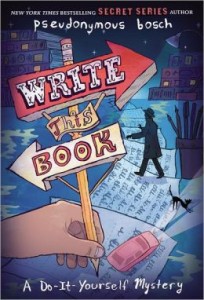 Unsuspecting fiction readers will be surprised to find themselves in the author’s role in Pseudonymous Bosch’s Write This Book! A Do-It-Yourself Mystery (Little, Brown, 2013; Gr. 4-7). The story centers on a missing writer, who abandons a work in progress. It’s up to two siblings and readers to discover why, or as Bosch puts it, “Think of it this way: the book is a mystery novel—but this time the novel itself is the mystery…. Your job is to solve it.” Bosch is a willing and enthusiastic guide, taking readers step-by-step through a novel’s structure, explaining the whys and hows from the foreword and preface to deciding on a setting and creating tension. Along the way they’ll learn about character and plot development, writing dialogue, literary terms, common writing pitfalls, and much, much more, all while determining the story’s direction. References to familiar books from E. B. White’s Charlotte’s Web to J.R.R. Tolkien’s The Hobbit drive home points, while the many mini-assignments and fill-in-the-blanks help the reader/writer bring the story to a satisfying conclusion. Serious injections of humor and illustration add to the fun. CCSS ELA-Literacy. W.5.3 Write narratives to develop real or imagined experiences or events using effective technique, descriptive details, and clear event sequences. CCSS ELA-Literacy. W.5.3a Orient the reader by establishing a situation and introducing a narrator and/or characters; organize an event sequence that unfolds naturally. CCSS.ELA-Literacy. W.5.3b Use narrative techniques, such as dialogue, description, and pacing, to develop experiences and events or show the responses of characters to situations.
 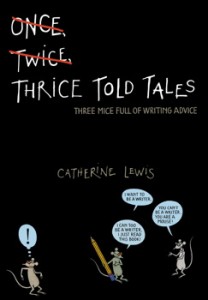 Three blind mice named Mary, Pee Wee, and Oscar help define nearly 100 literary elements, most unconventionally, in Catherine Lewis's Thrice Told Tales: Three Mice Full of Writing Advice by (S & S/Atheneum, 2013; Gr. 7 Up). Depicted as cartoon critters wearing sunglasses, the trio is clever at finding ways to explain such terms as “red herring,” “immediacy,” “cliché,” “picaro,” and “interior monologue.” The author's tongue-in-cheek tone is evident in her definition of “Sentimentality,” illustrated by a spoof of a publisher’s rejection letter to Pee Wee for an overly emotional manuscript. The publisher suggests that he rewrite, incorporating more ambiguity, irony, and tension—and signs off as the “Big Cheese.” Despite the childlike drawings, this title will appeal to sophisticated writers (and readers) who see how the connecting thread of the simple classic story changes with each literary device. There are amusing nods to famous authors (“They were the best of mice, they were the worst of mice…”), but it’s the “Snip of the Tail” captions from the author that offer the most clarity to each term. Teachers may want to borrow the premise of a twisted tale, and turn a class loose to create their own literary term definitions. CCSS RL 9-10. 5 Analyze how an author’s choices concerning how to structure a text, order events within it (e.g., parallel plots), and manipulate time (e.g., pacing, flashbacks) create such effects as mystery, tension, or surprise. CCSS W.8.3b Analyze how an author’s choices concerning how to structure a text, order events within it (e.g., parallel plots), and manipulate time (e.g., pacing, flashbacks) create such effects as mystery, tension, or surprise.
 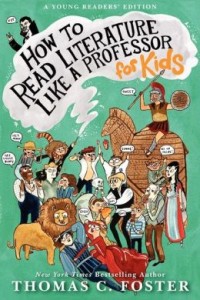 In How to Read Literature Like a Professor (2003; Gr 9. Up). Thomas C. Foster guides high school students as they look for themes and patterns in classic texts. His How to Read Literature Like a Professor for Kids (2013, both HarperCollins; Gr. 3-7) demonstrates for middle school students how to do the same for both classic and modern children’s literature. In a chapter titled, “Now Where Have I Seen Him Before?” the author compares Mowgli, the boy watched over by panthers in Rudyard Kipling’s The Jungle Book (1893), to Bod from Neil Gaiman’s The Graveyard Book (2008), a boy raised by ghosts—both children in need of a family. Students will learn to identify elements of a quest, supernatural characters who grow in strength by weakening others (the ghost in Charles Dickens's A Christmas Carol, Stephenie Meyer's vampires in the "Twilight" series), and more. While many young readers may not have encountered Ernest Hemingway's The Old Man and the Sea or Homer's Odyssey yet, the book can serve as a teacher tool to introduce these classics. Most valuable is the refreshing attention to the craft and structure of texts that will move classroom discussion from plot rehash to a higher level of understanding. CCSS RL 8.2 Determine a theme or central idea of a text and analyze its development over the course of the text, including its relationship to the characters, setting, and plot; provide an objective summary of the text. CCSS W.5.9 Compare and contrast two or more characters, settings, or events in a story or a drama, drawing on specific details in the text [e.g., how characters interact]”).
Added To Cart
RELATED


RECOMMENDED
CAREERS
The job outlook in 2030: Librarians will be in demand
CAREERS
The job outlook in 2030: Librarians will be in demand
ALREADY A SUBSCRIBER? LOG IN
We are currently offering this content for free. Sign up now to activate your personal profile, where you can save articles for future viewing
ALREADY A SUBSCRIBER? LOG IN
Thank you for visiting.
We’ve noticed you are using a private browser. To continue, please log in or create an account.

Add Comment :-
Be the first reader to comment.
Comment Policy:
Comment should not be empty !!!