


2018 School Spending Survey Report
Nonfiction Notes | March 2014
This month's selection of new nonfiction titles includes a little bit of everything: biography, memoir, science, and history—cultural and political.
 Ehlert, Lois. The Scraps Book: Notes from a Colorful Life. (Beach Lane Books; K-Gr 3). Illus. by author. This title, by the noted children’s picture book author and illustrator, works on so many levels: as a look at how an artist operates, an answer to that perennial question, “Where do you get your ideas?,” and as inspiration for those who love to create. In addition, Ehlert writes about her parents’ influence and their encouragement in her early artistic endeavors. She offers page upon page of information on her materials and book construction, incorporating numerous labeled sketches and examples of the artwork seen in her many published works. This is indeed a colorful look inside this artist’s world and process and a must-purchase for art classrooms and anyone considering a study on collage or this distinguished author/artist.
 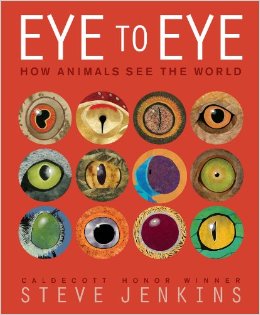 Jenkins, Steve. Eye to Eye: How Animals See the World. (Houghton Mifflin Harcourt; Gr 1-5). Illus. by author. In his latest title, the prolific Jenkins looks inside "more than 100 eyeballs." As the author relates, most animals rely on their eyes to find food, watch for predators, and locate mates and, depending on where they live and what they need them for, "have developed extraordinary diverse...ways of using them." Readers will learn about the four types of eyes and will be fascinated by information such as the fact that the bullfrog "doesn't appear to see things that aren't moving...face-to-face with a motionless fly, it will starve to death," that the blue mountain swallowtail butterfly can see colors we can't, or that a jumping spider has eight eyes. Large, colorful torn-and-cut paper illustrations bring readers face-to-face with some amazing creatures. An illustrated page on "The evolution of the eye" and one of "Animal facts" supplements the text.
 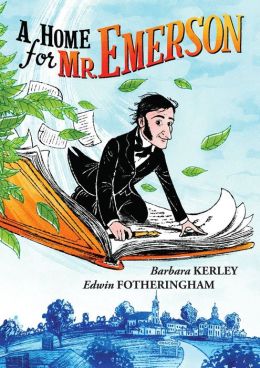 Kerley, Barbara. A Home for Mr. Emerson. (Scholastic; Gr 2-5) Illus. by Edwin Fotheringham. Readers of Kerley’s earlier titles—Those Rebels, Tom & John, The Extraordinary Mark Twain (According to Susy)—know that this author has a knack for illuminating both public and private lives of her subjects in engaging biographies for readers. As a young man, Ralph Waldo Emerson longed to create a “life around the things he loved”—the countryside, books, study, ideas, family, friends, and gardens—and in moving to Concord, MA, in 1834, he found that life. The author relates information about the man’s renown as a scholar and lecturer and as the father and husband who walked the woods with his children, ate pie for breakfast, and served his beloved community of Concord as hog catcher, chair of the school board, and a member of the volunteer fire department. A devastating home fire in Emerson’s later years drew him even closer to his neighbors. Throughout, highlighted quotes by the man provide insight into his thoughts and character. Fotheringham’s illustrations are both colorful and quirky, combining realistic and fanciful elements in this tribute to one of America’s foremost thinkers. The author’s endnotes include some simple exercises for children to try in response to statements made by Emerson as they consider the lives they would like “to create.”
  Goldsmith, Connie. Bombs Over Bikini: The World’s First Nuclear Disaster. (Twenty-First Century; Gr 6-9). In 1946, after World War ll had ended and the Cold War was heating up, the U.S military began testing nuclear bombs in the Pacific Marshall Islands; over the next 12 years, they detonated 67 nuclear bombs. Goldsmith documents the history of the program and its devastating effects on the environment, the inhabitants, and on the military personnel sent in to “clean up” after the operations, and, in particular, the fallout from the bomb named “Bravo.” She discusses the continuing efforts to decontaminate the area, as well as the compensation awarded to citizens (much of which was never received). Over time, progress has been made in reducing the amount of radioactivity in the area, and in 2013, the U.S. government declared Rongelap Atoll “safe for human habitation.” But the homes that have been built there for people to return to stand empty, and as one person commented, “I couldn’t imagine living there.” Clearly, other nuclear disasters preceded this one (Japan in 1945), but there is no question that that word "disaster" applies here as well. Black-and-white archival photos, source notes, a bibliography, a glossary, and a further reading list accompany the text.
 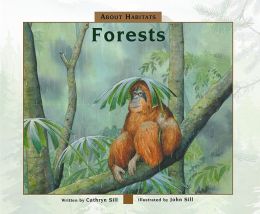 Sill, Cathryn. About Habitats: Forests. Illus. by John Sill (Peachtree; PreS-Gr 2). Sill, the author of a number of series titles about animals and habitats, here examines forests. On each spread, one line of large print text faces a full-page detailed watercolor illustration. The simple text (“Forests are large areas of land covered with many trees.”’) is suitable for early elementary students. The label for each picture indicates the forest illustrated and notes the animals and/or vegetation depicted in the artwork. While brief, the text, in combination with the art, imparts quite a bit of information about forests: types (and their climates), inhabitants, plant life, and the importance of the natural resources located there. End pages provide additional information about each of the 17 plates illustrating the book.
 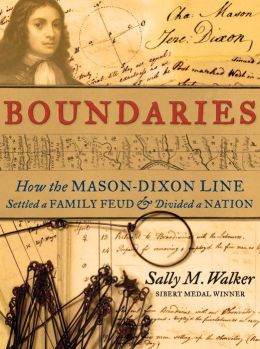 Walker, Sally M. Boundaries: How the Mason-Dixon Line Settled a Family Feud & Divided a Nation. (Candlewick; Gr 8 Up). In this well-researched account, Sibert Medal winner Walker examines a dispute that spanned both centuries and nations. The area in question was the border between the colonies of Maryland and Pennsylvannia, land given to the Calvert and Penn families in England in the 16th century. Initially, the vague borders weren't much of much of an issue, but once people arrived to settle these areas, the disputes began. Eventually, two Englishmen, Charles Mason and Jeremiah Dixon, with combined talents and expertise in astronomy, mathematics, and surveying, were hired to determine the actual boundary. The work was long and arduous but was finally completed in the late 1760s. Photos, maps, diagrams, and reproductions of historical documents enrich the telling of this complex true-life tale. Illustrated sidebars on such topics as currency and surveying instruments and practices enhance understanding. Extensive source notes and a bibliography conclude the volume. Consider for both history and science collections.
 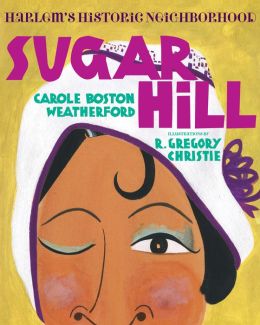 Weatherford, Carole Boston. Sugar Hill: Harlem’s Historic Neighborhood. Illus. by R. Gregory Christie. (Albert Whitman & Co.; Gr 3 Up). In the 1920s and 1930s Harlem’s Sugar Hill was home to a vibrant community of artists, writers, Civil Rights leaders—"leading lights" of the Harlem Renaissance. It was also home to shop owners, lawyers, doctors, and many families. Weatherford takes readers on a stroll through the neighborhood “where grand townhomes lend river views and parties swing to jazz and blues…" to catch glimpses of some of the well-known locals from Duke Ellington and Count Basie to Zora Neale Hurston and W. E. B. Du Bois. Christie’s art is as upbeat as the author’s rhythmic text, featuring broad swatches of pastels across scenes alive with motion. This look at one of our country’s most vibrant cultural centers is sure to charm readers. A “Who’s Who” contains notes on 12 individuals who lived and worked in the area. “Sugar Hill, Sugar Hill, where life’s so sweet that pride rings out on every street.”
Added To Cart
RELATED
BOOKS
PREMIUM
Some of Us Are Brave
BOOKS
PREMIUM
Hail Mariam
BOOKS
PREMIUM
Brady Mason’s Perfect Fit


RECOMMENDED
CAREERS
The job outlook in 2030: Librarians will be in demand
CAREERS
The job outlook in 2030: Librarians will be in demand
ALREADY A SUBSCRIBER? LOG IN
We are currently offering this content for free. Sign up now to activate your personal profile, where you can save articles for future viewing
ALREADY A SUBSCRIBER? LOG IN
Thank you for visiting.
We’ve noticed you are using a private browser. To continue, please log in or create an account.

Add Comment :-
Be the first reader to comment.
Comment Policy:
Comment should not be empty !!!