


2018 School Spending Survey Report
It’s My Life | Teen Angst, Attitude, and Acumen
These recent memoirs shed light on the teen experience from three very different perspectives: a college student with a debilitating disease, an awkward outsider chronicling her attempts at becoming popular, and an author looking back at how her tomboyish attitude made for a challenging childhood and adolescence.
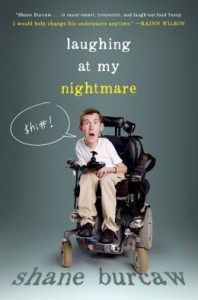 An autobiography penned by a young man living a rich, full life in spite of significant obstacles may sound like a hard sell for jaded teens who have seen and read it all, but the snarky wit, honesty, and energetic, in-your-face attitude of Shane Burcaw’s Laughing at My Nightmare (Roaring Brook, Oct. 2014; Gr 10 Up) sets this book apart. While spinal muscular atrophy (SMA) has confined Burcaw to a wheelchair and made him dependent on the help of friends and family to complete simple tasks, such as unpacking his backpack or getting out of bed, he defines himself less by his disease than by his creativity and wicked sense of humor. Frank and self-deprecating (“My head is normal human size, which looks ridiculously funny/creepy sitting on top of my tiny body. Imagine a bobblehead in a wheelchair”), the author describes his life from his diagnosis at the age of two to the present, touching upon the challenges presented by SMA (such as painful physical therapy, the need for a feeding tube to keep his weight up, and a weakened immune system) as well as the way his disease affected his ability to take part in everyday activities, such as attending middle school dances, going to college, or dating and having sex. However, Burcaw is no sainted martyr or courageous superhero, and he presents himself as a typical adolescent male, if more sensitive and observant than most. He’s all too honest about his own flaws, such as using his disability as an excuse to leave class and goof off or making a few missteps with his current girlfriend. This is an honest and authentic memoir that is just as likely to be dubbed irreverent as inspiring.
 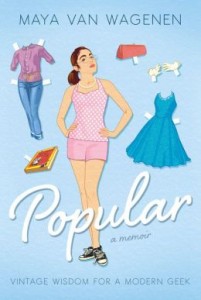 The makeover: it’s a tried-and-true trope, especially when it comes to teen fare. In Popular: Vintage Wisdom for a Modern Geek (Penguin, 2014; Gr 7 Up), adolescent Maya Van Wagenen, a self-described social outcast living in the border town of Brownsville, Texas, decides to take matters into her own hands when she discovers Betty Cornell’s Teen-Age Popularity Guide (Prentice-Hall, 1953), a manual written by a former teen model. Following such words of wisdom as “keep your chin up and your weight down” and “Someone once told me to stand as if I wore a beautiful jewel that I wanted to show off at my bosom, and I think perhaps it is the best advice I can pass on” and donning girdles and pearls, Van Wagenen chronicles her eighth grade year as she experiments with changing not only her hair and makeup but her outlook and attitude. A little socially unsure but incredibly self-aware for her young age, the author details her experiences sitting with different social groups at lunch, prepping for school picture day, and trying—all too hard—to talk to her crush, Ethan, as well as some more serious issues, such as dealing with the terminal illness of her mentor and former teacher, or coping with her family’s impending cross-country move. While the pastel cover suggests an airy, frothy feel, this is more than a Mean Girls or Clueless-esque page turner. Van Wagenen keeps the overall tone light and amusing, but the occasional reference to gang violence, drugs, and teen pregnancy, as well as her own family problems (the death of one of Van Wagenen’s siblings years ago, her five-year-old sister’s autism), gives Popular nuance and texture, and the gritty, realistic atmosphere provides for a sharp—and hilarious—contrast with Cornell’s relentlessly upbeat, whitewashed 1950s outlook. Readily poking fun at herself to uproarious results—one of the best moments includes an interaction with a teacher who mistakenly thinks the author’s new look means she’s homeless and offers to give her donated clothes—Van Wagenen is a Tina Fey or Lena Dunham in training. Mixed in with the self-deprecating humor is a streak of genuine tenderness; readers will root for this endearingly awkward but whip-smart teen to come into her own.
 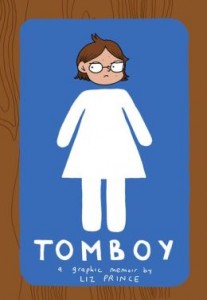 The ultimate square peg in a round hole, Liz Prince knew from childhood that a traditionally female pose would never work for her. In her graphic novel, Tomboy (Zest, Sept. 2014; Gr 9 Up), she examines a childhood and adolescence spent grappling with gender norms. Through simple but remarkably expressive black-and-white cartoon line drawings, Prince imbues seemingly commonplace memories with emotional significance: meltdowns trying on bras and dresses, being overlooked by boys she liked, who favored her more conventionally feminine best friend, and her discomfort with her developing body. Prince’s refusal to conform results in some teasing from classmates—boys and girls alike—who don’t understand her, and she finds herself at odds with how the media and pop culture define gender roles. However, she’s bolstered by various friendships and the support of family members, who respect her desire to be herself. Looking back on her adolescence, Prince is content with the characteristics that mark her as different, but the wisdom of age hasn’t dulled her sarcastic outlook. Her teen self is occasionally foul-mouthed, with a bit of a rebellious streak; like Lynda Barry or Marjane Satrapi, she conveys an important message without tamping down her attitude. This quirky work isn’t simply about not fitting in; it’s about finding a way to belong on one’s own terms.
Added To Cart
RELATED


RECOMMENDED
CAREERS
The job outlook in 2030: Librarians will be in demand
CAREERS
The job outlook in 2030: Librarians will be in demand
ALREADY A SUBSCRIBER? LOG IN
We are currently offering this content for free. Sign up now to activate your personal profile, where you can save articles for future viewing
ALREADY A SUBSCRIBER? LOG IN
Thank you for visiting.
We’ve noticed you are using a private browser. To continue, please log in or create an account.
Add Comment :-
Be the first reader to comment.
Comment Policy:
Comment should not be empty !!!