


2018 School Spending Survey Report
Graphic Biographies for Teens
Where else would Ötzi the Iceman, Ibn Battuta, Hildegard of Bingen, Bruce Lee, and Malala Yousafzai sit side by side but in a collective biography? These recently released books featuring fascinating figures and graphic art are guaranteed to appeal to teens.
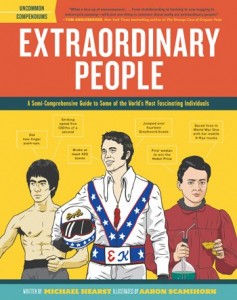 Where else would Ötzi the Iceman, Ibn Battuta, Hildegard of Bingen, Stagecoach Mary, Deion Sanders, Bruce Lee, and Malala Yousafzai rub shoulders but in Chronicle's “Uncommon Compendium” series? In Extraordinary People: A Semi-Comprehensive Guide to Some of the World’s Most Fascinating Individuals (May 2015; Gr 6 Up), Michael Hearst, author of Unusual Creatures (2012; Gr 4-8), has selected 50 individuals, admittedly not all “role models,” that he enjoyed learning about as a child and an adult. He devotes a page to each discussing their importance (or notoriety) and providing related information in the form of quick facts, true-or-false questions, quotes, quizzes, and an occasional ode. The author’s conversational style will delight readers, as will his humorous asides, puns, and catchy, sometimes corny, headers (“Fungus Amongus,” “Dude Was Fast!”). For each subject, there’s a full-page portrait opposite the text. In coloring and shadowing, Aaron Scamihorn's portraits resemble poster and graphic art. Hearst has knack for delivering facts the way kids and teens like them—quick and fun—and there’s even a shout-out for libraries (“Libraries are awesome. You should spend more time in yours.”).
  In James Gulliver Hancock’s Artists, Writers, Thinkers, Dreamers: Portraits of 50 Famous Folks & All Their Weird Stuff (Chronicle, 2014; Gr 9 Up), each subject’s name in large, colorful script, highlighted with bubbles, sparkles, or the like, sits on a white page opposite a full-page illustration. The two-tone artwork features a pen-and-ink portrait surrounded by cartoon drawings labeled with unusual facts about the person. Here’s the partial scoop on one subject: hates chewing gum, had her first pair of shoes at six, won the Miss Black Tennessee crown, owns a plane, and hosted the highest rated show of its kind: Oprah Winfrey, of course. And Napoléon—who knew he was a poor speller but good at math, threw tantrums when angry, and had a chess move named after him? Illustrated comments such as “Died From? Wallpaper Gas” (a theory about Napoléon, proposed by some) are also included. These and some of the other saucier details should pique readers’ interest enough to send them to other sources to learn more about such figures as Leonardo da Vinci, Martin Luther King Jr., Cleopatra, Harry Houdini, Babe Ruth, and Frida Kahlo.
 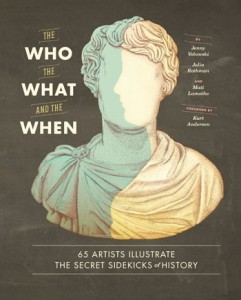 Partners, siblings, friends, and colleagues are among the people featured in Jenny Volvovski, Julia Rothman, and Matt Lamothe's The Who, the What, and the When: 65 Artists Illustrate the Secret Sidekicks of History (Chronicle, 2014; Gr 9 Up). Included among those who played a significant role in the lives of the more famous are Bayard Rustin, who helped shaped Martin Luther King Jr.’s message of nonviolence and Emily Warren Roebling, who stepped in to oversee the building of the Brooklyn Bridge when her husband was struck with caisson disease. These one-page profiles are comprised of names, dates, quotes, and fascinating anecdotal histories. Other portraits of interest include Alice B. Toklas (partner of Gertrude Stein), Joe Martin (Muhammad Ali’s coach), Ian Stewart (the “sixth” Rolling Stone), Christopher Morcom (friend of Alan Turing), and Johnny Torrio (Al Capone’s mentor). In addition to being important, many of the relationships portrayed are moving (see Jack Sendak, brother of Maurice Sendak), while others hint at complex bonds (see Marcus Tullius Tiro, Cicero’s enslaved secretary). Each profile is illustrated by a full-page, full-color portrait in a variety of media.
 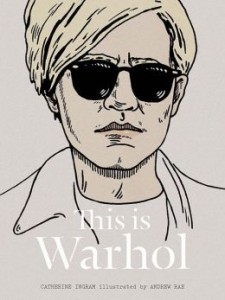 Laurence King Publishing has recently released a series of books about individual 20th-century artists, each subject's art—and life—surrounded by controversy at some point. Crossover titles with teen appeal, the books are hybrids of sorts, profusely illustrated texts containing numerous reproductions of paintings, photos, and cartoon artwork (complete with dialogue balloons), often several to a spread. Catherine Ingram's This Is Dali, illustrated by Andrew Rae, focuses on the life and art of the often outrageous, egomaniacal Spanish artist who embraced surrealism. The same author and illustrator produced This Is Warhol, on the one-time commercial artist whose later avant-guarde silkscreen images of Campbell Soup cans and figures from Mao to Marilyn Monroe ushered in an era of pop art. Other titles in the series offer portraits of American abstract expressionist Jackson Pollack in Ingram's This Is Pollack, illustrated by Peter Arkle, and an examination of the work of the British artist Francis Bacon, described by some as "pitiless," in Kitty Hauser's This Is Bacon (all 2014; all Gr 10 Up), illustrated by Christina Christoforou. A trailer offers a peek inside the books.
Added To Cart
RELATED


RECOMMENDED
CAREERS
The job outlook in 2030: Librarians will be in demand
CAREERS
The job outlook in 2030: Librarians will be in demand
ALREADY A SUBSCRIBER? LOG IN
We are currently offering this content for free. Sign up now to activate your personal profile, where you can save articles for future viewing
ALREADY A SUBSCRIBER? LOG IN
Thank you for visiting.
We’ve noticed you are using a private browser. To continue, please log in or create an account.

Add Comment :-
Be the first reader to comment.
Comment Policy:
Comment should not be empty !!!