


2018 School Spending Survey Report
Back to the Future | Consider the Source
New discoveries, new tools, and new perspectives constantly yield a new past—history is alive, coming into view right now. We must make sure that students see history as an adventure, a detective story, unfolding in front of us and not as a set of unyielding key points to be rehearsed and memorized for tests.
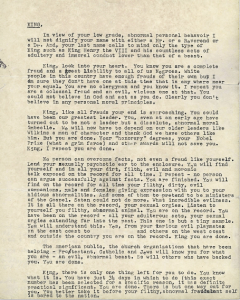
F.B.I. letter to Martin Luther King, Jr. (National Archives, College Park, MD).
That book, and my talk, began with one of the two redacted versions of a letter that the F.B.I. sent to Dr. Martin Luther King, Jr., and which the Civil Rights leader interpreted as an injunction to kill himself. I asked the students under what circumstances could our government have considered a note of this sort legal. Later in the book, I included the second version of the letter, which, seemingly randomly, blacked out new lines and restored others. The students in both schools jumped in with bright, apt questions and responses. And then, just a couple of days ago I saw this: Dr. Beverley Gage, a Yale history professor who is writing book on Hoover, had found a copy of the same letter with no editing/censoring at all. I quickly sent the link to my hosts at the two schools. It was just too perfect; the article collectively matched our class discussions. That was nice, but the real gold in this is what it tells us about history; the past keeps changing. New evidence yields new knowledge, or, at least nuances of what we once thought. And it’s not just documents that can produce this information. One of my favorite moments in talking about If Stones Could Speak: Unlocking the Secrets of Stonehenge (National Geographic, 2010) comes when I show a photo of a skeleton found buried very near the site. Strontium isotope testing, I explain, allows archeologists to determine the location of the soil that produced the grass eaten by the cows that produced the milk that the child drank as his or her teeth were being formed. Thus, we know from the skeleton’s teeth, that this person grew up in what is now Switzerland. New technology that explores deep into the structures of matter gives us new tools to examine the past. And then there are new perspectives—as when Adrienne Mayor (The Griffin and the Dinosaur, National Geographic, 2014) realized that the original descriptions of the legendary griffin read like factual accounts. After 10 years of research, Mayor determined these referenced a fossilized skeleton of the beaked, four-legged Protoceratops. New discoveries, new tools, and new perspectives constantly yield a new past—history is alive, coming into view right now. Reading about Dr. Gage’s discovery at Yale was a wonderful experience. It would be great to find more such treats on my computer after every school visit. In turn, I hope we can make sure that students see history as an adventure, a detective story, unfolding right now and not as a set of unyielding key points to be rehearsed and memorized for tests.
Added To Cart
RELATED


RECOMMENDED
CAREERS
The job outlook in 2030: Librarians will be in demand
CAREERS
The job outlook in 2030: Librarians will be in demand
ALREADY A SUBSCRIBER? LOG IN
We are currently offering this content for free. Sign up now to activate your personal profile, where you can save articles for future viewing
ALREADY A SUBSCRIBER? LOG IN
Thank you for visiting.
We’ve noticed you are using a private browser. To continue, please log in or create an account.
Add Comment :-
Be the first reader to comment.
Comment Policy:
Comment should not be empty !!!