


2018 School Spending Survey Report
Representing the Muslim American Experience
In a world where misinformation about Muslim Americans takes place daily, we have a chance to build understanding among children through our library collections.


Laila Alawa
Photo by Meera Mo
 It’s also important to understand the difference between the uniquely diverse Muslim American community and the Muslim population worldwide. The experiences of the larger population do not represent that of the smaller subset, and vice versa. Given that a growing number of the U.S. Muslim population was born and raised with a unique cultural identity as Muslim Americans, this community has distinct characteristics and lifestyles. However, the stark reality is that there is a lack of diversity and representation of Muslim Americans in mainstream elementary and middle school literature stacks. I grew up feeling alone, constantly having to explain my values, traditions, and religion. Given that only three in ten Americans surveyed by the Public Religion Research Institute and the Governance Studies at the Brookings Institution say that they speak with Muslims occasionally, the "othering" experience is one that many children growing up Muslim in America face, both within schools and outside them. Books about Muslim Americans are blocked from library shelves by radical watchdog groups and parents concerned about their children understanding the experiences that other children undergo, perpetuating the problem of representation and comprehension of differences. In addition, the often one-sided, negative portrayal of Muslims in the media creates a dichotomy in which Muslim Americans cannot consolidate their identity. Many school children grow up exposed only to extreme representations of being Muslim in America and don’t have the chance to humanize the experiences of their Muslim classmates. On the other side of coin, Muslim American students grow up feeling othered—unable to find characters speaking to them in the media or literature. This leads them to feel as though their identity is incompatible with the greater American framework. Quite simply, if Muslim Americans are not seen in books, their peers in school do not see them for their unique identity, either. How can we rectify the gaping hole in school libraries? Simply blaming the missing representation on a lack of books and stories is not enough. We must choose the higher road and actively promote the opportunity to be included. Beyond books, there are ample opportunities for educators to stock their libraries with documentaries and Web sources that provide a more multidimensional perspective of Muslim American experiences. We have a responsibility to regard multi-faith and cultural representation as a natural occurrence in literature. In a world where misinformation and dehumanization of Muslim Americans takes place daily, the chance to build an understanding should not be disregarded. Let’s give libraries—and students—the chance to truly benefit from a rainbow of experiences.
 Laila Alawa is a Muslim feminist, writer and cultural critic based in Washington, DC. She is the founder and president of Coming of Faith LLC, a social media associate at Unity Productions Foundation, associate editor for The Islamic Monthly, and columnist for The Huffington Post, MuslimGirl.net, PolicyMic, and The Guardian. Follow her on Twitter @lulainlife.
Finding Muslim American Voices for Today’s Libraries
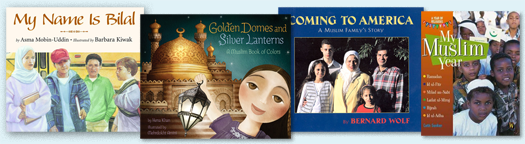
Books and multimedia featuring Muslim American voices and stories can be found on different resource sites online, such as the Association for Library Service to Children, ProgrammingLibrarian.com’s Bridging Cultures Muslim Journeys, and the National Endowment for the Humanities. More trustworthy online resources can be found in “Muslim”-tagged books on Goodreads.com, a recent State Department publication featuring notable Muslim Americans and their voices, and an Questia compilation of sources discussing being Muslim in America. The following booklist focuses on storytelling and personal voices, rather than generalized introductions to the faith community.PreS
 Amira's Totally Chocolate World by J. Samia Mair (The Islamic Foundation, 2010). Amira loves chocolate so much that every night before she goes to sleep, she asks God to make everything chocolate. On Eid ul-Fitr, she wakes up to find a totally chocolate world! Night of the Moon: A Muslim Holiday Story by Hena Kahn, illustrated by Julie Paschkis (Chronicle, 2008). Yasmeen has a wonderful time celebrating the Muslim holy month of Ramadan with her family and friends. The White Nights of Ramadan by Maha Addasi, illustrated by Ned Gannon (Boyds Mills, 2008). A Kuwaiti girl tells how her family celebrates Girgian, a part of the Ramadan holiday.
 MIDDLE GRADE
YA
Ask Me No Questions by Marina Tamar Budhos (Atheneum 2006). Fourteen-year-old Nadira, her sister, and their parents leave Bangladesh for New York City. But the expiration of their visas and the events of September 11, 2001, bring frustration, sorrow, and terror for the whole family.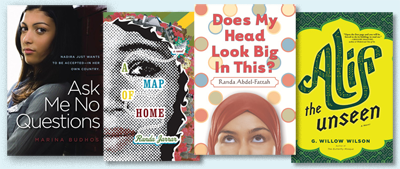 Does My Head Look Big in This? by Randa Abdel-Fattah (Orchard/Chronicle, 2007). Year Eleven at an exclusive prep school in the suburbs of Melbourne, Australia, gets complicated for Amal when she decides to wear the hijab, the Muslim head scarf, full-time as a badge of her faith—without losing her identity or sense of style. A Map of Home by Randa Jarrar (Other Press, 2008). Nidali, the rebellious daughter of an Egyptian-Greek mother and a Palestinian father, narrates the story of her childhood in Kuwait, her teenage years in Egypt (to where she and her family fled the 1990 Iraqi invasion), and her family's last flight to Texas. Alif the Unseen by G. Willow Wilson (Grove, 2012). In an unnamed Middle Eastern security state, a young Arab-Indian hacker shields his clients—dissidents, outlaws, Islamists, and other watched groups—from surveillance and tries to stay out of trouble.
 Documentaries/Films
It’s My Country Too: Muslim Americans directed by Clifford Bestall (BBC and October Films, 2005). This production follows the Pakistani rock star Salman Ahmad, a U.S. citizen of Pakistani origin, as he asks fellow Muslims what their lives are like in post-9/11 America. Prince Among Slaves directed by Andrea Kalin (Unity Productions Foundation, 2007). Chronicles Abdul-Rahman’s true journey from being an African Muslim prince to an American slave. Includes historic and academic commentary. Inside Islam: What a Billion Muslims Really Think directed by Rob Gardner (Unity Productions Foundation, 2009). A documentary exploring the opinions of Muslims around the globe as revealed in the world’s first major opinion survey on the subject, conducted by Gallup, the preeminent polling organization. Islamic Art: Mirror of the Invisible World directed by Rob Gardner (Unity Productions Foundation, 2011). This ninety-minute film takes audiences on an epic journey across nine countries and over 1,400 years of history. Koran by Heart directed by Greg Barker (HBO documentary films, 2011). A look at a global Quran-reading contest among young Muslim children that takes place annually in Cairo during Ramadan. A coming-of-age story about Muslim kids in modern times. The Muslims Are Coming! directed by Dean Obeidallah and Negin Farsad (FilmBuff, 2013). A tour of middle America by Muslim comedians who visit big cities, rural villages, conservative hotbeds, and everywhere in between to explore the issue of Islamophobia.
Added To Cart
RELATED

RECOMMENDED
CAREERS
The job outlook in 2030: Librarians will be in demand
CAREERS
The job outlook in 2030: Librarians will be in demand
ALREADY A SUBSCRIBER? LOG IN
We are currently offering this content for free. Sign up now to activate your personal profile, where you can save articles for future viewing
ALREADY A SUBSCRIBER? LOG IN
Thank you for visiting.
We’ve noticed you are using a private browser. To continue, please log in or create an account.
Add Comment :-
Be the first reader to comment.
Comment Policy:
Comment should not be empty !!!