


2018 School Spending Survey Report
SLJ Reviews and Interviews of 2014 National Book Award Longlist in the Young People’s Category
The National Book Foundation today announced the titles on the long list for the 2014 National Book Awards in the Young People's Category. Below are SLJ reviews, blog posts, and interviews with the authors of the these works for children and teens.
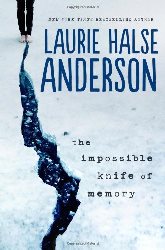
 Anderson, Laurie Halse. The Impossible Knife of Memory. 384p. Viking. Jan. 2014. Tr $18.99. ISBN 9780670012091. Gr 9 Up–Hayley is the daughter of a veteran, and his PTSD colors every aspect of their lives. After serving his country, Andy is trying to rebuild some stability for himself and his daughter, but each day is a challenge for them both. Hayley lives with the constant threat of her father harming himself or others while also dealing with feelings of abandonment after essentially losing her parental figures. She copes through snark and skepticism but begins to let her guard down when her charming, easygoing classmate, Finn, gives her a much-needed taste of normal teenage life. A relationship with Finn opens the door to the possibility of trusting again, but it’s not easy. Through Hayley’s tenuous search for balance, Anderson explores the complicated nature of perception and memory, and how individuals manage to carry on after experiencing the worst. Readers will be thoroughly invested in this book’s nuanced cast of characters and their struggles. Hayley’s relatable first-person narration is interspersed with flashbacks of Andy’s brutal war experiences, providing a visceral look at his inner demons. The endearing Finn and Hayley’s bubbly best friend, Gracie, add levity to the narrative, even as they, too, grapple with their own problems. With powerful themes of loyalty and forgiveness, this tightly woven story is a forthright examination of the realities of war and its aftermath on soldiers and their families. One of Anderson’s strongest and most relevant works to date.–Allison Tran, Mission Viejo Library, CA Fearless: An Interview with Laurie Halse Anderson by Kathleen T. Horning
 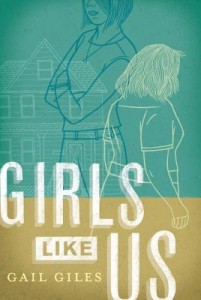 Giles, Gail. Girls Like Us. 224p. ebook available. Candlewick. 2014. Tr $16.99. ISBN 9780763662677. LC 2013944011. Gr 8 Up–Quincy and Biddie are “speddies” (special education students). They have just graduated high school and must live out in the world on their own. After being matched together by their teacher, they are given adult responsibilities: Quincy works at a supermarket while Biddie cooks and cleans for the older woman who is boarding them. The teens must learn how to fend for themselves in a world that is unfamiliar. They have both experienced physical, mental, and sexual violence, and must rely on each other to come out stronger than they were before. Girls Like Us is filled with genuine relationships that develop over time and feel authentic. There is humor and heart throughout, making the severity of the protagonists’ situations more accessible to readers. A story line about Biddie’s obsession with a family of ducks in their backyard is particularly poignant. The one- or two-page chapters alternate between Quincy and Biddie and are told in voices that are genuine to their experiences but never sensationalized. The frank discussions and depictions of the violence committed against them are shocking but never vulgar. Giles has constructed a unique, hard-hitting yet refreshing story with well-developed characters free from expected clichés or caricatures. A powerful novel that teens will enjoy wholeheartedly.–Christopher Lassen, Brooklyn Public Library, NY
  Hiaasen, Carl. Skink No Surrender. 288p. Knopf. Sept. 2014. Tr $18.99. ISBN 9780375870514; lib. ed. $21.99. ISBN 9780375970511. Gr 9 Up–Richard and his cousin Malley are best friends. But while Richard is pretty levelheaded, Malley tends to get into trouble. So Richard is only mildly surprised to discover that she’s run off with a guy she met on the Internet in order to avoid being sent to boarding school in New Hampshire. Richard wants to go find her, and luckily he runs into what may be the perfect person to help him do just that: a ragged, one-eyed ex-governor of Florida named Skink. With Skink at the helm, the two set off across Florida in search of Richard’s cousin. While Malley’s character is not as fully developed as the others and the story seems highly improbable, Skink, a favorite character from Hiaasen’s adult novels, is incredibly memorable. Whether it’s diving in to a gator-infested river after a rogue canoe, getting his foot run over by a semi while trying to save a baby turtle, or hiding out in the sand to save the next turtle, Skink is always full of surprises. And like a cat with nine lives, one never knows how he’ll make it out or what will happen next. One thing’s for sure: readers will want to be along for the ride. Although the ending meanders, fans of Hiaasen’s novels won’t mind the detours one bit.–Necia Blundy, formerly at Marlborough Public Library, MA
  Milford, Kate. Greenglass House. 384p. Clarion. Aug. 2014. Tr $17.99. ISBN 9780544052703. Gr 4-6–The Greenglass House is the kind of ancient, creaky home in which a gothic horror story might be set, and the plot in Milford’s latest seems to be headed that way, at least at first. Milo has just finished his homework and is looking forward to the quiet time over Christmas break, when the inn for smugglers his adopted parents run is usually deserted. But in the midst of a howling blizzard, an odd assortment of visitors with secretive purposes seemingly related to the history of the building shows up at the inn. When the power goes out and items begin to go missing from the strange new guests’ rooms, Milo decides to team up with the cook’s daughter, Meddy, to figure out which, if any, of the guests arrived with nefarious purposes. Meddy’s interest in Role Playing Games (RPGs) and her insistence that she and Milo adopt new names and personalities for their quest can make certain passages confusing, as Milo often refers to and thinks of himself as his game character, Negret. A twist near the end of the story helps fold the RPG plotline into the overarching narrative, while the icy, atmospheric setting and nuanced character development propel the story forward, in spite of lingering questions about the world the characters live in. Give this one to fans of Trenton Lee Stewart’s “The Mysterious Benedict Society” (Little, Brown).–Elisabeth Gattullo Marrocolla, Darien Library, CT Review of the Day: Greenglass House by Kate Milford | A Fuse #8 Production by Betsy Bird
 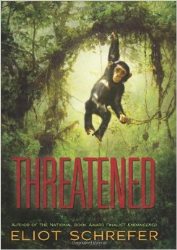 Schrefer, Eliot. Threatened. 288p. Scholastic. Feb. 2014. Tr $17.99. ISBN 9780545551434; ebk. $17.99. ISBN 9780545551441. LC 2013018599. Gr 7 Up–After the death of his mother and sister, Luc is left in the hands of a moneylender, Monsieur Tatagani. One of many orphans forced to do Tatagani’s bidding, Luc has found a way to be useful and earn a few coins wiping glasses in a bar in Gabon. One night a man shows up with a monkey and a silver attaché case, claiming to be a researcher sent by the National Geographic Society to study the chimpanzees in the interior. The mysterious man, called “the Prof,” offers Luc a job as his helper. From this modest beginning comes a tale of survival and discovery for both humans and chimps. There are no easy answers here, but deep themes are explored. The plight of the endangered chimps is brought to the attention of readers, as are the challenges of socioeconomic status and geographic realities of Gabon. There are times when Luc’s voice as an uneducated orphan adolescent seems vivid and real, at other times less so. Still, the valor and soul of Luc is captivating. Fascinating and sure to lead to discussion.–Carol A. Edwards, Denver Public Library, CO Review: Endangered | A Chair, A Fireplace, & A Tea Cozy by Liz Burns. Endangered was a finalist for the 2013 National Book Awards.
 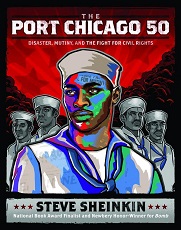 The Port Chicago 50: Disaster, Mutiny, and the Fight for Civil Rights by Steve Sheinkin (Roaring Book) Gr 7 Up—In the summer of 1944, 50 sailors, all of them African American, were tried and convicted of mutiny by the U.S. Navy. They had refused to follow a direct order of loading dangerous rockets and munitions on ships bound for battle in the Pacific after an enormous explosion had killed more than 300 of their fellow sailors and other civilians working on the dock. At the heart of this story is the rampant racism that permeated the military at all levels, leaving minority sailors and soldiers to do the drudge work almost exclusively while their white counterparts served on the front lines. Through extensive research, Sheinkin effectively re-creates both the tense atmosphere at Port Chicago before and after the disaster as well as the events that led to the men’s refusal of this one particular order that they felt put them directly in harm’s way. Much of the tension in this account stems from the growing frustration that readers are meant to feel as bigotry and discrimination are encountered at every turn and at every level of the military. There is a wealth of primary-source material here, including interviews with the convicted sailors, court records, photographs, and other documents, all of which come together to tell a story that clearly had a huge impact on race relations in the military. This is a story that remains largely unknown to many Americans, and is one of the many from World War II about segregation and race that is important to explore with students. Abundant black-and-white photos, extensive source notes, and a thorough bibliography are included.—Jody Kopple, Shady Hill School, Cambridge, MA Courageous African American WWII Sailors Profiled in The Port Chicago 50 | Audio Pick
  Smith, Andrew. 100 Sideways Miles. 288p. S. & S. Sept. 2014. Tr $17.99. ISBN 9781442444959; ebk. $10.99. ISBN 9781442444973. Gr 9 Up –Finn Easton has lived his life in the shadow of a book. As a child, Finn was severely injured and his mother killed in a freak accident: a dead horse landed on them when it fell off a truck that was traveling over a bridge. After the accident, his father took many of Finn’s unique characteristics (his name, heterochromatic eyes, propensity to measure time in miles traveled by the Earth in orbit, struggle with epilepsy, and a particular scar along his back) and made them into a character in a Robert Heinlein–esque novel, The Lazarus Door. The novel has attained cult status around the world and made Finn’s life a nightmare. The only person who treats him as though he is not the character in the book is his best friend, Cade Hernandez, the tobacco-chewing, sex-obsessed, teacher-baiting hero to their classmates, beloved for his pitching skills and his ability to get most people—especially girls—to do whatever he wants. Late in their junior year, Julia Bishop moves in and Finn falls in love. She is creative and funny. When she announces that she is moving back home to Chicago shortly after Finn’s birthday, he is heartbroken, but decides to continue with his planned road trip with Cade to Dunston University in Oklahoma, a school they plan to attend unless Cade is drafted by the major leagues or is given an athletic scholarship to another university. The trip is the first time Finn has been out of California or away from home, and Cade helps him cut the cord by throwing away his cell while on the road in Arizona. While driving in a deluge in Oklahoma, they witness an accident and risk their own lives rescuing a little boy, a dog, and a grandfather from a raging river. This will appeal to teens who like novels with a bit of an absurdist edge, such as Libba Bray’s Going Bovine (Delacorte, 2009).–Suanne B. Roush, formerly at Osceola High School, Seminole, FL
 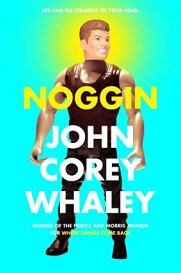 Whaley, John Corey. Noggin. 352p. S & S/Atheneum. Apr. 2014. Tr $17.99. ISBN 9781442458727; ebk. $10.99. ISBN 9781442458741. LC 2013020137. Gr 9 Up–Travis Coates, 16, is dying of cancer, so he accepts an offer from a cryogenic group to have his head removed and frozen with the hope that it would be attached to another body in the future and he could be reanimated. Five years later, he “wakes up” with a new body and is still 16. There are a few minor problems with his new life–he is a celebrity/freak and gets more attention than he wants, he has to get used to a body that has different abilities than his old one, and he has to go to school with kids he doesn’t know. The biggest problem is that Travis’s best friend and his girlfriend are now 21 years old and have moved on with their lives while he feels like he has simply taken a nap. Cate is engaged and not interested in in a relationship with a teenager. Travis is obsessed with the idea that he can win her back and won’t accept her repeated “no.” He tries various means to convince her that he’s still the one for her: some hilarious, some touching, some inappropriate, but all definitely sophomoric. The premise of the story is interesting although far-fetched. The author does a good job of describing the emotions and reactions of all of the characters, but Travis’s fixation on Cate becomes tiresome and a plot twist at the end feels like it was thrown in just to make the story longer.–Nancy P. Reeder, Heathwood Hall Episcopal School, Columbia, SC Though our reviewer didn't much enjoy John Corey Whaley's Noggin, our teen reviewers certainly did. Teens Review ’17 & Gone’, ‘Landry Park’, and Whaley’s Latest Teens Review Spring 2014 Releases, Second Take on Whaley’s ‘Noggin’
  Wiles, Deborah. Revolution. 544p. (The Sixties Trilogy: Bk. 2). Scholastic. May 2014. Tr $19.99. ISBN 9780545106078. Gr 5-8–In Wiles’s second installment of the trilogy, readers are offered two alternate viewpoints from very different worlds within the same Greenwood, Mississippi town during the tumultuous Freedom Summer of 1964. Sunny, a 12-year-old white girl, is worried about reports of “invaders” descending upon the sleepy Southern enclave and causing trouble. Meanwhile, Raymond, a black boy from Baptist Town (known among the white citizens as “Colored Town”), is becoming increasingly aware of all the places (especially the public pool and Leflore’s theater) he is barred from attending due to Jim Crow laws. As Sunny’s worldview is suddenly expanded as she begins to learn more about the sinister underbelly of her seemingly perfect town, her story intersects with Raymond’s. Among the cadre of brave young volunteers working to register black Mississippians to vote—a mix of white and black members of various civil rights associations—is Jo Ellen, the older sister from Countdown (Scholastic, 2010). As in the first book, song lyrics, biblical verses, photographs, speeches, essays, and other ephemera immerse readers in one of the most important—and dangerous—moments during the Civil Rights Movement. While Sunny’s experiences receive a slightly deeper focus than Raymond’s, readers are offered a window into each community and will see both characters change and grow over the course of the summer. Inclusion of primary source materials, including the text of a real and vile pamphlet created by KKK members, does not shy away from the reality and hurtful language used by bigots during this time period. For those looking to extend the story with a full-sensory experience, the author has compiled YouTube clips of each song referenced in the book on a Pinterest board (http://ow.ly/vBGTc). With elements of family drama and coming-of-age themes that mirror the larger sociopolitical backdrop, Revolution is a book that lingers long after the last page.–Kiera Parrott, School Library Journal ‘Revolution’ | A Conversation with Deborah Wiles by Jennifer M. Brown History comes to life in Wiles’s second “Sixties” installment| Audio Pick
 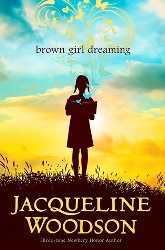 Woodson, Jacqueline. Brown Girl Dreaming. 320p. Penguin/Nancy Paulsen Bks. Aug. 2014. Tr $16.99. ISBN 9780399252518. Gr 4-7 –“I am born in Ohio but the stories of South Carolina already run like rivers through my veins” writes Woodson as she begins her mesmerizing journey through her early years. She was born in Columbus, Ohio in 1963, “as the South explodes” into a war for civil rights and was raised in South Carolina and then New York. Her perspective on the volatile era in which she grew up is thoughtfully expressed in powerfully effective verse, (Martin Luther King is ready to march on Washington; Malcom X speaks about revolution; Rosa Parks refuses to give up her seat only seven years earlier and three years have passed since Ruby Bridges walks into an all-white school). She experienced firsthand the acute differences in how the “colored” were treated in the North and South. “After the night falls and it is safe for brown people to leave the South without getting stopped and sometimes beaten and always questioned; We board the Greyhound bus bound for Ohio.” She related her difficulties with reading as a child and living in the shadow of her brilliant older sister, she never abandoned her dream of becoming a writer. With exquisite metaphorical verse Woodson weaves a patchwork of her life experience, from her supportive, loving maternal grandparents, her mother’s insistence on good grammar, to the lifetime friend she meets in New York, that covers readers with a warmth and sensitivity no child should miss. This should be on every library shelf.–D. Maria LaRocco, Cuyahoga Public Library, Strongsville, OH Video: Jacqueline Woodson Keynote | SLJ Day of Dialog 2014 by Kathy Ishizuka Review of the Day: Brown Girl Dreaming by Jacqueline Woodson | A Fuse #8 Production by Betsy Bird
Added To Cart
RELATED


RECOMMENDED
CAREERS
The job outlook in 2030: Librarians will be in demand
CAREERS
The job outlook in 2030: Librarians will be in demand
ALREADY A SUBSCRIBER? LOG IN
We are currently offering this content for free. Sign up now to activate your personal profile, where you can save articles for future viewing
ALREADY A SUBSCRIBER? LOG IN
Thank you for visiting.
We’ve noticed you are using a private browser. To continue, please log in or create an account.

Add Comment :-
Comment Policy:
Comment should not be empty !!!
Danielle
Thanks for putting this excellent resource together! Just as a heads up, the book review for "Endangered" on Liz Burns' blog is actually a different book with the same title.Posted : Sep 15, 2014 09:47