


2018 School Spending Survey Report
Jon Agee Wins Irma Black Award; Mara Rockliff Takes Cook Prize
Bank Street College in New York City was the setting of a stirring presentation of the coveted awards for best read-aloud and STEM picture books.
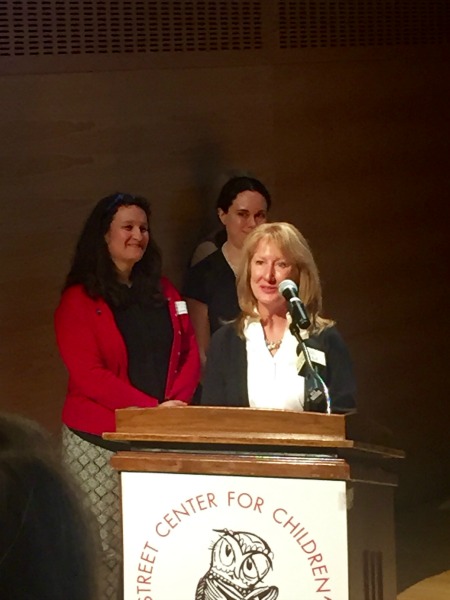
Anne Vittur Kennedy takes the podium.
Canine Mad Scientists Rule
Finalists Ole Könnecke, for You Can Do It, Bert! (Gecko, 2015), Anne Vittur Kennedy for Ragweed’s Farm Dog Handbook (Candlewick, 2015), and Michael Hall for Red: A Crayon’s Story (Greenwillow, 2015) were honored first. Könnecke, based in Germany, sent a video of thanks, explaining a bit on how You Can Do It, Bert! was developed. (Originally a small gift book, Könnecke had to reillustrate it for the larger picture book format). Michael Hall’s editor, Virginia Duncan, accepted on his behalf, offering his comments that “It is a great thrill to see my deeply frustrated crayon, Red, in such esteemed company” and that “it is a picture book’s interplay between words and pictures that fascinates me more than anything.” Anne Vittur Kennedy took the podium last, saying that when creating Ragweed, she was “writing for the child I was” and that the character of Ragweed would likely say of the nomination, “This is the best biscuit he’s ever had.”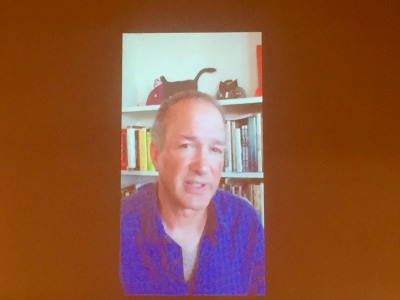
Jon Agee in a video message.
The winner of the 2016 Irma Black Award for the best picture book read aloud for first and second grade was Jon Agee for It’s Only Stanley (Dial, 2015). Before presenting the award, children’s librarian Allie Jane Bruce read a few quotes from students at Hunter College Elementary School in New York City. One child said, “I like it because the dog is a mad scientist.” Agee, who could not attend, sent a video in which he discussed the eight-year process of developing this work and the challenges of creating a picture book with attention to the pacing, tempo, color, scale, perspective, and more. It is a fitting award for Agee, who remarked on the structure of It’s Only Stanley. “It had this fun counterpoint; the agitated Wimbledons followed by this ominous spread of their dog hard at work, with no words at all.”OUTSIZED PERSONALITIES, COLOSSAL HAIR
This year’s Cook Prize nominees honoring STEM picture books for third and fourth graders were all about careful observation and reevaluated topics that are often overlooked in nonfiction. Finalist Lisa Kahn Schnell, author of High Tide for Horseshoe Crabs (Charlesbridge, 2015), detailed her work with scientists studying, tagging, and observing horseshoe crabs and the difficulty of writing about a creature not soft, silky, or flashy. Schnell cited our ability to “feel awe and wonder, to observe carefully, and to persist in asking our questions” as essential to quality learning and development. Finalist Laurie Wallmark, author of Ada Byron Lovelace and the Thinking Machine (Creston, 2015), spoke of her love of computer science and the joy of meeting a young boy just as excited about Ada as she was. Wallmark discussed the importance of disrupting stereotypes about who can be a scientist and of giving proper credit to those previously overlooked because of gender, race, and more. “I want to expose people to the great diversity in STEM,” Wallmark stated, then adding that she hoped readers will be inspired to purse their own interests in science.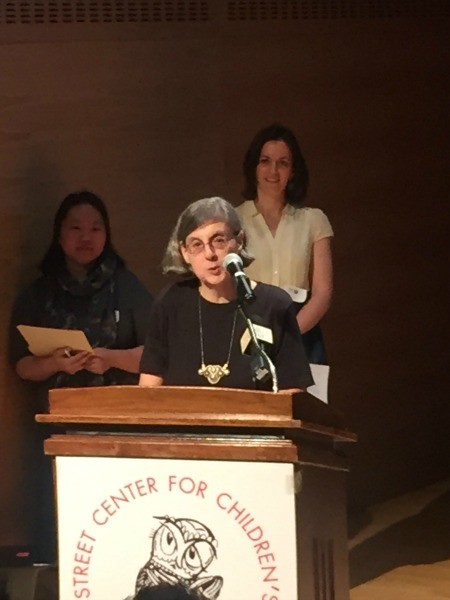
Laurie Wallmark shares her inspiration with attendees.
Mara Rockliff, author of Mesmerized (Candlewick, 2015) and the winner of the 2016 Cook Prize, crystallized the message of the ceremony by acknowledging that while the saying goes “small minds discuss people,” it is by using the “great ideas, outsized personalities, and the colossal hair” of 18th-century France (in this case) that innovations in and the study of science can be explored in a unique and fascinating way. Rockliff mused on the unexpectedness of winning a science- based award considering her “thousand percent error lab reports” in high school, but she underlined that the need for science-based thinking is not limited to the past. Considering the proliferation of false or inaccurate information in the news and on the Internet, Benjamin Franklin’s quest to disprove Dr. Mesmer’s faulty claims, as detailed in her title, is just as relevant today as it was in his time.
Added To Cart
RELATED


RECOMMENDED
CAREERS
The job outlook in 2030: Librarians will be in demand
CAREERS
The job outlook in 2030: Librarians will be in demand
ALREADY A SUBSCRIBER? LOG IN
We are currently offering this content for free. Sign up now to activate your personal profile, where you can save articles for future viewing
ALREADY A SUBSCRIBER? LOG IN
Thank you for visiting.
We’ve noticed you are using a private browser. To continue, please log in or create an account.
Add Comment :-
Be the first reader to comment.
Comment Policy:
Comment should not be empty !!!