Technology
For this close-up report on going digital, SLJ talked to academic experts, librarians, teachers, and students at two Illinois high schools. Big questions: What are the best ebook providers? How many student iPads get damaged? Do students read more in ebook or print? And more.

Inspired by the experiences of Connecticut librarian Sarah Ludwig's Minecraft library club, Elizabeth Grohoski and Karen Letteriello of the Mattituck-Laurel Library (NY) are now using a virtual Minecraft library to attract young patrons. The game allows users to build in a 3-D virtual world with cubes similar to Legos—but without any proscriptive kits and manuals.

I am on a serious mission to push our library out onto the platforms my kiddos love most–their phones, and to a lesser extent, their tablets. I so want our library to be in the pockets. As I finished preparing our QR code handout, it occurred to me that most of the codes, in fact [...]

You’ll want to share this event and its resources with the classroom teachers you are helping to flip. On September 6, the Flipped Learning Network will host the first global Flip Your Classroom Day. To celebrate, the network encourages teachers everywhere to pledge to flip one lesson in the hope that the flipping experience will be a sticky one. [...]
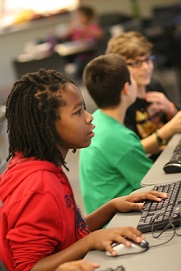
Imagine a day in your library devoted to the basics of coding in Python and sending a roomful of teens home with computers they can keep. Now imagine doing this for about $30! It’s completely possible, because it happened at Southwest Regional Library, a regional branch of the Durham County Library system in Durham, North Carolina.

What could your library do with gigabit broadband? If you don’t have a list of innovative ways to use an Internet connection 10 or 100 times faster than the current norm, start making it now.
Every year, as we move back into our libraries and classrooms, we search for meaningful, inspiring, attractive visuals to fill our display cases, to grace our bulletin boards, to embed on our websites. Many of you have already experienced this, but if not, I must warn you of the dangers of searching Pinterest boards for [...]

Sure, the Web is a key resource for educators, but what’s the best way to share the good stuff you’ve collected with students and teachers and keep it all organized? EduClipper may be an answer.

A $25 computer that fits in the palm of your hand, the Raspberry Pi has the potential to challenge the digital divide and make coding in schools as commonplace as textbooks. Computing could truly become about what kids can make rather than what schools can buy. Teacher Chad Sansing explains it all, with resources for digging in and getting started.
1,680 articles
ALREADY A SUBSCRIBER? LOG IN
We are currently offering this content for free. Sign up now to activate your personal profile, where you can save articles for future viewing
ALREADY A SUBSCRIBER? LOG IN
Thank you for visiting.
We’ve noticed you are using a private browser. To continue, please log in or create an account.