News & Features

Bomb by Steve Sheinkin Roaring Brook/Macmillan Code Name Verity by Elizabeth Wein Hyperion/Disney Judged by Donna Jo Napoli
Both CODE NAME VERITY and BOMB are set during WWII. The first is historical fiction, the second is creative nonfiction. Both the setting and the genres are dear to me. Both books were meticulously researched, and both books held me spellbound to the end.
CODE NAME VERITY is told in the first person present tense. An unnamed woman is a prisoner-of-f. She is a spy for the UK (not British, but Scottish – a point she insists on), who landed in a small town in Nazi-occupied France, and got caught almost immediately upon arrival because she looked the wrong way when she was crossing the street. She is writing an account of everything that happened leading up to her being caught, from the very beginning of her involvement in the war effort. When she finishes that account, she is quite sure the Nazis will no longer have any use for her, which means she will be killed. In the pages she scrawls, she describes at length how Maddie, a British girl, came to learn to fly an airplane and wound up joining the Women’s Auxiliary Air Force (WAAF) as a radio operator. Events conspired to place Maddie in the chair at the airstrip when a damaged plane called in, “Mayday, Mayday…” It was a young German pilot who was so lost, he thought he was landing …
» Continue Reading: Round 2, Match 1: Bomb vs Code Name Verity


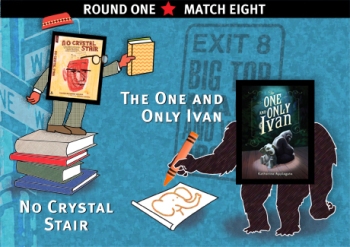


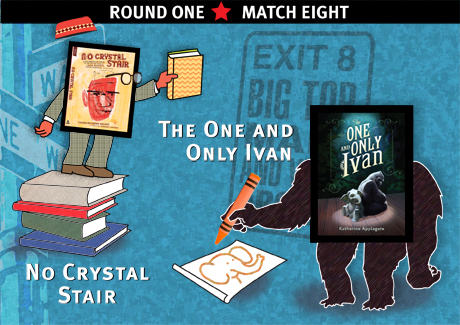
What does a self-educated radical bookseller have to do with a depressed 35-year-old strip-mall gorilla? More than it would appear. Both suffer violent childhoods and initially muddle through adulthood. Both grow to identify the oppression around them and decide to challenge it. Both rely on words, and the power of words, to seek justice. Both ultimately make a huge impact. And both No Crystal Stair and The One and Only Ivan, while fiction, are based on real-life tales of perseverance and victory.
No Crystal Stair: A Documentary Novel of the Life and Work of Lewis Michaux, Harlem Bookseller is written by Vaunda Micheaux Nelson, the great-niece of Lewis Michaux. Lewis Michaux’s story requires this “documentary novel” format rather than a typical non-fiction biography, as so much of his life was fabricated, mysterious, or now unknown — beginning with the date of his birth (sometime between 1884 and 1895) and his name (William Lonnell or Lewis H.; some family members use the name Micheaux, with an e). As a child, he was publicly lashed for stealing a sack of peanuts, and as a young man spent time on a chain gang for theft. At some point in the 1930s, he decided to open a bookstore in Harlem because “the so-called Negro needs to hear and learn from the voices of black men and women.” By …
» Continue Reading: Round 1, Match 8: No Crystal Stair vs The One and Only Ivan
ALREADY A SUBSCRIBER? LOG IN
We are currently offering this content for free. Sign up now to activate your personal profile, where you can save articles for future viewing
ALREADY A SUBSCRIBER? LOG IN
Thank you for visiting.
We’ve noticed you are using a private browser. To continue, please log in or create an account.