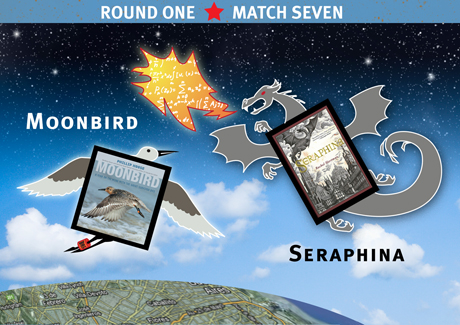
Moonbird by Phillip Hoose FSG/Macmillan
Seraphina by Rachel Hartman Random House
Judged by Marie Lu
So. Seraphina vs. Moonbird.
I have to admit, I first approached this particular matchup scratching my head. Where to even begin? At first glance, there’s not much similarity at all between these two distinctive books: Seraphina is phenomenal YA fiction, while Moonbird is phenomenal nonfiction. Seraphina is about dragons learning to survive in a fantasy world ruled by humans who fear them, while Moonbird is an account of one tiny shorebird’s remarkable life while his species slowly sinks into extinction. Seraphina relies solely on black and white text to tell its story, while Moonbird dazzles with both words and breathtaking images.
Seraphina is about discrimination and acceptance. Moonbird is about resilience and survival.
Upon closer inspection, however, I actually found quite a bit of similarity between the two. After all, birds are real dragons, aren’t they? So let’s start, and let’s do this list-style:
- Style. Got styo? These two sure as hell do. The first glaring difference between Seraphina and Moonbird, of course, is that the former is fiction (and we’re talking fantasy fiction, the most fictional of fiction), and the latter is nonfiction. Yet, Seraphina contains such beautifully detailed worldbuilding that one feels almost transported to a real place, a real world with canals and bridges and bell towers, churches and choirs and dragons. Similarly, Moonbird‘s journey about little B95 is written with such lyrical narrative that the …
Nobody's Secret, the latest offering from Michaela MacColl, continues to get rave reviews. School Library Journal's reviewer says, "The fast-moving plot makes this a well-crafted page-turner. The dialogue rings true, both to the historical time and to the chronological ages and social status of the characters." And SLJTeen's reviewer agrees. M.G. Higgins's Bi-Normal is going on my to-read list. I just finished listening to David Levithan and John Green's Will Grayson, Will Grayson, and I'm wondering what advice their openly gay jock Tiny Cooper would give Higgins's protagonist, Brett Miller.
After surveying the kids in my facility, I created the following system to rate the books that they're reading: one star = Wack, two stars = Bootsy, three stars = Koo, four stars = Clean, and five stars = That book Go! A book that’s “clean” is “real.” A book that “goes” has action. For my readers, a book is ideally both action-packed and real. What makes a book either or both? As usual, it’s not that straightforward, but here’s one attempt to decipher the question.
OK, rub it in—our music reviewer wasn't even born when My Bloody Valentine released its first album in 1991.... How about a puzzle game in which a cave with a "wicked sense of humor" is your guide? I don't usually associate puppets with blood and gore, but the review of Black Knight Sword has changed my outlook.
As dwindling funds and looming budget cuts reach many of the nation’s public libraries, 12 institutions received $5,000 mini-grants to support programming in their diverse communities. ALSC recently gifted these Día Family Book Club Program awards to expand El día de los niños/El día de los libros (Día) into an ongoing yearlong celebration. The winning libraries give SLJ some insights into how they garnered the much-needed funds.
After a directive by Chicago Public Schools last week to restrict student access for all grades below 11 to Persepolis, Marjane Satrapi’s award-winning memoir about growing up during the Iranian Revolution, CPS CEO Barbara Byrd-Bennett quickly issued a memo clarifying that the graphic novel should remain on library shelves. However, educators remain wary about the classroom restrictions, prompting the ALA's Association’s Office for Intellectual Freedom and the Freedom to Read Foundation to respond.
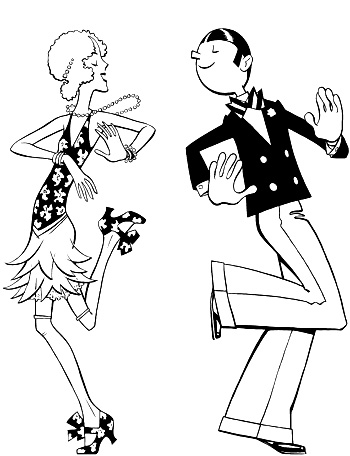
The books below will effectively sharpen readers’ knowledge and understanding of the Roaring 20's, from carefully researched nonfiction to perceptive examples of historical fiction.
Together we looked for ‘cheese holes’, or spaces in the story that allow the audience to participate in, contribute further to, and augment the original story using their own intelligence and imagination.
Learn how one man changed the course of history during the 1962 Cuban Missile Crisis in The Man Who Saved the World, a starred DVD from PBS.