FICTION

The World's Best Noses, Ears, and Eyes

illus. by Ingela P. Arrhenius. 32p. Holiday House. Sept. 2014. Tr $16.95. ISBN 9780823431618.
COPY ISBN
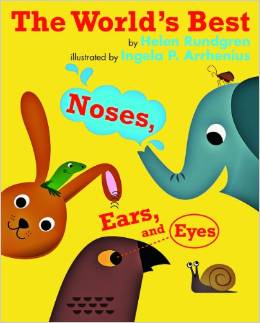
Gr 1–3—Though this picture book seems aimed at the preschool set based on the cartoonlike illustrations (the endpapers are a delightful montage of eyes, ears, and noses), the copious amount of text per page is more appropriate for elementary school students. Rundgren compares the qualities of the eyes, ears, and noses of several animals (with each species explaining why it thinks it possesses the best ones), at times acknowledging that judging which animal has best sense depends upon its particular needs. Unfortunately, the book has a number of flaws: text and illustrations anthropomorphize the animals, and some of the information is incorrect. The book states that a generic male moth can smell a female from a mile away, when, in fact, males of a number of species of moths can detect females from as far away as seven miles. The claim that sharks can detect a few drops of blood in a large body of water is exaggerated. When it comes to eyes, the colossal, or giant, squid has the largest eyes, not, as the book states, the octopus; as for seeing in the dark, owls and tarsiers have better eyesight than cats, and dragonflies have better compound eyes than houseflies. While this offering is attractive, its numerous flaws make it too problematic for general purchase.—Nancy Silverrod, San Francisco Public Library
Framed as a competition wherein various animals (most native to the U.S.) boast of the prowess of their sensory organs, this book supplies information about, for example, a moth's "antennae noses," a bat's echolocation ears, and a giraffe's "elevated eyes." Bright cartoons illustrate the lighthearted text. Perhaps disappointingly, no conclusions are reached--except that "pretty average" humans lack a single standout sense.

Be the first reader to comment.

Comment Policy:
  • Be respectful, and do not attack the author, people mentioned in the article, or other commenters. Take on the idea, not the messenger.
  • Don't use obscene, profane, or vulgar language.
  • Stay on point. Comments that stray from the topic at hand may be deleted.
  • Comments may be republished in print, online, or other forms of media.
  • If you see something objectionable, please let us know. Once a comment has been flagged, a staff member will investigate.


RELATED 

ALREADY A SUBSCRIBER?

We are currently offering this content for free. Sign up now to activate your personal profile, where you can save articles for future viewing

ALREADY A SUBSCRIBER?