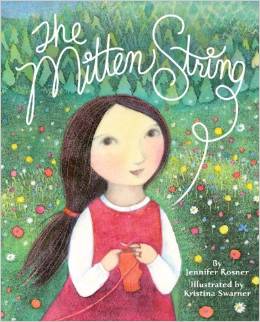

K-Gr 3—The Tobers raise sheep, and young Ruthie loves to knit mittens from their wool for the villagers. When her family befriends a deaf woman whose wagon has broken down and her baby, the child observes how the mother, Bayla, sleeps with a string tied between her own wrist and Aaron's, to alert her if her son wakes up in the night. Inspired, Ruthie knits the pair a set of baby- and mother-sized mittens connected by a string and goes on to make more for the local children to keep them from losing their mittens. "You are both clever and kind," her mother praises. "You make our world a bit better with every stitch." The character of Bayla is based on the author's great-great-aunt; Rosner also has two deaf daughters. It is not surprising, therefore, that her portrayal of deafness is extremely respectful and sensitive. When Bayla uses sign language with Aaron, "To Ruthie, it looked as if Bayla were standing before an invisible spinning wheel, her words flowing from her fingers like delicate strands of yarn." Swarner's rounded and gentle watercolor prints add to the safe, warm feeling of this story of resourcefulness and mutual admiration. The "old country" Jewish setting is subtle, giving the story flavor without dominating it. Knitting and sign-language glossaries round out this attractive title. This beautiful story of kindness, acceptance, and resourcefulness will have wide appeal.—
Heidi Estrin, Congregation B'nai Israel, Boca Raton, FLUsing wool from her family's sheep, Ruthie knits mittens to sell at the market. When her family helps a deaf woman and her baby, Ruthie knits a special set of mittens for them connected by a piece of yarn so the mother can feel the baby moving. The soft illustrations have an old-fashioned feel in keeping with the story's (unspecified) setting. Knitting and sign-language glossaries appended.
Be the first reader to comment.
Comment Policy:
Comment should not be empty !!!