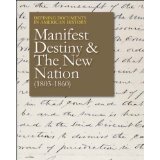
Gr 9 Up—This set uses detailed analysis of primary sources to explore seven broad topics concerning the newly independent United States: "Antebellum Law and Politics," "Manifest Destiny," "The Spirit of Reform," "African American Protest Literature," "The New American Identity," "Religious Expansion," and "Native American Land and Autonomy." Most sections contain about 10 chronologically arranged primary sources (speeches, essays, letters, court decisions, etc.), for a total of 61. Major entries are accompanied by an overview, historical context, and essential themes, and conclude with three to five supplemental historical documents (without analysis). "The Spirit of Reform," for example, begins with a feminist essay by Hannah Crocker (1818), contains Emerson's essay on self-reliance (1841), and concludes with transcripts and remarks from the trial of John Brown (1848). Single-page lesson plans accompany each entry, offering questions and activities. Concise and well-written section introductions give even-handed treatment to many-layered topics, and the essays are uniformly of high quality. The primary sources range from a few fairly dry legal decisions to more impassioned entries such as two rousing speeches by Tecumseh, accounts from a man emigrating from England in steerage, and a memoir from a woman traveling to California in pursuit of gold. Purchase includes access to the content online. Shaded boxes for the primary source material in print make those resources slightly easier to identify in that format, but the electronic version is overall easy to navigate and greatly increases the versatility of the material for libraries and classroms. Either one is an excellent choice for teachers or motivated high school students looking for a detailed examination of this period.—
Maggie Knapp, Trinity Valley School, Fort Worth, TX




Be the first reader to comment.
Comment Policy:
Comment should not be empty !!!