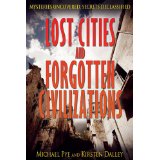
Lost Cities and Forgotten Civilizations
PYE, Michael & , eds. 262p. (Mysteries Uncovered, Secrets Declassified Series). diag. further reading. glossary. index. maps. notes. photos. reprods. websites. Rosen. 2013. lib. ed. $37.25. ISBN 9781448892518. LC 2012032332.
COPY ISBN
Gr 7 Up—What do UFOs, the pyramids, and the lost city of Atlantis have in common? Apparently a lot. This book may sound like a conventional work on archaeological mysteries, but it is not. It is comprised of essays by different authors. Erich von D niken, author of
Chariots of the Gods (Putnam, 1968), a work that suggests that space aliens actively guided human history, is one of the contributors. The most down-to-earth articles discuss possible locations of Atlantis. Sometimes the articles contradict one another with their varied and fabulous alternative theories for the building of the pyramids and other ancient wonders; one author posits that ancient people could levitate giant stones with sound, while another states that aliens must have moved the giant stones. Von D niken supplies the biggest problem to his own "Ancient Alien Astronaut Theory." Speaking about the construction of Stonehenge, he states, "But what is perhaps most baffling is that the Stone Age planners were able to think abstractly." In reality, there is nothing baffling about people in the Stone Age thinking abstractly, because they had the same capacity for abstract thought as anyone else in any age. This volume goes beyond other books in the genre of the "unexplained." A book about ghost stories from Gettysburg does not take away from the actual history of the Battle of Gettysburg, nor does a book about Bigfoot take away from the actual history of the Pacific Northwest. The Ancient Alien Astronaut Theory, however, does take away from actual history; it takes away from human history the achievements and struggles of actual human beings, many of whom labored and struggled in conditions unimaginable today.—
Jeffrey Meyer, Mount Pleasant Public Library, IA



Be the first reader to comment.
Comment Policy:
Comment should not be empty !!!