



2018 School Spending Survey Report
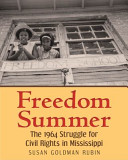
Freedom Summer: The 1964 Struggle for Civil Rights in Mississippi
128p. appendix. bibliog. chron. ebook available. index. maps. notes. photos. reprods. websites. Holiday House. May 2014. Tr $18.95. ISBN 9780823429202. LC 2013020208.
COPY ISBN
 Gr 9 Up—Fifty years after the Freedom Summer murders, this meticulously researched, compellingly told account covers an incredible moment in history. Mickey Schwerner, Andrew Goodman, and James Chaney were three young civil rights workers who decided to work for the Council of Federated Organizations (COFO) to confront bigotry in Mississippi and register African Americans to vote. They left for Meridian, accompanied by student volunteers from across the United States, (where only 6.4 percent of eligible African American voters were registered.) Schwerner, Goodman, and Chaney were killed by Klansmen after being arrested. Their deaths deepened the conviction of the others and served to engender incredible strides in the forward momentum of the civil rights movement. This work gives a real sense of the time and place, the issues and the opposing sides, and the impact on the nation. Including myriad period photos and drawings, facsimiles of reports and records, meticulous source notes, an extensive bibliography, picture credits, and an extensive index, this title is the epitome of excellent historical reporting, with the human element never forgotten.—Ann Welton, Grant Elementary School, Tacoma, WA
With meticulous research and documentation, Rubin focuses broadly on Freedom Summer: the organizers, the volunteers, the voter registration drives, etc. She conducted many interviews, in person, by telephone, and by email, with people who were directly involved, and their firsthand accounts--along with copious archival black-and-white photographs--bring the events to life. Timeline, websites. Bib., ind.
Provides a detailed account of the Mississippi Summer Project, which was a major contributing factor in Mississippi’s remarkable increase of eligible black voters from 6.4 percent registered in 1964 to nearly 60 percent in 1966. Numerous primary quotes provide immediacy and illustrate the energy of Freedom Summer. When he volunteered to help disenfranchised African Americans, Andrew Goodman—who was one of three workers murdered by Ku Klux Klansmen—said to his parents, “We’re living in what is supposed to be a democracy, and they’re not allowed to vote. If someone says he cares about people, how can he not be concerned about this?” Emphasizes the clash between Mississippi Summer Project idealism and the state’s deep-rooted racism in 1964. For example, in training, Freedom Summer workers coming from the North were taught that “police were not their friends as they had been taught as children.” Visuals such as captioned historical photographs, documents, and Project sketches provide insight into both daily life and dramatic moments of the era.
With the fiftieth anniversary of Freedom Summer this year, we are bound to see books on the subject (see Deborah Wiles's Revolution, p. 108), and these two volumes -- both meticulously researched and well documented -- provide excellent introductions. Rubin focuses more broadly on Freedom Summer itself: the organizers, the volunteers, the voter registration drives, etc. She conducted many interviews, in person, by telephone, and by e-mail, with people who were directly involved, and their firsthand accounts -- along with copious archival black-and-white photographs -- bring the events to life. The murders of three young civil rights workers -- James Chaney, Andrew Goodman, and Michael Schwerner -- are included, but they're not the central focus as they are in Mitchell's absorbing book. Like Rubin, he conducted a number of interviews, most with close friends and family members of the men. He provides a fascinating biographical sketch of each, based on these interviews, which gives readers insight into the men's deep commitment to social justice. Mitchell also gives a thorough account of the search for their bodies, and of the years of investigation that culminated in the 2005 trial of one of the murderers, who was at that time eighty years old. Both volumes are useful; the design and content of Rubin's book will be more accessible to younger teens, while The Freedom Summer Murders is more compelling. It will grab you from its opening paragraphs and won't let go until justice is served. kathleen t. horning
ALREADY A SUBSCRIBER? LOG IN
We are currently offering this content for free. Sign up now to activate your personal profile, where you can save articles for future viewing
ALREADY A SUBSCRIBER? LOG IN
Thank you for visiting.
We’ve noticed you are using a private browser. To continue, please log in or create an account.

Be the first reader to comment.
Comment Policy:
Comment should not be empty !!!