
NONFICTION

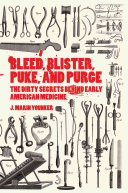
Bleed, Blister, Puke, and Purge: The Dirty Secrets Behind Early American Medicine

112p. bibliog. notes. photos. Zest. Oct. 2016. Tr $13.99. ISBN 9781942186328.
COPY ISBN
Gr 6 Up—Beginning with the arrival of colonists to the New World, Younker provides readers with a chronicle of medical care in early U.S. history. The heroic method—a combination of medical practices that included bleeding, blistering, and purging—was a key component of patient care well into the mid-1800s. Illness was often attributed to out-of-sync humors—a theory, as Younker explains, that harkens back to the influential writings of early physicians Hippocrates and Galen. Employed to rebalance the humors, heroic medical practices were anything but heroic, as they undoubtedly caused more pain or death than relief or cure. Readers learn about a variety of early American oddities as well as incremental medical advancements, such as the proliferation of freak shows, the practice of grave robbing for dissection of cadavers, medical quacks, and the emergence of the first hospital and medical school. It wasn't until the late 19th century that Louis Pasteur's work on germ theory and Joseph Lister's employment of carbolic acid as an antiseptic during surgery finally took hold in the United States and changed the way medicine was practiced. The chronology isn't always as linear as the chapter headings would suggest, and photos are sparse, but numerous sidebars chock-full of fascinating anecdotes coupled with Younker's sarcastic commentary peppered throughout add interest.
VERDICT A compelling read that will be useful as a companion text for early U.S. history curricula and for students with an interest in the macabre.

Be the first reader to comment.

Comment Policy:
  • Be respectful, and do not attack the author, people mentioned in the article, or other commenters. Take on the idea, not the messenger.
  • Don't use obscene, profane, or vulgar language.
  • Stay on point. Comments that stray from the topic at hand may be deleted.
  • Comments may be republished in print, online, or other forms of media.
  • If you see something objectionable, please let us know. Once a comment has been flagged, a staff member will investigate.


RELATED 

ALREADY A SUBSCRIBER?

We are currently offering this content for free. Sign up now to activate your personal profile, where you can save articles for future viewing

ALREADY A SUBSCRIBER?