Battle Commander
232 Articles
From:
To:
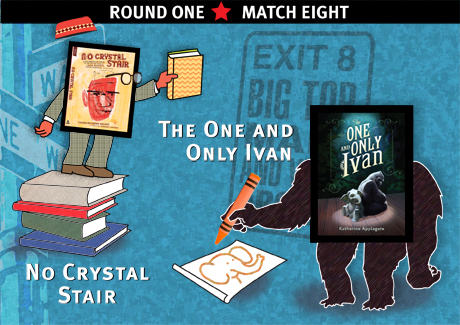
Round 1, Match 8: No Crystal Stair vs The One and Only Ivan
What does a self-educated radical bookseller have to do with a depressed 35-year-old strip-mall gorilla? More than it would appear. Both suffer violent childhoods and initially muddle through adulthood. Both grow to identify the oppression around them and decide to challenge it. Both rely on words, and the power of words, to seek justice. Both ultimately make a huge impact. And both No Crystal Stair and The One and Only Ivan, while fiction, are based on real-life tales of perseverance and victory.
No Crystal Stair: A Documentary Novel of the Life and Work of Lewis Michaux, Harlem Bookseller is written by Vaunda Micheaux Nelson, the great-niece of Lewis Michaux. Lewis Michaux’s story requires this “documentary novel” format rather than a typical non-fiction biography, as so much of his life was fabricated, mysterious, or now unknown — beginning with the date of his birth (sometime between 1884 and 1895) and his name (William Lonnell or Lewis H.; some family members use the name Micheaux, with an e). As a child, he was publicly lashed for stealing a sack of peanuts, and as a young man spent time on a chain gang for theft. At some point in the 1930s, he decided to open a bookstore in Harlem because “the so-called Negro needs to hear and learn from the voices of black men and women.” By …
» Continue Reading: Round 1, Match 8: No Crystal Stair vs The One and Only Ivan
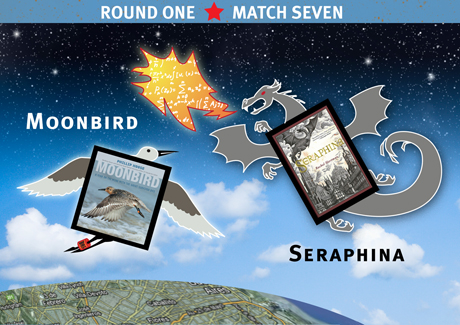
Round 1, Match 7: Moonbird vs Seraphina
So. Seraphina vs. Moonbird.
I have to admit, I first approached this particular matchup scratching my head. Where to even begin? At first glance, there’s not much similarity at all between these two distinctive books: Seraphina is phenomenal YA fiction, while Moonbird is phenomenal nonfiction. Seraphina is about dragons learning to survive in a fantasy world ruled by humans who fear them, while Moonbird is an account of one tiny shorebird’s remarkable life while his species slowly sinks into extinction. Seraphina relies solely on black and white text to tell its story, while Moonbird dazzles with both words and breathtaking images.
Seraphina is about discrimination and acceptance. Moonbird is about resilience and survival.
Upon closer inspection, however, I actually found quite a bit of similarity between the two. After all, birds are real dragons, aren’t they? So let’s start, and let’s do this list-style:
- Style. Got styo? These two sure as hell do. The first glaring difference between Seraphina and Moonbird, of course, is that the former is fiction (and we’re talking fantasy fiction, the most fictional of fiction), and the latter is nonfiction. Yet, Seraphina contains such beautifully detailed worldbuilding that one feels almost transported to a real place, a real world with canals and bridges and bell towers, churches and choirs and dragons. Similarly, Moonbird‘s journey about little B95 is written with such lyrical narrative that the …
» Continue Reading: Round 1, Match 7: Moonbird vs Seraphina
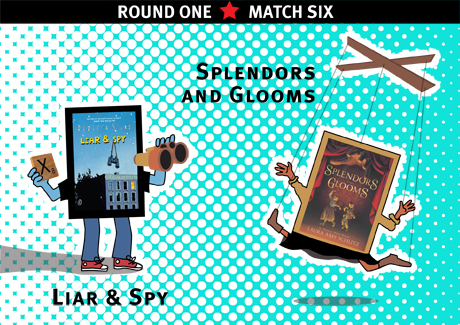
Round 1, Match 6: Liar and Spy vs Splendors and Glooms
Shall I Compare Thee
They want me to compare you, the two of you. But I don’t want to. I’d rather compare you to a summer’s day, or to my Mistress’s eyes, or to anything but to each other. How can I choose between you when I love you both, when you are each so different? One of you temperate, the other anything but. One of you shaking with rough winds, the other blooming with the darling buds of May.
But perhaps this is the wrong question. Perhaps I need instead to ask, How do I love thee?
How do I love thee? Let me count the ways.
Let’s start with you, Splendors and Glooms.
You are the kind of book I adored as a kid and still do. You are The Wolves of Willoughby Chase; you are David Copperfield. You are gothic. Your words are like sugarplums, rich and sweet and a little spicy. Your words describe orphaned children and fiendish adults. They describe chilblains and secrets and locked towers. They describe Dickensian mud and Dickensian characters. It’s hard to out-Heep Uriah Heep, but your villainous Grisini, master of the greasy compliment, stacks up wonderfully well. Your words describe a magical world; they leave sugarplum visions dancing in my head. An opal that consigns its owner to a fiery death. A fire opal in a filigree …
» Continue Reading: Round 1, Match 6: Liar and Spy vs Splendors and Glooms
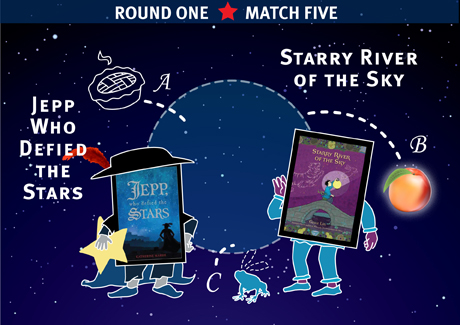
Round 1, Match 5: Jepp, Who Defied the Stars vs Starry River of the Sky
I have a problem.
No, it’s not that I can’t choose between Jepp, Who Defied the Stars and Starry River of the Sky. I have a bigger problem than that.
I am supposed to choose which of these two books is better. But I have no idea what “better” means.
I’m not crying wolf here. I’m not just trying to be provocative.
“Better” is a word that can mean just about anything. Does Jepp taste better than Starry River? (No. They taste equally disgusting.) Does Starry River serve as a projectile better? (Yes. It’s nearly square dimensions make it perfect for launching at spouses who interrupt you while you’re trying to figure out what the word “better” means.)
Okay—I’m not trying to be obtuse. I know that saying something is a “better book” does not, usually, mean it’s better for launching across a room.
Nor does it mean that it weighs more, or costs less, or has a smaller carbon footprint.
I wish it did, though. You see, you can measure weight, and price, and carbon footprints. We can all stand around a scale and agree that The Oxford English Dictionary weighs more than Curious George. The reason we can do this is because we have an agreed definition of what “weighs more” means.
We …
» Continue Reading: Round 1, Match 5: Jepp, Who Defied the Stars vs Starry River of the Sky
This Week’s Peanut Gallery
Just before the Battle began, a few more BoB Followers gave us their predictions.
Jen at Read for Keeps offered hers complete with a charming sketch:
Armed with my mug o’ tea (naught but the finest Alishan high mountain tea leaves, of course), I attempt to divine the course of the 2013 SLJ Battle of the Kids’ Books. Behold my bracket:
Lisa also at Read for Keeps also chimed in:
School Library Journal’s BoB is one of my favorite events of the year. The mad scramble to read all 16 contenders, the howls of misery and delight (remember last year when a certain book lost via a coin toss?), and, of course, a spectacular opportunity to demonstrate my lack of divination powers.
The Brain Lair considered:
But, today starts my favorite Battle, the one School Library Journal (SLJ) puts on each year! The 16-book list is handed out after the ALA Youth Media Awards. Starting mid- to late March, an author will judge two books and decide which moves to the second round. This goes on each weekday until we get to the Big Kahuna. The book Kahuna judges the final two books plus a book that rises from the dead! Each year, SLJ adds a new twist to the contest. This year – students writing as books! Check out Day 1, Day 2, Day 3, and Day 4. Such a great idea! I must figure out a way to incorporate it!
Sondy did her predictions too:
It’s that …
» Continue Reading: This Week’s Peanut Gallery
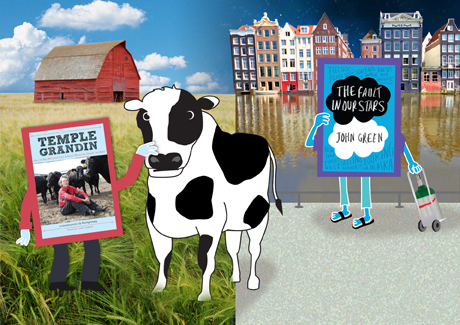
Round 1, Match 4: The Fault in Our Stars vs Temple Grandin
Temple Grandin by Sy Montgomery Houghton Mifflin The Fault in Our Stars by John Green Dutton/Penguin Judged by Deb Caletti
I had a moment of panic after hearing which books I’d be judging. While I wasn’t familiar with the first book, Temple Grandin: How the Girl Who Loved Cows Embraced Autism and Changed the World, by Sy Montgomery, you’d have to have been orbiting space for the last year not to know about the second, The Fault in Our Stars, by John Green. Maybe you’ve heard of him? On a little thing called YouTube? Or, The New York Times bestseller list? Wait. What about CARNEGIE HALL? His fifty gajillion fans even go by their own cult-following nickname: Nerdfighters. Laurie Halse Anderson called Mr. Green, “A holy man.” I may have forgotten to mention all of those shiny medals that grace his covers.
Now, don’t hit me with your book lights, but I have never read John Green. The idea of reading him now with the intent to judge made me honestly nervous. Who was I to do such a thing? As well, Nerdfighters are, let’s just say, an ardent group. And what about the underdog, Temple Grandin? I love an underdog! Still, this would be like the fight between… Well, I was going to give a sports metaphor, but I know nothing about sports.
The point is this: one more accolade for The Fault in Our Stars by John Green would be akin to giving …
» Continue Reading: Round 1, Match 4: The Fault in Our Stars vs Temple Grandin

Round 1, Match 3: Endangered vs Three Times Lucky
Endangered by Elliot Schrefer Scholastic Three Times Lucky by Sheila Turnage Dial/Penguin Judged by Kathi Appelt
Set these two books side by side, and with the exception of their trim sizes, it would be difficult to find anything about them that is similar. But once I sat back and let the full impact of both stories settle in, I realized that they had more in common than one might imagine. For one, they both feature orphans.
One is the story of an orphaned girl, raised on the bayou by a quirky cast of townsfolk. The other is the story of a displaced girl raised in the jungle by a cast of orphaned bonobos. (Okay, I promise, that’s the end of my cleverness).
Both stories have strong narrative voices, told in the first person past tense. Mo LoBeau, of Tupelo Landing, is the natural sister of so many well-loved middle grade heroes. One can’t help but read her and conjure up Opal, Frankie and Turtle. She shares their attributes as well: pluck, smarts, and gumption. It’s easy to get on her side from the very opening pages, and the reader is literally lifted through the story by the buoyancy of the language. This book was written in my native tongue, and it made my ears happy to hear it.
Sophie’s voice, in Endangered, is not nearly so dear. Hers is older, and more melancholy. But it is just as distinct. In it, are the echoes of …
» Continue Reading: Round 1, Match 3: Endangered vs Three Times Lucky
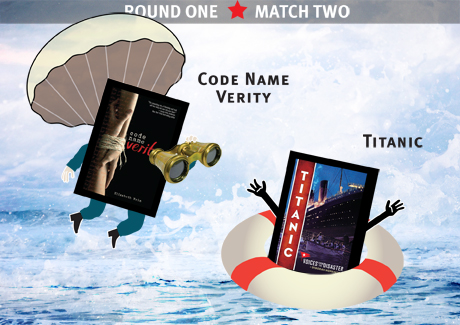
Round 1, Match 2: Code Name Verity vs Titanic
Code Name Verity by Elizabeth Wein Hyperion/Disney Titanic by Deborah Hopkinson Scholastic Press Judged by Margarita Engle
Judging is inherently biased. It is a blatantly subjective process. Since I am primarily a writer of novels in verse, I foolishly assumed that I would be asked to choose between two volumes of poetry. Instead, I have received two works of prose, and just to make the choice even more challenging, one is historical fiction, while the other is nonfiction. This is not a simple case of comparing apples and oranges; it’s apple pie against whipped cream. I want both!
Titanic: Voices From the Disaster, by Deborah Hopkinson, and Code Name Verity, by Elizabeth Wein, are both spectacular feats of literary accomplishment. Both are based on towering mountains of detailed research. Both cover historical topics so disturbing and terrifying that in my opinion, both books are only suitable for teens. Younger children would be devastated.
At this point, I should probably admit that I have read other books about the Titanic, but I have never seen anything about captive British women pilots in World War II. I didn’t know they existed, and I happen to love the rediscovery of forgotten aspects of history. On the other hand, Titanic surprised me with an astounding array of heart-wrenching photographs, personal anecdotes, and excerpts of letters by survivors.
Let’s talk about those photographs. Am I supposed to judge this Battle between a famous shipwreck and unknown women pilots solely …
» Continue Reading: Round 1, Match 2: Code Name Verity vs Titanic
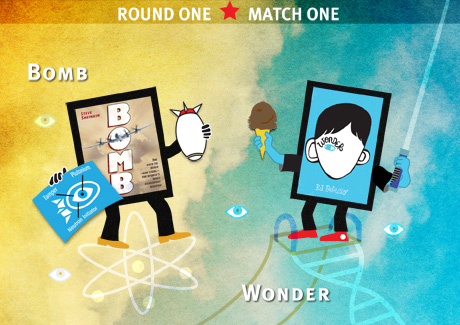
Round 1, Match 1: Bomb vs. Wonder
You would be hard-pressed to find two books with less in common: a heartfelt novel about a boy with a severe facial deformity who starts school for the first time; and a thrilling non-fiction account of the challenge, intrigue, and daring surrounding the creation of the atomic bomb.
Making the transition from the haven of home schooling to the wilds of middle school would be difficult for anyone, but for Auggie Pullman, the resilient narrator of R.J. Palacio’s Wonder, it’s terrifying. Early in the story, he tells us about the way people look away from him. It’s subtle, and he tries not to let it bother him, but he notices every time. Will he ever be able to fit in and form friendships?
There are many remarkable things about Palacio’s novel. I’m not sure I’ve ever been immersed in a more accurate account of the daily life of a grade five boy, both in and out of the classroom. Palacio’s got all the details right: the politics and passions, joys and sorrows of the ten-year-old are expertly captured here. Favourite books and food and clothing. The brutal rituals of lunch seating. The heartbreak of being betrayed by a best friend.
I admired very much Palacio’s decision to split the narration between Auggie and several other characters, allowing us not only to witness Auggie’s story, but how he effects the people closest …
» Continue Reading: Round 1, Match 1: Bomb vs. Wonder
ALREADY A SUBSCRIBER? LOG IN
We are currently offering this content for free. Sign up now to activate your personal profile, where you can save articles for future viewing
ALREADY A SUBSCRIBER? LOG IN
Thank you for visiting.
We’ve noticed you are using a private browser. To continue, please log in or create an account.